Severe Spasticity in Cerebral Palsy Should Not Simply Be Accepted: When Specialist Assessment Can Help
Cerebral palsy is a lifelong condition affecting movement and posture, but severe
muscle stiffness should not automatically be accepted as something a child simply
has to live with. When spasticity begins limiting movement, walking, sitting,
transfers, dressing, hygiene or rehabilitation, a detailed specialist assessment
can help determine whether there are treatable components.
What Is Cerebral Palsy?
Cerebral palsy is a lifelong disorder of movement and posture caused by disturbances
in the developing brain. Its clinical presentation can vary considerably from one
child to another.
Some children have predominantly spasticity, while others may have
dystonia, weakness, impaired coordination, or a combination of
these problems.
This difference is important because the same treatment is not appropriate for every
child with cerebral palsy.
The first step should therefore be to understand what is actually limiting the
child’s function and whether any part of that limitation may be modifiable.
What Is Spasticity in Cerebral Palsy?
Spasticity refers to abnormal muscle tone that can make movement stiff or difficult.
In a child with cerebral palsy, significant spasticity may restrict movement that
the child otherwise has the potential to perform.
The important clinical question is not simply whether a child has cerebral palsy.
It is whether abnormal muscle tone is preventing the child from using voluntary
movement that is already present.
The key question is whether spasticity is limiting movement already present and,
if so, whether reducing that spasticity could improve movement, daily activities
and rehabilitation.
Severe Spasticity Should Not Automatically Be Considered “Just Part of CP”
A diagnosis of cerebral palsy does not mean that every functional limitation should
automatically be attributed to the underlying condition.
When increasing stiffness begins interfering with a child’s function, specialist
assessment may help determine whether spasticity, dystonia, weakness or another
neurological problem is the dominant limitation.
The goal is not to promise that surgery will make a child “normal.” The goal is to
identify potentially modifiable problems, reduce barriers to movement where
appropriate, and give the child the best possible opportunity to use the function
they have.
When Should a Child With Cerebral Palsy Be Reassessed?
Earlier specialist assessment does not necessarily mean earlier surgery.
It means identifying potentially treatable problems before they become accepted as
an unavoidable explanation for every functional limitation.
A specialist assessment may be particularly relevant when:
- Increasing stiffness interferes with walking or mobility
- Sitting becomes increasingly difficult
- Transfers become more difficult
- Dressing or personal hygiene becomes difficult because of abnormal tone
- Functional progress has plateaued despite appropriate rehabilitation
- Repeated focal treatments provide only temporary benefit
- It is unclear whether spasticity, dystonia, weakness or another neurological
problem is the main functional limitation
The objective is to identify the child’s modifiable problems and establish
realistic functional goals.
Cerebral Palsy Treatment Is Multidisciplinary
Cerebral palsy management should not be viewed as a choice between rehabilitation
and neurosurgery.
Depending on the individual child, treatment may involve a combination of:
- Physiotherapy
- Occupational therapy
- Antispastic medications
- Botulinum toxin injections
- Intrathecal baclofen
- Orthopaedic procedures
- Selected neurosurgical procedures
Neurosurgery, when appropriate, should be considered as one component of a much
longer rehabilitation pathway rather than as the end of treatment.
Reducing abnormal muscle tone may, in carefully selected children, create a better
environment in which rehabilitation can help the child make use of the movement
that remains.
What Is Selective Dorsal Rhizotomy (SDR)?
Selective dorsal rhizotomy (SDR) is a neurosurgical procedure
used in carefully selected children with significant lower-limb spasticity.
During SDR, selected sensory nerve rootlets contributing to lower-limb spasticity
are divided with the aim of reducing abnormal muscle tone.
Because SDR is an irreversible procedure, the decision to perform
it should never be based on the diagnosis of cerebral palsy alone.
Appropriate patient selection, detailed neurological assessment, functional goals,
multidisciplinary evaluation and discussion of potential complications and
uncertainties are essential.
Who May Be Considered for Selective Dorsal Rhizotomy?
Not every child with cerebral palsy and spasticity is a candidate for SDR.
The press release cites NICE guidance that recommends consideration of selective
dorsal rhizotomy for appropriately selected children and young people with
spasticity affecting the lower limbs, particularly those at GMFCS levels II or III,
following multidisciplinary assessment.
The decision should also take into account the irreversible nature of the procedure,
known complications, uncertainty surrounding some long-term outcomes, and the
availability of intensive rehabilitation after treatment.
What Does the Evidence Say About Selective Dorsal Rhizotomy?
The evidence surrounding SDR supports a careful and selective approach rather than
offering the procedure to every child with cerebral palsy.
A 2025 systematic review and meta-analysis cited in the release found significant
improvements in measures of lower-limb spasticity and gross motor function following
SDR in children with cerebral palsy, while also noting limitations in the available
evidence and follow-up.
Longer-term reviews have highlighted uncertainties regarding functional outcomes
and the quality and consistency of the available evidence.
Potential complications also need to be considered. Reviews of SDR complications
have reported structural and neurological complications, reinforcing the importance
of careful patient selection and long-term surveillance during growth.
Therefore, the evidence does not support treating SDR as a procedure that should be
automatically offered to every child with cerebral palsy.
Why Specialist Assessment Matters More Than Simply Choosing Surgery
The important question for a child with cerebral palsy is not simply:
“Does my child need surgery?”
A more useful starting question is:
“What is actually limiting my child’s function, and is any part of it treatable?”
This approach helps distinguish between spasticity, dystonia, weakness and other
factors that may affect function.
It also allows the treatment plan to be built around the child’s actual functional
goals rather than around a procedure.
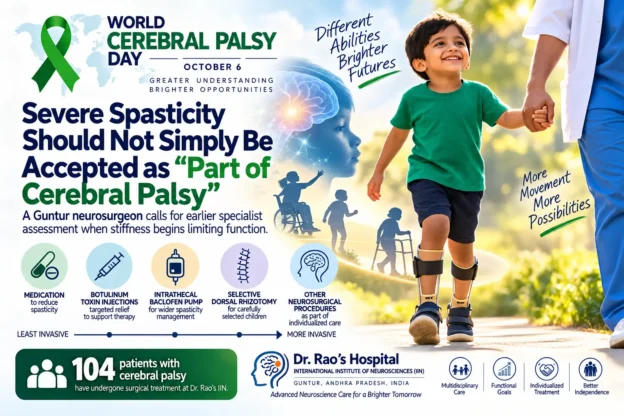
Dr. Rao’s Hospital Reports Surgical Treatment of 104 Patients With Cerebral Palsy
Dr. Rao’s Hospital – International Institute of Neurosciences (IIN), Guntur,
reports surgical treatment of 104 patients with cerebral palsy.
According to the institutional experience described in the World Cerebral Palsy Day
release, this experience has reinforced the importance of individualized treatment
rather than applying one procedure to every child.
The hospital evaluates and provides a range of approaches for clinically significant
spasticity, including medical management, botulinum toxin therapy, intrathecal
baclofen and selected neurosurgical procedures.
Decisions regarding surgery are based on the individual child’s neurological
examination, functional limitations, pattern of tone, treatment goals,
rehabilitation potential and multidisciplinary assessment.
Three Questions Every Family Should Ask During a Specialist Assessment
Families considering treatment for significant spasticity may find it useful to
discuss these three questions with the treating team:
Is the main problem spasticity, dystonia, weakness or a combination of these?
What voluntary movement does my child already have that may be hidden or
restricted by abnormal muscle tone?
If treatment reduces the abnormal tone, what specific rehabilitation programme
will help my child use the movement that remains?
These questions shift the conversation away from simply asking how to reduce muscle
stiffness. They bring the discussion back to the real goal: improving the child’s
function and independence.
What Is the Goal of Cerebral Palsy Surgery?
The purpose of cerebral palsy surgery is not to “cure” cerebral palsy or to make a
child normal.
The purpose is to identify what may be modifiable, reduce barriers to movement where
appropriate, and provide the child with the best possible opportunity to use their
existing functional potential.
For appropriately selected children, treatment of significant spasticity may become
one component of a broader rehabilitation programme.
This is why postoperative rehabilitation is not an optional afterthought. It is an
important part of the overall treatment pathway.
World Cerebral Palsy Day: A Different Conversation About Spasticity
World Cerebral Palsy Day provides an opportunity to recognize people living with
cerebral palsy and the families and professionals supporting them.
It is also an opportunity to look beyond the diagnosis itself and consider potentially
modifiable factors that influence function throughout childhood.
Severe, function-limiting spasticity should not automatically be accepted as an
unavoidable part of cerebral palsy.
At the same time, this does not mean that every child with cerebral palsy needs
neurosurgery. The appropriate approach is individualized assessment followed by
treatment that matches the child’s neurological findings, functional goals,
rehabilitation potential and overall needs.
When Should Parents Seek a Specialist Opinion?
Parents may consider specialist assessment when their child’s increasing stiffness
begins to interfere with function or when progress has stopped despite appropriate
rehabilitation.
A specialist assessment can help determine:
- What type of abnormal muscle tone is present
- Which movements are being restricted
- Whether spasticity is the principal functional limitation
- What treatment options are available
- Whether rehabilitation alone may be appropriate
- Whether medication, injections, intrathecal therapy, orthopaedic treatment or neurosurgery should be considered
- What functional goals should guide treatment
Cerebral Palsy Treatment Should Be Built Around the Child
Every child with cerebral palsy is different. The pattern of spasticity, dystonia,
weakness, coordination problems, existing voluntary movement, functional goals and
rehabilitation potential can vary substantially.
Therefore, treatment should not begin with a procedure. It should begin with a
careful assessment of the child and a clear understanding of what is limiting
function.
For selected children, reducing severe spasticity may create an opportunity for
more effective rehabilitation and improved use of existing movement. For others,
non-surgical management may remain the most appropriate strategy.
The goal is always individualized care rather than a one-size-fits-all approach.
Dr. Mohana Rao Patibandla – Pediatric Neurosurgeon in Guntur
Dr. Mohana Rao Patibandla is the Founder and Chief Neurosurgeon of
Dr. Rao’s Hospital – International Institute of Neurosciences (IIN)
in Guntur, Andhra Pradesh.
His clinical training and practice include pediatric neurosurgery, minimally invasive
neurosurgery, skull base surgery, cerebrovascular and endovascular neurosurgery,
neuro-oncology and stereotactic radiosurgery.
Dr. Rao’s Hospital is a dedicated neurosciences centre providing neurological and
neurosurgical care, including pediatric neurosurgery and management of complex
neurological conditions.
Cerebral Palsy and Spasticity Evaluation in Guntur
If your child has cerebral palsy and severe or increasing spasticity is affecting
walking, sitting, transfers, dressing, hygiene, rehabilitation or other daily
activities, a specialist assessment can help identify the factors limiting function
and discuss appropriate treatment options.
Dr. Rao’s Hospital – International Institute of Neurosciences (IIN)
Old Bank Road, Kothapeta, Guntur, Andhra Pradesh, India
Phone:
+91 90100 56444
Email:
info@drraoshospitals.com
Frequently Asked Questions About Cerebral Palsy and Spasticity
Can cerebral palsy be cured?
Cerebral palsy is a lifelong disorder related to disturbances in the developing brain.
The purpose of treatment is not to cure cerebral palsy, but to manage symptoms,
reduce functional barriers where possible and help the child achieve the best
possible function and independence.
Is severe spasticity always part of cerebral palsy?
Spasticity is common in cerebral palsy, but not every child has the same pattern of
abnormal tone. Some children may have dystonia, weakness, impaired coordination or
combinations of these problems. A specialist assessment can help determine what is
actually limiting function.
Does every child with cerebral palsy need neurosurgery?
No. The appropriate treatment depends on the individual child. Management may include
rehabilitation, medications, botulinum toxin, intrathecal baclofen, orthopaedic
treatment or selected neurosurgical procedures.
What is selective dorsal rhizotomy?
Selective dorsal rhizotomy, or SDR, is a neurosurgical procedure in which selected
sensory nerve rootlets contributing to lower-limb spasticity are divided to reduce
abnormal muscle tone. Because the procedure is irreversible, careful patient
selection and multidisciplinary assessment are essential.
Is selective dorsal rhizotomy suitable for every child with cerebral palsy?
No. SDR is considered only for appropriately selected children. The child’s pattern
of spasticity, neurological findings, functional goals, rehabilitation potential,
potential complications and the uncertainty surrounding some long-term outcomes
should all be discussed before treatment.
Why is rehabilitation important after treatment for spasticity?
Reducing abnormal muscle tone does not by itself guarantee functional improvement.
Rehabilitation helps the child learn to use the movement that remains and work toward
specific functional goals.
When should parents seek a specialist opinion for spasticity?
Specialist assessment may be appropriate when increasing stiffness interferes with
walking, sitting, transfers, dressing, hygiene or rehabilitation, when functional
progress plateaus, or when it is unclear whether spasticity, dystonia, weakness or
another neurological problem is the main limitation.
Clinical Evidence and References
The educational information in this article is based on the World Cerebral Palsy Day
discussion published by Dr. Rao’s Hospital and the clinical evidence cited in that
release, including NICE guidance and systematic reviews concerning selective dorsal
rhizotomy.
- National Institute for Health and Care Excellence (NICE).
Cerebral palsy in under 25s: assessment and management. NICE Guideline NG62.
- National Institute for Health and Care Excellence (NICE).
Spasticity in under 19s: management. NICE Guideline CG145.
- Otero-Luis I, et al. Efficacy of selective dorsal rhizotomy in the treatment of
spasticity in children with cerebral palsy: a systematic review and meta-analysis.
Journal of Neurosurgery: Pediatrics. 2025;35(6):571–580.
- Himmelmann K, et al. Long-term effects of selective dorsal rhizotomy in children
with cerebral palsy: a systematic review. Developmental Medicine & Child Neurology.
2019.
- Systematic review of complications following selective dorsal rhizotomy in cerebral
palsy, as cited in the World Cerebral Palsy Day release.
Medical Disclaimer
This article is intended for general educational and informational purposes only.
It does not replace an individual medical consultation, diagnosis or treatment plan.
Not every child with cerebral palsy or spasticity is a candidate for surgery.
Treatment decisions should be made following appropriate neurological, functional
and multidisciplinary assessment and discussion of the potential benefits, risks,
alternatives and uncertainties with the child’s treating specialists.