
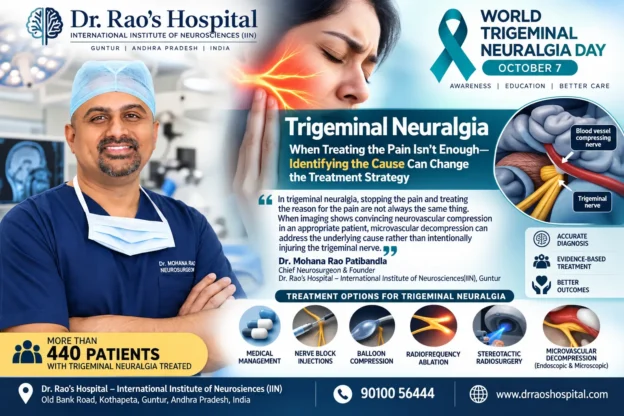
Trigeminal Neuralgia Treatment: Why Finding the Cause of Facial Pain Matters
Trigeminal neuralgia can cause sudden, severe facial pain that feels like an electric shock.
But for some patients, the most important question is not simply how to stop the pain—it is
whether an underlying cause can be identified and treated.
What Is Trigeminal Neuralgia?
Trigeminal neuralgia is a neurological condition characterized by recurrent attacks of
severe facial pain. Patients may describe the pain as electric shocks, stabbing sensations,
or lightning-like pain.
Everyday activities such as talking, chewing, brushing the teeth, touching the face, or even
exposure to a light breeze may trigger an attack.
Because the pain may occur around the jaw, cheek, or teeth, some patients initially consult
a dentist. When dental disease does not adequately explain the symptoms, a neurological
cause should be considered.
Trigeminal Neuralgia Does Not Have One Best Treatment for Everyone
One of the most important principles in treating trigeminal neuralgia is that the same
procedure is not necessarily appropriate for every patient.
Treatment should take into account the patient’s symptoms, neurological examination,
MRI findings, age, medical fitness, previous treatments, and willingness to accept the
risks associated with a particular procedure.
The goal is not simply to choose the procedure with the highest reported success rate.
The more useful question is:
Which treatment provides the best balance of durable pain control, preservation
of facial sensation, procedural risk, and the patient’s individual preferences?
Why MRI Matters in Trigeminal Neuralgia
Appropriate brain MRI is an important part of evaluating suspected trigeminal neuralgia.
Imaging can help exclude other causes and can provide information relevant to treatment
planning and surgical candidacy.
However, an MRI should not be interpreted in isolation. Simply seeing a blood vessel close
to the trigeminal nerve does not automatically establish that the vessel is responsible
for the patient’s pain.
The clinical symptoms and imaging findings need to tell a consistent story.
When a patient has clinical features consistent with classical trigeminal neuralgia and
MRI demonstrates a convincing neurovascular relationship, the treatment discussion may
change significantly.
What Is Neurovascular Compression?
In classical trigeminal neuralgia, a blood vessel may compress or contact the trigeminal
nerve and contribute to the characteristic attacks of facial pain.
When the clinical diagnosis and imaging support this mechanism, treatment may be directed
at the underlying neurovascular conflict rather than only interrupting pain transmission.
This distinction is particularly important when long-term pain control and preservation
of facial sensation are important goals.
What Is Microvascular Decompression (MVD)?
Microvascular decompression, commonly called MVD, is a surgical procedure designed to
address the underlying neurovascular conflict in appropriately selected patients.
Unlike procedures that intentionally injure or interrupt the trigeminal nerve to control
pain, MVD involves identifying the offending vascular structure and separating it from
the nerve, typically by placing protective material between them.
This makes MVD fundamentally different from procedures that intentionally interrupt
trigeminal nerve transmission.
The European Academy of Neurology guideline cited in the recent discussion recommends
microvascular decompression as first-line surgery for classical trigeminal neuralgia
when surgery is indicated.
Why MVD May Be Considered for Long-Term Pain Relief
The objective of treatment is not always simply immediate pain relief. For appropriately
selected patients, durable pain control while preserving facial sensation may be an
important consideration.
Comparative evidence cited in the EIN Presswire release reports higher short- and
long-term pain freedom with MVD compared with stereotactic radiosurgery in selected
patients, together with lower rates of facial numbness and dysesthesia, although MVD
carries greater postoperative procedural risk.
One prospective long-term comparison cited in the release reported pain-free rates
after MVD of 83% at five years compared with 47% after stereotactic radiosurgery,
with a longer median time to pain recurrence following MVD.
These findings do not mean that MVD is the right procedure for every patient. Instead,
they reinforce the importance of matching the treatment to the patient’s diagnosis,
anatomy, health, and treatment goals.
Is Microvascular Decompression Suitable for Everyone?
No. Not every person with trigeminal neuralgia is an appropriate candidate for MVD.
An older patient with significant medical comorbidities, a patient who does not want
intracranial surgery, or a patient without convincing neurovascular compression may be
better served by a less invasive treatment approach.
The decision should therefore be individualized rather than based solely on the name
of the procedure.
Other Treatment Options for Trigeminal Neuralgia
Depending on the patient’s diagnosis and individual circumstances, treatment options
may include:
- Medical treatment for patients who achieve adequate pain control
- Nerve-block and injection-based treatment in selected circumstances
- Radiofrequency ablation through the foramen ovale
- Balloon compression or rhizotomy
- Stereotactic radiosurgery
- Microvascular decompression
- Endoscopic-assisted or endoscopic microvascular decompression in appropriately selected cases
The European Academy of Neurology guideline cited in the release recommends surgery when
pain is inadequately controlled with medication or medication is poorly tolerated, with
the choice of procedure guided by the type of trigeminal neuralgia and individual
circumstances.
More Than 440 Trigeminal Neuralgia Patients: Experience Across the Treatment Spectrum
Dr. Rao’s Hospital – International Institute of Neurosciences (IIN) reports treatment
experience involving more than 440 patients with trigeminal neuralgia.
The institutional procedural experience reported in the EIN Presswire release includes
approximately:
- 213 microvascular decompression procedures
- 114 endoscopic MVD procedures
- 76 stereotactic radiosurgery procedures
- 35 balloon compression/rhizotomy procedures
- 120 radiofrequency ablation procedures
These figures represent institutional procedural experience rather than unique patient
counts. An individual patient may undergo more than one procedure during the course of
treatment.
This breadth of experience highlights an important principle: having multiple treatment
options is valuable only when those options are used selectively and appropriately.
When Recurrent Trigeminal Neuralgia Should Prompt Reassessment
Repeated procedures can provide meaningful pain relief and may remain appropriate for
patients who are not candidates for MVD or who prefer a less invasive approach.
However, when pain repeatedly returns, reassessment may be appropriate rather than
automatically repeating the same procedure.
Recurrent pain should prompt consideration of whether the diagnosis remains consistent
with classical trigeminal neuralgia, whether there is convincing neurovascular conflict,
what previous procedures have changed, and whether the treatment strategy should be
modified.
Five Questions to Ask Before Trigeminal Neuralgia Treatment
Patients considering a procedure for trigeminal neuralgia may benefit from discussing
the following questions with their treating specialist:
- Does my clinical picture fit classical trigeminal neuralgia?
- Does my MRI show convincing neurovascular compression of the trigeminal nerve?
- If MVD is being considered, what is my expected chance of durable pain relief and what are the operative risks?
- If a less invasive procedure is recommended, how quickly should I expect pain relief, how durable is it likely to be, and what is the risk of facial numbness?
- If the pain returns, what will the next treatment option be?
Trigeminal Neuralgia: Treat the Cause When the Cause Can Be Identified
Trigeminal neuralgia is often described simply as severe facial pain. For some patients,
however, there may be an identifiable anatomical problem behind that pain.
When the clinical diagnosis, imaging, and patient profile point toward convincing
neurovascular compression, it may be appropriate to discuss whether the underlying
cause can be treated rather than repeatedly treating only the symptom.
This does not mean that every patient with trigeminal neuralgia requires surgery.
Rather, when classical trigeminal neuralgia, convincing neurovascular compression,
and appropriate surgical candidacy come together, microvascular decompression may
deserve serious consideration because it can address the underlying neurovascular
conflict while aiming to preserve facial sensation.
Why Treatment Should Be Individualized
There is no universal “best procedure” for every patient with trigeminal neuralgia.
The most appropriate treatment depends on the mechanism of pain, MRI findings,
overall health, previous treatment, age, procedural risks, and patient preferences.
The goal should be a carefully considered treatment strategy that balances pain relief,
durability, preservation of sensation, procedural risk, and the patient’s individual
circumstances.
If facial pain continues despite treatment, a specialist reassessment can help determine
whether the diagnosis, imaging interpretation, or treatment strategy needs to be revisited.
Dr. Mohana Rao Patibandla – Neurosurgeon in Guntur
Dr. Mohana Rao Patibandla is the Founder and Chief Neurosurgeon of
Dr. Rao’s Hospital – International Institute of Neurosciences (IIN), Guntur, Andhra Pradesh.
His clinical practice includes minimally invasive neurosurgery, skull base surgery,
pediatric neurosurgery, cerebrovascular and endovascular neurosurgery, neuro-oncology,
and stereotactic radiosurgery.
Dr. Rao’s Hospital is a dedicated neurosciences centre providing neurosurgical and
neurological care with infrastructure that includes intraoperative neurophysiological
monitoring, neuronavigation, a hybrid operating theatre, and a biplane catheterisation
laboratory.
Trigeminal Neuralgia Treatment in Guntur
If you or a family member is experiencing recurrent electric-shock-like facial pain,
pain triggered by chewing or touching the face, or persistent facial pain despite
previous treatment, specialist neurological evaluation may help determine the underlying
cause and appropriate treatment options.
Dr. Rao’s Hospital – International Institute of Neurosciences (IIN)
Old Bank Road, Kothapeta, Guntur, Andhra Pradesh, India
Phone: +91 90100 56444
Email: info@drraoshospitals.com
Medical Disclaimer
This article is intended for general educational and informational purposes only.
It does not replace an individual medical consultation, diagnosis, or treatment plan.
Treatment decisions for trigeminal neuralgia should be made after appropriate clinical
evaluation, imaging review, and discussion of the potential benefits and risks with a
qualified neurosurgeon or neurologist.