World Physiotherapy Day 2026: Dr. Mohana Rao Patibandla Highlights the Vital Role of Early Neurorehabilitation in Stroke, Brain, and Spine Recovery
World Physiotherapy Day 2026
GUNTUR, Andhra Pradesh, India — September 8, 2026
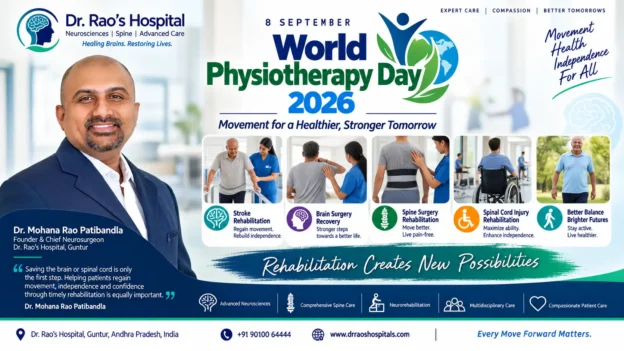
On World Physiotherapy Day 2026, Dr. Mohana Rao Patibandla, Founder and Chief Neurosurgeon of Dr. Rao’s Hospital, Guntur, emphasized that early physiotherapy and specialized neurorehabilitation are among the most important factors determining recovery after stroke, brain surgery, spinal cord injury, traumatic brain injury, and complex spine surgery. He noted that rehabilitation should begin as early as medically appropriate and continue through a personalized multidisciplinary recovery program to maximize independence and quality of life.
Observed globally every year on September 8, World Physiotherapy Day raises awareness about the critical contribution of physiotherapists in preventing disability, restoring movement, and improving long-term health outcomes. The 2026 global campaign places particular emphasis on physiotherapy’s role in stroke recovery, cardiovascular health, and physical activity, making neurorehabilitation especially relevant for patients recovering from neurological illnesses and injuries.
Why Early Neurorehabilitation Matters


According to Dr. Mohana Rao Patibandla, recovery from neurological disease does not end after successful surgery or emergency treatment.
“Saving the brain or spinal cord is only the first step. Helping patients regain movement, balance, speech, confidence, and independence through timely neurorehabilitation is equally important.”
Dr. Rao explained that advances in neurosurgery, endovascular stroke treatment, minimally invasive spine surgery, and neurocritical care have significantly improved survival. However, long-term outcomes depend heavily on structured rehabilitation delivered by trained physiotherapists working alongside neurologists, neurosurgeons, rehabilitation physicians, speech therapists, occupational therapists, and nursing teams.
Conditions That Benefit from Neurological Physiotherapy


At Dr. Rao’s Hospital, physiotherapy forms an integral part of comprehensive neurosciences care for patients with:
Neurological Condition
| Role of Physiotherapy
|
|---|---|
Stroke (Ischemic & Hemorrhagic)
| Walking recovery, balance, strength, mobility, prevention of disability.
|
Brain Tumor Surgery
| Improving coordination, gait, muscle strength, and functional recovery after surgery.
|
Traumatic Brain Injury
| Balance retraining, mobility restoration, posture, and cognitive-functional rehabilitation.
|
Spinal Cord Injury
| Strengthening, wheelchair mobility, standing programs, gait rehabilitation where appropriate.
|
Spine Surgery
| Early mobilization, pain reduction, posture correction, and return to daily activities.
|
Parkinson’s Disease
| Gait training, balance improvement, fall prevention, and mobility exercises.
|
| Peripheral Nerve Disorders | Muscle strengthening, nerve recovery support, and functional rehabilitation. |
Stroke Recovery Begins Early


Stroke remains one of India’s leading causes of long-term disability. While emergency treatments such as clot removal and neurocritical care save lives, rehabilitation determines how well patients return to independent living.
Dr. Rao emphasized that, for many medically stable stroke patients, early mobilization and physiotherapy can begin within the first 24–48 hours under specialist supervision, depending on the patient’s neurological and medical condition. Early rehabilitation helps reduce complications associated with prolonged immobility and supports recovery of movement and balance.
Key goals of stroke physiotherapy include:
Restoring walking ability.
Improving balance and coordination.
Strengthening weakened limbs.
Preventing muscle stiffness and joint contractures.
Reducing the risk of falls.
Promoting independence in daily activities.
He added that every stroke patient requires an individualized rehabilitation program rather than a one-size-fits-all approach.
Rehabilitation After Brain Surgery Is Essential


Patients undergoing surgery for brain tumors, aneurysms, epilepsy, hydrocephalus, or traumatic brain injuries often experience temporary weakness, balance disturbances, or coordination difficulties.
Dr. Rao explained that postoperative physiotherapy helps patients:
Regain muscle strength.
Improve coordination and posture.
Restore gait and mobility.
Increase endurance.
Return safely to work and daily life.
Early rehabilitation also helps reduce postoperative complications related to prolonged bed rest.
Spine Surgery Recovery Is a Journey


Modern spine surgery allows many patients to mobilize much earlier than previously possible.
Following cervical and lumbar spine surgery, physiotherapy focuses on:
Safe mobilization.
Core strengthening.
Posture correction.
Flexibility exercises.
Functional movement training.
Return-to-work rehabilitation.
Dr. Rao emphasized that rehabilitation programs are tailored according to the type of surgery, neurological recovery, and patient-specific goals.
Spinal Cord Injury Rehabilitation Requires a Multidisciplinary Team


Patients with spinal cord injuries often require prolonged rehabilitation involving multiple specialties.
Physiotherapy plays an important role in:
Preserving muscle function.
Improving mobility.
Preventing pressure injuries.
Managing spasticity.
Teaching transfers and wheelchair skills.
Maximizing independence.
Dr. Rao stressed that rehabilitation should begin during hospitalization whenever clinically appropriate and continue after discharge through structured follow-up.
Preventing Falls and Improving Balance


Neurological physiotherapy is equally important for older adults with balance disorders, Parkinson’s disease, peripheral neuropathy, and vestibular dysfunction.
Balance rehabilitation helps:
Reduce fall risk.
Improve walking confidence.
Enhance coordination.
Maintain independence in older adults.
Dr. Rao encouraged families not to ignore recurrent falls or persistent imbalance, as these may indicate underlying neurological conditions requiring evaluation.
Physical Activity Is Brain Health


World Physiotherapy Day also promotes physical activity as an essential component of long-term health.
Dr. Rao highlighted that regular physical activity can contribute to:
Better cardiovascular health.
Reduced stroke risk factors.
Improved brain function.
Better recovery after neurological illness.
Improved mental health and quality of life.
He encouraged patients recovering from neurological conditions to remain physically active under professional guidance rather than avoiding movement due to fear.
The Dr. Rao’s Hospital Neurorehabilitation Approach


At Dr. Rao’s Hospital, Guntur, neurorehabilitation is integrated into comprehensive neuroscience care through collaboration between neurosurgeons, neurologists, physiotherapists, neurocritical care specialists, rehabilitation experts, speech therapists, occupational therapists, and specialized nursing teams.
The hospital’s rehabilitation philosophy includes:
Early neurological assessment.
Individualized rehabilitation planning.
Goal-oriented physiotherapy.
Balance and gait training.
Strength and mobility rehabilitation.
Functional independence training.
Long-term follow-up and recovery monitoring.
This multidisciplinary approach aims to improve recovery and help patients return to independent daily living whenever possible.
A Message to Patients and Families
Dr. Rao advised patients and caregivers not to delay rehabilitation after neurological illness or surgery.
“Recovery is a process, not a single event. Early physiotherapy, consistent rehabilitation, family participation, and regular follow-up together provide patients with the best opportunity to regain independence.”
He encouraged individuals experiencing weakness after stroke, persistent back pain after spinal injury, difficulty walking, balance problems, or neurological disability to seek early evaluation by a neuroscience team rather than waiting for symptoms to worsen.
About Dr. Rao’s Hospital
Dr. Rao’s Hospital is a dedicated neuroscience hospital in Guntur, Andhra Pradesh, specializing in neurology, neurosurgery, spine surgery, stroke care, neuro-oncology, pediatric neurosurgery, cerebrovascular surgery, endovascular neurosurgery, epilepsy surgery, minimally invasive brain and spine surgery, and comprehensive neurorehabilitation.
The hospital provides advanced diagnosis, emergency neurological care, surgical treatment, intensive neurocritical care, and rehabilitation services for patients across Andhra Pradesh and India.
Frequently Asked Questions
What is World Physiotherapy Day?
World Physiotherapy Day is observed every year on September 8 to recognize the contribution of physiotherapists in improving health, mobility, rehabilitation, and quality of life worldwide.
Why is physiotherapy important after a stroke?
Physiotherapy helps stroke patients regain movement, balance, strength, walking ability, and independence while reducing long-term disability through structured rehabilitation.
When should physiotherapy begin after stroke?
For many medically stable patients, rehabilitation begins as early as clinically appropriate under specialist supervision, based on neurological and medical stability.
Is physiotherapy necessary after brain or spine surgery?
Yes. Rehabilitation after brain and spine surgery helps restore strength, mobility, posture, balance, coordination, and functional independence.
Can physiotherapy help patients with spinal cord injuries?
Physiotherapy is a key component of spinal cord injury rehabilitation and focuses on mobility, muscle preservation, balance, wheelchair skills, and maximizing independence.
Media Contact
Dr. Rao’s Hospital – International Institute of Neurosciences (IIN)
12-19-67, Old Bank Road, Kothapet, Guntur, Andhra Pradesh – 522001, India
Phone: +91 90100 64444
Website: Dr. Rao’s Hospital
Email: info@drraoshospitals.com
On World Physiotherapy Day 2026, Dr. Mohana Rao Patibandla emphasizes that recovery from stroke, brain surgery, spinal cord injury, and spine surgery depends not only on successful treatment but also on timely neurorehabilitation. Early physiotherapy, individualized rehabilitation, and multidisciplinary neuroscience care help patients regain mobility, independence, and quality of life. #WorldPhysiotherapyDay #StrokeRecovery #Neurorehabilitation #SpineRehabilitation #DrRaosHospital
#WorldPhysiotherapyDay2026, #WorldPhysiotherapyDay, #DrMohanaRaoPatibandla, #DrRaosHospital, #Neurorehabilitation, #StrokeRecovery, #StrokeRehabilitation, #BrainSurgeryRecovery, #SpineRehabilitation, #SpinalCordInjuryRehabilitation, #NeurologicalPhysiotherapy, #BrainHealth, #SpineHealth, #AdvancedNeurosciences, #Guntur, #AndhraPradesh, #HealingBrainsRestoringLives, #EveryMoveForwardMatters
Advanced Neurosurgery in Guntur
Comprehensive Neurology Care in Guntur
Advanced Spine Surgery in Guntur
Minimally Invasive Brain and Spine Surgery
Pediatric Neurosurgery in Guntur
Advanced Epilepsy Surgery in Guntur
International Patients – Neurosurgery in India
Book an Appointment at Dr. Rao’s Hospital
Primary Pages
Dr. Rao’s Hospital – International Institute of Neurosciences
Dr. Mohana Rao Patibandla – Best Neurosurgeon in Guntur
World-Class Neurosurgery at Dr. Rao’s Hospital
Advanced Neurosurgery and Spine Care at Dr. Rao’s Hospital
Brain Surgery Internal Links
Minimally Invasive Brain Surgery
Brain Specialist in Andhra Pradesh
Neurosurgery Excellence at Dr. Rao’s Hospital
Spine Surgery Internal Links
Advanced Spine Surgery at Dr. Rao’s Hospital
Comprehensive Spine Surgery Services
Minimally Invasive Neurosurgery
Keyhole Brain and Spine Surgery
Stroke & Endovascular Internal Links
Stroke and Cerebrovascular Treatment
Hybrid Cath Lab and Endovascular Neurosurgery
Brain Aneurysm and Cerebrovascular Care
Functional Neurosurgery Internal Links
Functional Neurosurgery in Andhra Pradesh
Deep Brain Stimulation and Functional Neurosurgery
Neuro-Oncology Internal Links
Minimally Invasive Neuro-Oncology
Advanced Brain Tumor Treatment in Andhra Pradesh
Hospital Technology Internal Links
Stealth 8 Neuronavigation System
Flat Panel Biplane Hybrid Cath Lab
Intraoperative Neuromonitoring (IONM)
Dr. Mohana Rao Patibandla
Dr. Mohana Rao Patibandla – Biography
Dr. Mohana Rao Patibandla – Neurosurgeon in Guntur
Dr. Mohana Rao Patibandla’s Vision for Advanced Neurosurgery
Related Blog Links
- Why Dr. Rao’s Hospital Is Emerging as a Global Destination for Advanced Neurosurgery and Spine Care
- Minimally Invasive Brain Surgery: Revolutionizing Neurosurgery
- Advanced Spine Surgery and Spine Neuro Care
- Brain & Spine Center at Dr. Rao’s Hospital
- Neurosurgery Excellence at Dr. Rao’s Hospital
- Dr. Mohana Rao Patibandla – Professional Biography
World Federation of Neurosurgical Societies (WFNS)
American Association of Neurological Surgeons (AANS)
Congress of Neurological Surgeons (CNS)
National Institute on Aging – Alzheimer’s Disease
Alzheimer’s Disease International
