
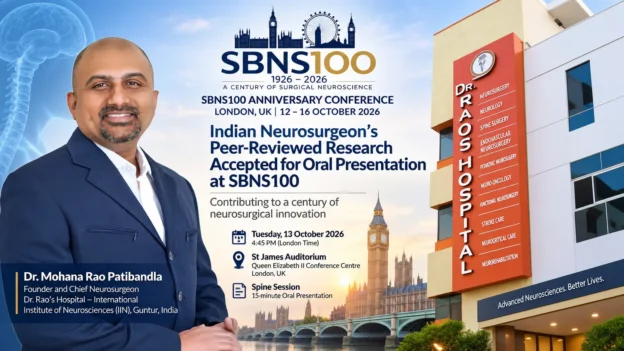
SBNS100 London 2026: An Indian Neurosurgeon’s Research Joins the Scientific Programme of British Neurosurgery’s Centenary Meeting
GUNTUR, Andhra Pradesh | September 9, 2026
When the Society of British Neurological Surgeons (SBNS) marks its centenary in London this October, one of the scientific presentations in the conference’s spine programme will come from India.
Dr. Mohana Rao Patibandla, a neurosurgeon based in Guntur, Andhra Pradesh, has had his peer-reviewed scientific work accepted for oral presentation at the SBNS100 Anniversary Conference, the 100th anniversary scientific meeting of the Society of British Neurological Surgeons. The conference will be held at the Queen Elizabeth II Conference Centre in Westminster, London, bringing together neurosurgeons and neuroscience specialists from around the world to discuss advances across cranial, spinal, vascular, pediatric, functional, and neuro-oncology surgery.
The conference programme confirms that Dr. Patibandla will present his research during the Spine Session on October 13, 2026, as part of the meeting’s final scientific programme.
For Indian academic neurosurgery, the milestone is less about attending an international conference and more about contributing original clinical research to one of the world’s longest-running neurosurgical scientific forums.
A Scientific Meeting That Marks a Century of Neurosurgery


Founded in 1926, the Society of British Neurological Surgeons is among the oldest national neurosurgical societies globally. Over the past century, it has played an influential role in neurosurgical education, research, professional standards, and international collaboration across the United Kingdom.
The SBNS100 Anniversary Conference has been designed as both a historical celebration and a forward-looking scientific congress. According to the conference programme, discussions span every major subspecialty in modern neurosurgery, including spine surgery, cerebrovascular neurosurgery, skull base surgery, pediatric neurosurgery, neuro-oncology, functional neurosurgery, neurocritical care, and emerging technologies such as artificial intelligence in surgical practice.
Unlike regional scientific meetings, SBNS100 has been positioned as an international multidisciplinary neuroscience conference involving surgeons, neurologists, neuroradiologists, neuro-anesthetists, neuro-intensive care physicians, researchers, trainees, and allied neuroscience professionals.
From Peer Review to the Final Scientific Programme
Scientific presentations at major international conferences typically undergo an independent review process before being allocated oral presentation slots.
Dr. Patibandla’s research has now progressed through that process into the final SBNS100 scientific programme, with a confirmed oral presentation schedule.
Presentation Details Confirmed by the Conference
SBNS100 Spine Session
Date | Tuesday, 13 October 2026 |
Time | 4:45 PM (London) |
Session | Spine Session |
Format | 15-minute Oral Scientific Presentation |
Venue | St James Auditorium, QEII Conference Centre, London |
Transnasal Endoscopic Odontoidectomy for Failed Posterior Craniovertebral Fusion: Salvage Decompression and Outcomes in 6 Complex Cases
The acceptance means the work will be presented within a peer-reviewed scientific session dedicated to spine surgery and craniovertebral junction disorders.
Why Craniovertebral Junction Surgery Is Among Neurosurgery’s Most Complex Fields


The craniovertebral junction (CVJ) is the anatomical transition where the skull meets the upper cervical spine and where the brainstem continues into the spinal cord. Even small structural abnormalities in this region can produce significant neurological symptoms because of the density of critical neural pathways.
Conditions affecting this area include congenital instability, trauma, inflammatory disorders, tumors, basilar invagination, and complex revision cases following previous surgery.
Posterior stabilization procedures are widely accepted for treating many craniovertebral junction instabilities. However, a minority of patients continue to experience persistent ventral compression of the cervicomedullary junction despite posterior fixation, creating one of the more challenging scenarios in spine surgery.
It is this clinical problem that forms the basis of Dr. Patibandla’s accepted presentation.
A Modern Endoscopic Solution to a Difficult Surgical Problem


The presentation explores the role of transnasal endoscopic odontoidectomy as a salvage decompression strategy in patients who continue to have ventral brainstem compression after posterior craniovertebral fusion.
Historically, access to the odontoid process was obtained through a transoral approach. Advances in skull base endoscopy have expanded minimally invasive endonasal corridors that provide direct access to selected lesions at the craniovertebral junction.
Rather than proposing a universal surgical solution, the presentation focuses on:
Patient selection.
Surgical indications.
Technical considerations.
Operative strategy.
Neurological recovery.
Radiological outcomes.
The study is based on six complex clinical cases, reflecting real-world experience in revision craniovertebral junction surgery.
Why Conference Presentations Matter in Academic Medicine


Scientific conferences occupy a unique role in medicine.
Unlike journal publications, conferences provide an opportunity for clinicians to present emerging research, discuss complex cases with peers, receive expert feedback, and compare experiences across institutions and countries.
Acceptance into a peer-reviewed conference programme indicates that a scientific committee considered the submitted work suitable for presentation within the conference’s academic agenda. It does not imply endorsement of the findings by the organizing society, but it recognizes the work as a contribution to scientific discussion.
For surgeons working in highly specialized areas such as craniovertebral junction surgery, these meetings also become forums for refining operative techniques and discussing uncommon clinical scenarios.
A Growing International Presence for Indian Neurosurgery


Indian neurosurgeons have increasingly contributed to international scientific meetings through original research, innovation, and collaboration across subspecialties.
Participation at conferences such as SBNS100 reflects the growing visibility of clinical research originating from India in areas including skull base surgery, minimally invasive spine surgery, cerebrovascular interventions, pediatric neurosurgery, and neuro-oncology.
For clinicians practicing outside India’s largest metropolitan academic centers, international scientific presentations also demonstrate how specialized research can emerge from regional neuroscience institutes serving diverse patient populations.
The Broader Scientific Themes at SBNS100


The SBNS100 programme reflects several evolving priorities in contemporary neurosurgery.
Among the conference’s major themes are:
Scientific Area | Focus of Discussion |
| Spine Neurosurgery | Craniovertebral junction surgery, deformity, minimally invasive techniques, revision surgery. |
| Cerebrovascular Neurosurgery | Stroke, aneurysms, AVMs, bypass surgery, and endovascular advances. |
| Skull Base Surgery | Endoscopic approaches and complex cranial pathology. |
| Neuro-Oncology | Precision surgery and evolving treatment strategies for brain tumors. |
| Pediatric Neurosurgery | Congenital and acquired neurological disorders in children. |
| Artificial Intelligence | Imaging, surgical planning, robotics, and decision-support systems. |
The breadth of the programme illustrates how neurosurgery increasingly overlaps with imaging science, intensive care, rehabilitation, computational medicine, and engineering.
A Surgeon’s Perspective
Speaking ahead of the conference, Dr. Mohana Rao Patibandla said:
“The craniovertebral junction remains one of the most technically demanding areas in spine surgery. International scientific meetings create opportunities to discuss uncommon clinical problems, exchange experience with colleagues from different healthcare systems, and continue improving evidence-based neurosurgical practice.”
The statement reflects the educational purpose of scientific conferences rather than the promotion of any single institution or procedure.
About the Researcher
Dr. Mohana Rao Patibandla is a neurosurgeon based in Guntur, Andhra Pradesh, India, and the Founder and Chief Neurosurgeon of Dr. Rao’s Hospital – International Institute of Neurosciences (IIN). His clinical interests include craniovertebral junction surgery, skull base neurosurgery, minimally invasive brain and spine surgery, cerebrovascular neurosurgery, pediatric neurosurgery, neuro-oncology, and functional neurosurgery.
He has completed fellowship training in multiple neurosurgical subspecialties in India and the United States and continues to participate in international scientific meetings focused on advances in neurological surgery.
Why This Story Is Newsworthy
The significance of this announcement lies in the scientific milestone, not institutional marketing.
The news is that a peer-reviewed clinical study from India has been incorporated into the final scientific programme of the SBNS100 Anniversary Conference, where it will be presented before an international audience during the centenary meeting of one of the world’s oldest neurosurgical societies.
That distinction makes it relevant to the broader conversation about India’s growing contribution to global academic neurosurgery.
Author
Dr. Mohana Rao Patibandla, M. Ch (NIMS), FESBSS (KIMS), FAANS (USA), FMINS (OSU, USA), FEVNS (UVA, USA), FPNS (UCD, USA), FNOSRS (UVA, USA).
Dr. Rao’s Hospital / Patibandla Narayana Swamy Neurosciences LLP
12-19-67, Old Bank Road, Kothapet, Besides AK Khan Biryani point, Guntur, Andhra Pradesh, India 522001
Phone: +91 9010056444
Email: info@drraoshospitals.com; drpatibandla@gmail.com;
Website: https://drraoshospitals.com
Advanced Neurosurgery in Guntur
Comprehensive Neurology Care in Guntur
Advanced Spine Surgery in Guntur
Minimally Invasive Brain and Spine Surgery
Pediatric Neurosurgery in Guntur
Advanced Epilepsy Surgery in Guntur
International Patients – Neurosurgery in India
Book an Appointment at Dr. Rao’s Hospital
Dr. Rao’s Hospital – International Institute of Neurosciences
Dr. Mohana Rao Patibandla – Best Neurosurgeon in Guntur
World-Class Neurosurgery at Dr. Rao’s Hospital
Advanced Neurosurgery and Spine Care at Dr. Rao’s Hospital
BRAIN SURGERY LINKS
Minimally Invasive Brain Surgery
Brain Specialist in Andhra Pradesh
Neurosurgery Excellence at Dr. Rao’s Hospital
Spine Surgery Internal Links
Advanced Spine Surgery at Dr. Rao’s Hospital
Comprehensive Spine Surgery Services
Minimally Invasive Neurosurgery
Keyhole Brain and Spine Surgery
Stroke & Endovascular Internal Links
Stroke and Cerebrovascular Treatment
Hybrid Cath Lab and Endovascular Neurosurgery
Brain Aneurysm and Cerebrovascular Care
Functional Neurosurgery Internal Links
Functional Neurosurgery in Andhra Pradesh
Deep Brain Stimulation and Functional Neurosurgery
Neuro-Oncology Internal Links
Minimally Invasive Neuro-Oncology
Advanced Brain Tumor Treatment in Andhra Pradesh
Hospital Technology Internal Links
Stealth 8 Neuronavigation System
Flat Panel Biplane Hybrid Cath Lab
Intraoperative Neuromonitoring (IONM)
Dr. Mohana Rao Patibandla Links
Dr. Mohana Rao Patibandla – Biography
Dr. Mohana Rao Patibandla – Neurosurgeon in Guntur
Dr. Mohana Rao Patibandla’s Vision for Advanced Neurosurgery
Related Blog Links
- Why Dr. Rao’s Hospital Is Emerging as a Global Destination for Advanced Neurosurgery and Spine Care
- Minimally Invasive Brain Surgery: Revolutionizing Neurosurgery
- Advanced Spine Surgery and Spine Neuro Care
- Brain & Spine Center at Dr. Rao’s Hospital
- Neurosurgery Excellence at Dr. Rao’s Hospital
- Dr. Mohana Rao Patibandla – Professional Biography
EXTRA SOURCES
World Federation of Neurosurgical Societies (WFNS)
American Association of Neurological Surgeons (AANS)
Congress of Neurological Surgeons (CNS)