Fortune India Exchange Features Dr. Rao’s IIN: Building a Global Neuroscience Institution from Guntur
By Dr. Mohana Rao Patibandla · · Guntur, Andhra Pradesh
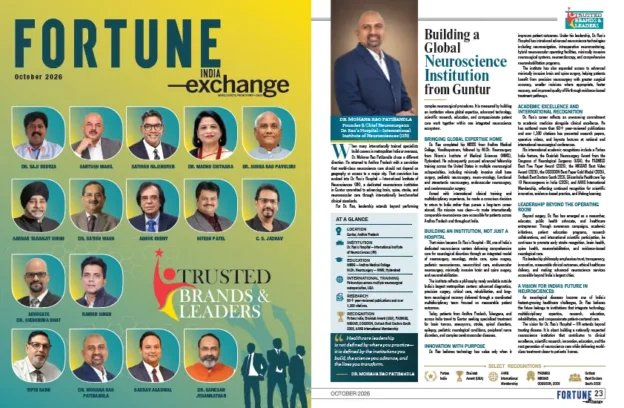
Dr. Mohana Rao Patibandla, Founder and Chief Neurosurgeon of Dr. Rao’s Hospital – International Institute of Neurosciences (IIN), Guntur, featured in Fortune India Exchange’s October 2026 “Trusted Brands & Leaders” section, in the profile “Building a Global Neuroscience Institution from Guntur.”
Dr. Mohana Rao Patibandla featured in Fortune India Exchange’s October 2026 “Trusted Brands & Leaders” section.
Fortune India Exchange has featured Dr. Mohana Rao Patibandla, minimally invasive neurosurgeon, pediatric neurosurgeon, cerebrovascular endovascular neurosurgeon, skull base neurosurgeon, neuro-oncology specialist and stereotactic radiosurgeon, in its October 2026 issue.
The profile, titled “Building a Global Neuroscience Institution from Guntur,” appears in the magazine’s “Trusted Brands & Leaders” section and covers his training, research and the growth of Dr. Rao’s Hospital – International Institute of Neurosciences (IIN) in Guntur, Andhra Pradesh. The official release is available on EIN Presswire.
“Healthcare leadership is not defined by where you practice—it is defined by the institutions you build, the science you advance, and the lives you transform.”
— Dr. Mohana Rao Patibandla, Neurosurgeon & Founder, Dr. Rao’s Hospital
Specialised neuroscience care outside the metros
The feature looks at how specialised neuroscience services can be built outside India’s largest metropolitan centres. It describes the clinical areas served by Dr. Rao’s IIN, the technologies in its operating model, and the role of research, education and multidisciplinary care.
Dr. Rao’s IIN lists neurosurgery, neurology, stroke care, spine surgery, pediatric neurosciences, neurocritical care, endovascular neurosurgery, minimally invasive brain and spine surgery, and neurorehabilitation among its service areas. Patients present with conditions such as brain tumours, aneurysms, stroke, spinal disorders, epilepsy, pediatric neurological conditions, peripheral nerve disorders and cerebrovascular diseases. Explore the full range on the Dr. Rao’s IIN website.
The article also reports fellowship training in the United States across several neurosurgical subspecialties:
Minimally invasive skull base surgery
Pediatric neurosurgery
Neuro-oncology
Functional and stereotactic neurosurgery
Endovascular neurosurgery
Cerebrovascular surgery
The profile describes his decision to return to Andhra Pradesh and build his practice in Guntur as part of a focus on developing specialised neurological services in the region. Today, Dr. Rao’s IIN draws patients from other Indian states and from abroad, and its reach has extended to seven cities.
Technology at Dr. Rao’s IIN
The October issue lists the following among the technologies and services described at the institution:
Hybrid neurovascular operating facilities and a biplane catheterisation laboratory
Minimally invasive neurosurgical systems and neuroendoscopy
Neurorehabilitation programmes
Hybrid Operation Theatre
Technology is applied case by case. Its use depends on the diagnosis, the proposed procedure and the clinical team’s assessment, and its presence alone does not establish a particular treatment outcome. Learn more about minimally invasive brain and spine surgery and endovascular neurosurgery at Dr. Rao’s IIN. For background on image-guided surgery, see Brainlab.
Research and recognition
The profile reports that Dr. Rao has authored more than 60 peer-reviewed publications and received over 1,300 citations. It also refers to his presentations of research papers, operative videos and lectures at national and international neurosurgical conferences, and over the course of his career he has performed 12,000 minimally invasive surgeries, 4,000 of them in Guntur.
The article lists the following professional recognitions:
These details are reported as part of the publication’s profile and have not been independently evaluated.
Public education and neurological care
Beyond clinical practice, the article describes Dr. Rao’s involvement in patient education, academic initiatives, research collaborations and public awareness on stroke recognition, brain health, spine health and neurorehabilitation.
Awareness matters because some symptoms need urgent assessment. Sudden weakness, difficulty speaking, loss of balance or a sudden severe headache can indicate a medical emergency and warrant immediate medical attention. The NHS guide to stroke symptoms explains the warning signs. For other neurological conditions, clinical assessment determines the diagnosis and whether observation, medication, rehabilitation, surgery or another approach is appropriate.
Frequently asked questions
What did Fortune India Exchange publish about Dr. Rao’s IIN?
The October 2026 issue carries the profile “Building a Global Neuroscience Institution from Guntur” in the Trusted Brands & Leaders section.
Where is Dr. Rao’s IIN located?
Old Bank Street, besides AK Biryani Point, Kothapeta, Guntur, Andhra Pradesh, India.
Editorial note: This post reports on a published profile and attributes biographical, research and institutional details to that source. It does not represent an independent assessment of clinical performance or patient outcomes. This content is for general information and is not a substitute for professional medical advice.
Publication: Fortune India Exchange · Issue: October 2026 · Feature: “Building a Global Neuroscience Institution from Guntur” · Source release:EIN Presswire
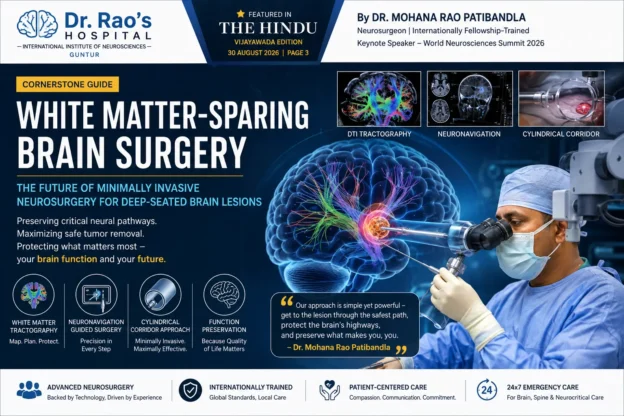
White Matter-Sparing Brain Surgery: The Future of Minimally Invasive Neurosurgery for Deep-Seated Brain Lesions
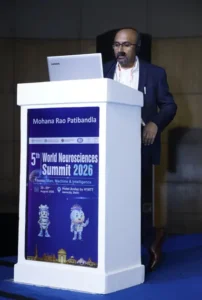
Featured in The Hindu (Vijayawada Edition, 30 August 2026) following Dr. Mohana Rao Patibandla’s keynote presentation at the World Neurosciences Summit (WNS) 2026, New Delhi.
Dr. Mohana Rao Patibandla presenting his keynote lecture, “Minimally Invasive Cylindrical Corridor Surgery – Modern Microsurgery Strategy for Deep-Seated Brain Lesions,” at the 5th World Neurosciences Summit 2026 in New Delhi, highlighting advanced White Matter-Sparing Brain Surgery techniques for preserving critical neural pathways.
Cornerstone Article
White Matter-Sparing Brain Surgery: The Future of Minimally Invasive Neurosurgery for Deep-Seated Brain Lesions
Author: Dr. Mohana Rao Patibandla, Neurosurgeon, Founder & Chief Neurosurgeon, Dr. Rao’s Hospital – International Institute of Neurosciences, Guntur, Andhra Pradesh, India
Published: September 2026
Reading Time: 18–22 minutes
Target Keywords: White matter sparing surgery, minimally invasive brain surgery, cylindrical corridor surgery, deep-seated brain tumor surgery, brain lesion surgery, neurosurgeon India, Dr. Mohana Rao Patibandla.
Executive Summary
The human brain contains billions of neurons connected through highly organized white matter tracts—the communication highways that allow movement, speech, memory, vision, sensation, and cognition. Traditional surgery for deep-seated brain tumors or lesions often requires passing through healthy brain tissue, increasing the risk of neurological deficits.
White Matter-Sparing Surgery, also called Minimally Invasive Cylindrical Corridor Surgery, represents a transformative advancement in neurosurgery. Instead of cutting through healthy brain tissue, surgeons navigate between natural white matter pathways, preserving critical neural connections while reaching tumors or lesions deep inside the brain.
This technique was the focus of Dr. Mohana Rao Patibandla’s keynote lecture at the World Neurosciences Summit 2026, where he presented modern microsurgical strategies for safely treating deep-seated brain lesions. The approach was subsequently highlighted by The Hindu in a feature article discussing the future of minimally invasive brain surgery.
The lecture highlighted the growing importance of minimally invasive microsurgical corridors in contemporary neurosurgery.
World Neurosciences Summit 2026_ Invited Faculty Dr. Mohana Rao Pat_ – [www.india.com] (1).pdf
Featured in The Hindu: National Recognition of White Matter-Sparing Surgery
The Hindu reported Dr. Mohana Rao Patibandla’s press conference explaining how preserving normal brain tissue and neural pathways has become a key objective of modern minimally invasive microsurgery. The article also described cylindrical corridor surgery as a white matter-sparing strategy for deep-seated brain lesions.
This coverage reflects growing public awareness of advanced brain-preserving surgical techniques in India.
Why This Matters for Patients in India
Patients increasingly seek:
Safer surgery.
Smaller incisions.
Faster recovery.
Preservation of neurological function.
International-standard neurosurgical care within India.
White matter-sparing surgery aligns with these goals when clinically appropriate.
Why Choose Dr. Rao’s Hospital for White Matter-Sparing Brain Surgery?
6
Dr. Rao’s Hospital – International Institute of Neurosciences, Guntur, offers comprehensive brain and spine care with advanced neurosurgical technology and internationally trained expertise.
Areas of Expertise
Brain Tumor Surgery
Skull Base Surgery
Endoscopic Brain Surgery
Pediatric Neurosurgery
Cerebrovascular Surgery
Epilepsy Surgery
Functional Neurosurgery
Minimally Invasive Neurosurgery
Advanced Technologies
Operating Microscope
Neuronavigation
Neuroendoscopy
Neurophysiological Monitoring
Advanced MRI Planning
Minimally Invasive Brain Surgery
Frequently Asked Questions (FAQ)
1. What is White Matter-Sparing Brain Surgery?
White matter-sparing brain surgery is a minimally invasive microsurgical approach that reaches deep brain lesions through natural white matter corridors while minimizing injury to healthy neural pathways.
2. What is Cylindrical Corridor Surgery?
It is a minimally invasive technique using a tubular retractor to create a gentle corridor through the brain, allowing surgeons to access deep lesions with less tissue disruption.
3. Is White Matter-Sparing Surgery safer than traditional brain surgery?
It may reduce disruption to healthy brain tissue in carefully selected patients, but safety depends on lesion type, location, patient health, and surgical expertise.
4. Which brain tumors can be treated?
Selected gliomas, metastases, intraventricular tumors, cavernomas, colloid cysts, and certain deep-seated lesions may be suitable candidates.
5. What is tractography?
Tractography is an MRI technique (DTI) that maps white matter pathways before surgery to help surgeons avoid critical neural connections.
6. Does every patient need tractography?
Not always. It is especially useful when lesions are close to eloquent brain pathways.
7. Is recovery faster?
Many selected patients experience smaller incisions, less pain, and earlier mobilization, although recovery varies with the underlying disease and surgery performed.
8. Is this surgery available in India?
Yes. Advanced minimally invasive white matter-sparing brain surgery is available in specialized neuroscience centers including Dr. Rao’s Hospital in Guntur.
9. Can brain function be preserved completely?
The goal is maximal preservation of neurological function, but outcomes depend on lesion location, disease biology, and individual patient factors.
10. How do I know if I’m a candidate?
A neurosurgical consultation with MRI review, tractography when indicated, and individualized surgical planning is necessary.
Key Takeaways
6
White Matter-Sparing Surgery represents one of the most significant advances in modern neurosurgery because it shifts the surgical philosophy from simply reaching a lesion to protecting the brain’s communication networks while treating disease.
For carefully selected patients with deep-seated brain tumors, cavernomas, intraventricular lesions, and other complex pathologies, minimally invasive cylindrical corridor surgery offers a highly precise approach centered on preserving neurological function whenever possible.
As highlighted during Dr. Mohana Rao Patibandla’s keynote lecture at the World Neurosciences Summit 2026 and subsequently featured in The Hindu, the future of neurosurgery lies in combining advanced imaging, neuronavigation, microsurgical precision, and white matter preservation to achieve better patient outcomes.
Dr. Mohana Rao Patibandla is an internationally fellowship-trained neurosurgeon and the Founder & Chief Neurosurgeon of Dr. Rao’s Hospital – International Institute of Neurosciences, Guntur, Andhra Pradesh, India.
His advanced training includes skull base surgery, pediatric neurosurgery, minimally invasive brain surgery, neuro-oncology, cerebrovascular and endovascular neurosurgery, and functional neurosurgery in India and the United States. He regularly serves as invited faculty at national and international neuroscience conferences and delivered a keynote lecture at the World Neurosciences Summit 2026 on White Matter-Sparing Minimally Invasive Cylindrical Corridor Surgery.
Patients with deep-seated gliomas, meningiomas, metastatic tumors, and other complex lesions may benefit from
Brain Tumor Surgery performed using modern white matter-sparing microsurgical techniques. Many lesions located near the skull base require specialized Skull Base Surgery
combined with advanced neuronavigation and minimally invasive approaches.
Our comprehensive Neuro-Oncology Program focuses on personalized treatment for benign and malignant brain tumors. Children with deep-seated brain tumors may benefit from advanced Pediatric Neurosurgery that prioritizes preservation of developing neural pathways.
Selected intraventricular tumors and colloid cysts can often be treated using Endoscopic Brain Surgery or minimally invasive cylindrical corridor techniques.
White matter-sparing surgery relies heavily on Neuronavigation-Guided Brain Surgery
to identify the safest surgical pathway while protecting eloquent brain regions.
Patients with epilepsy caused by cavernomas or focal cortical lesions may also be candidates for Epilepsy Surgery using minimally invasive neurosurgical strategies.
Learn more about the international training, experience, research, and surgical philosophy of Dr. Mohana Rao Patibandla Founder of Dr. Rao’s Hospital – International Institute of Neurosciences.
Need Expert Care for a Brain Tumor or Deep-Seated Brain Lesion?
At Dr. Rao’s Hospital – International Institute of Neurosciences (IIN),
we provide advanced White Matter-Sparing Brain Surgery, Minimally Invasive Brain Tumor Surgery, Skull Base Surgery, Endoscopic Brain Surgery, Neuro-Oncology, Pediatric Neurosurgery, Stroke Care, and Spine Surgery using internationally
recognized technology and evidence-based treatment protocols.
Every patient receives a personalized surgical plan based on advanced MRI,
neuronavigation, white matter tractography, intraoperative neuromonitoring,
and minimally invasive microsurgical techniques designed to preserve neurological function whenever possible.
Comprehensive Neuro-Oncology, Neurocritical Care and Rehabilitation.
24×7 Emergency Brain, Stroke and Spine Care.
Contact Dr. Rao’s Hospital
Dr. Rao’s Hospital – International Institute of Neurosciences (IIN)
12-19-67, Old Bank Road, Kothapet,
Opposite Sravani Hospital, Besides AK Biryani point,
Guntur – 522001, Andhra Pradesh, India.