
Stereotactic Radiosurgery: The Hindu Features Dr. Mohana Rao Patibandla on Non-Invasive Neurosurgery
Modern Neurosurgery Is Not Always About Surgery: Understanding Stereotactic Radiosurgery Through a Complex Trigeminal Neuralgia Case
The Hindu features Dr. Mohana Rao Patibandla on the evolving role of non-invasive neurosurgical treatment and the importance of choosing the safest treatment for every individual patient.

Modern neurosurgery is undergoing a fundamental transformation. Advances in imaging, precision targeting, neurophysiology and radiation technology have expanded the treatment possibilities available to patients with complex neurological disorders. Today, successful neurosurgical care is not necessarily defined by the complexity of an operation. Increasingly, it is defined by identifying the most appropriate treatment while preserving neurological function and minimizing avoidable risks.
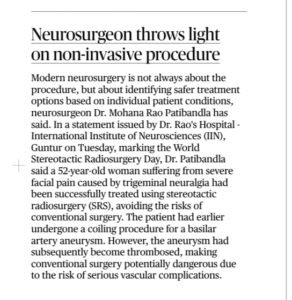
This philosophy was highlighted in The Hindu’s coverage published on November 25, 2026, titled “Neurosurgeon throws light on non-invasive procedure.” The article featured the clinical perspective of Dr. Mohana Rao Patibandla, Founder and Chief Neurosurgeon of Dr. Rao’s Hospital – International Institute of Neurosciences (IIN), Guntur, Andhra Pradesh.
The newspaper highlighted a particularly challenging clinical situation involving a 52-year-old woman with severe facial pain caused by trigeminal neuralgia, who had previously undergone coiling for a basilar artery aneurysm. Following the subsequent thrombosis of the aneurysm, conventional surgical treatment presented additional vascular considerations. The treating team selected stereotactic radiosurgery (SRS) as a non-invasive treatment approach. The patient was reported to be free from pain following treatment.
The case illustrates an important principle: the best treatment is not always the most invasive one. It is the treatment that offers an appropriate balance between potential benefit, risk, anatomy and the patient’s overall clinical condition.
What Is Stereotactic Radiosurgery?
Stereotactic radiosurgery (SRS) is a highly precise, non-invasive radiation-based treatment that delivers focused radiation to a carefully defined target within the brain or nervous system. Despite the word “surgery” in its name, SRS does not involve a conventional surgical incision, opening of the skull or removal of tissue.
It combines advanced medical imaging, computerized treatment planning and precisely directed radiation beams. Individual radiation beams pass through surrounding tissues, but their convergence at the intended target produces the prescribed radiation dose.
The objective is to influence the biological activity of the targeted tissue while limiting unnecessary radiation exposure to surrounding critical structures.
SRS is an established treatment modality used in appropriately selected patients with several neurological conditions, including:
- Trigeminal neuralgia.
- Selected benign and malignant brain tumours.
- Vestibular schwannomas (acoustic neuromas).
- Brain metastases.
- Selected arteriovenous malformations (AVMs).
- Other carefully selected intracranial lesions.
The exact indication, radiation dose, treatment technique and expected response depend on the underlying diagnosis, target anatomy, previous treatments and individual patient factors.
Why the Trigeminal Neuralgia Case Was Clinically Important
The case reported by The Hindu is particularly interesting because the patient’s medical history made treatment selection more complex than it might be in an otherwise straightforward case of trigeminal neuralgia.
The patient was a 52-year-old woman suffering from severe facial pain. She had previously undergone endovascular coiling for a basilar artery aneurysm. Subsequently, the aneurysm became thrombosed.
A thrombosed aneurysm in the basilar artery region creates important considerations when evaluating additional surgical procedures. The relationship between the aneurysm, adjacent vascular structures, cranial nerves and brainstem must be carefully considered. Conventional surgical intervention may carry substantial vascular and neurological risks in selected anatomical circumstances.
In this situation, the treatment team considered the patient’s previous vascular history and the risks associated with conventional surgical intervention. Stereotactic radiosurgery was selected as the treatment approach for the trigeminal neuralgia.
The reported clinical outcome was encouraging: the patient was free from pain following treatment.
It is important to distinguish the two conditions involved. The previous basilar artery aneurysm was part of the patient’s medical history and influenced treatment planning. SRS was selected to treat the trigeminal neuralgia; it was not a treatment intended to eliminate or treat the thrombosed aneurysm.
This distinction highlights why detailed clinical assessment is essential before choosing any neurosurgical or radiosurgical intervention.
Understanding Trigeminal Neuralgia: Why Facial Pain Can Be Debilitating
The trigeminal nerve is the fifth cranial nerve and is primarily responsible for carrying sensory information from the face to the brain. It has three major divisions:
- Ophthalmic division (V1): Provides sensation to the forehead, upper eyelid and parts of the eye region.
- Maxillary division (V2): Provides sensation to the cheek, upper jaw and upper teeth.
- Mandibular division (V3): Provides sensation to the lower jaw and lower teeth and also carries motor fibres to muscles of mastication.
Trigeminal neuralgia is a neurological pain disorder characterized by sudden, severe, recurrent episodes of facial pain. Patients often describe the sensation as an electric shock, stabbing pain or intense shooting pain affecting one side of the face.
Even ordinary activities such as brushing teeth, chewing food, speaking, washing the face or experiencing a gentle breeze may trigger an episode.
For some patients, the condition can become so debilitating that eating, sleeping and maintaining normal social activities become difficult.
Trigeminal neuralgia may be associated with neurovascular compression, changes in nerve function or other underlying neurological abnormalities. In some patients, additional imaging and clinical investigations are necessary to identify secondary causes.
A careful diagnosis is essential because not every type of facial pain represents trigeminal neuralgia. Dental disorders, temporomandibular joint conditions, other cranial neuropathies and certain headache disorders can produce overlapping symptoms.
How Does Stereotactic Radiosurgery Work for Trigeminal Neuralgia?
Stereotactic radiosurgery provides a treatment option for appropriately selected patients with trigeminal neuralgia, particularly when medication is ineffective, poorly tolerated or when other procedures are unsuitable.
In this application, highly focused radiation is directed at a carefully selected portion of the trigeminal nerve pathway, commonly near its root entry zone. The radiation produces biological changes in the nerve that can reduce abnormal pain transmission.
The treatment requires careful imaging, accurate target definition and individualized radiation planning. The surrounding brainstem and other important neurological structures must be considered during treatment planning.
Unlike conventional open surgery, SRS does not require a surgical incision or direct surgical manipulation of the nerve.
However, patients should understand that the response is not necessarily immediate. Pain relief may take weeks or longer to develop, and the response varies between individuals. Some patients may continue to require medication during this period.
Possible complications include facial numbness, altered facial sensation, dysesthesia and, less commonly, other neurological effects. The treating team should explain the expected benefits and potential risks before treatment.
Gamma Knife and Other Stereotactic Radiosurgery Technologies
Gamma Knife is one of the established technologies used to deliver stereotactic radiosurgery. It uses multiple precisely focused radiation beams to concentrate a prescribed dose at a defined intracranial target.
Other platforms include linear accelerator-based systems and robotic radiosurgery systems such as CyberKnife.
Although the technologies differ in their radiation delivery mechanisms, they share the fundamental principle of accurate, image-guided targeting.
The choice of platform depends on the condition being treated, the size and location of the target, available technology, treatment planning considerations and the expertise of the treating team.
It is important to recognize that Gamma Knife and stereotactic radiosurgery are not interchangeable terms. Gamma Knife is a specific radiosurgery platform, whereas SRS describes the broader treatment approach.
When Is Non-Invasive Treatment Preferable to Conventional Neurosurgery?
One of the most important developments in contemporary neurosurgery is the recognition that a conventional operation is not necessarily the first or best option for every patient.
In certain situations, an open surgical procedure may involve additional risks because of:
- Previous intracranial vascular procedures.
- Complex vascular anatomy or thrombosed aneurysms.
- Lesions located close to the brainstem or cranial nerves.
- Significant medical comorbidities.
- Previous surgery, radiation treatment or anatomical changes.
- The possibility of damaging critical neurological structures.
For appropriately selected conditions, stereotactic radiosurgery may provide an alternative that avoids direct surgical manipulation of delicate structures.
Nevertheless, non-invasive treatment is not automatically safer or more effective in every clinical situation. SRS has its own limitations, including delayed treatment response, radiation-related adverse effects and restrictions based on target size, location and diagnosis.
For some patients, medication, microvascular decompression, percutaneous procedures, conventional surgery or other treatment approaches may offer better outcomes.
The essential responsibility of the neurosurgeon is to evaluate these options objectively and recommend the approach that best addresses the patient’s individual needs.
“Modern neurosurgery is not always about the procedure, but about identifying safer treatment options based on individual patient conditions.”
Why Individualized Neurosurgical Decision-Making Matters
Two patients with the same neurological diagnosis may require entirely different treatment strategies.
A younger patient with classical trigeminal neuralgia and demonstrable neurovascular compression may be considered for microvascular decompression. Another patient with significant medical comorbidities or a complex previous vascular history may be evaluated for radiosurgery or another less invasive option.
Likewise, a patient with a brain tumour may require microsurgical removal, stereotactic radiosurgery, fractionated radiation treatment, chemotherapy or a combination of modalities.
These decisions cannot be made based on a diagnosis alone. They require consideration of clinical symptoms, neurological examination, MRI and vascular imaging, previous procedures, the location and characteristics of the pathology, patient preferences and long-term treatment goals.
This is why multidisciplinary collaboration between neurosurgeons, radiation oncologists, neuroradiologists, medical physicists and other specialists is important in complex radiosurgical care.
World Stereotactic Radiosurgery Day: Recognizing a Transformative Innovation
November 24 is observed as World Stereotactic Radiosurgery Day. The date commemorates the birthday of Swedish neurosurgeon Professor Lars Leksell, who pioneered stereotactic radiosurgery.
Professor Leksell’s work helped establish a new approach to treating selected intracranial disorders through precise, focused radiation rather than conventional open surgical intervention.
Over the decades, developments in neuroimaging, computerized treatment planning, radiation delivery systems and image guidance have significantly expanded the clinical applications of this technology.
Today, SRS represents an important component of modern multidisciplinary neuroscience care, offering selected patients treatment possibilities that were previously difficult or sometimes impossible to achieve without invasive surgery.
Dr. Mohana Rao Patibandla and the Evolution of Advanced Neurosurgical Care in Guntur
Dr. Mohana Rao Patibandla is the Founder, CMD and Chief Neurosurgeon of Dr. Rao’s Hospital – International Institute of Neurosciences (IIN), Guntur, Andhra Pradesh.
His professional training encompasses multiple subspecialties of neurosurgery, including minimally invasive neurosurgery, skull-base surgery, pediatric neurosurgery, neuro-oncology, epilepsy surgery, cerebrovascular and endovascular neurosurgery, functional neurosurgery and stereotactic radiosurgery.
His approach emphasizes the importance of matching the treatment strategy to the individual patient rather than routinely selecting a particular procedure.
Dr. Rao’s Hospital was established to provide specialized neurological, neurosurgical and spine care in Andhra Pradesh. Its clinical infrastructure includes advanced neurosurgical facilities, a hybrid operating theatre, neuro-interventional facilities, neuronavigation, advanced surgical microscopy and endoscopic systems.
These technologies support the evaluation and treatment of selected complex neurological and neurosurgical conditions. However, technology alone does not determine the quality of treatment. Appropriate patient selection, accurate diagnosis, clinical judgment and experienced multidisciplinary care remain essential.
For patients and families, access to a comprehensive neuroscience centre can help facilitate the assessment of different treatment options, including medication, conventional surgery, minimally invasive procedures and radiosurgical approaches when appropriate.
Learn more about Dr. Mohana Rao Patibandla’s neurosurgical background and professional profile.
The Hindu Coverage: A Recognition of Patient-Centred Neurosurgical Thinking
The November 25, 2026 report in The Hindu brings attention to an important aspect of modern neurosurgical practice: selecting treatment according to the individual patient’s condition rather than assuming that every neurological problem requires conventional surgery.
The reported trigeminal neuralgia case demonstrates how a patient’s previous vascular treatment and subsequent anatomical considerations can influence the choice of intervention.
For the broader medical community, the case is a reminder that advances in neurosurgery should not be measured only by the number or complexity of operations performed. They should also be measured by the ability to identify suitable alternatives, preserve neurological function and improve quality of life.
For patients experiencing severe facial pain, the message is equally important: an accurate diagnosis and a specialist evaluation can help identify the full range of available treatment options.
Read the original coverage: Neurosurgeon throws light on non-invasive procedure – The Hindu, November 25, 2026.
Frequently Asked Questions About Stereotactic Radiosurgery
1. What is stereotactic radiosurgery in simple terms?
Stereotactic radiosurgery is a non-invasive treatment that uses highly focused radiation to target specific areas of the brain or nervous system. It does not involve a conventional surgical incision.
2. Can trigeminal neuralgia be treated with stereotactic radiosurgery?
Yes. SRS is an established treatment option for selected patients with trigeminal neuralgia. It targets a carefully defined portion of the trigeminal nerve pathway to reduce abnormal pain transmission.
3. Is Gamma Knife the same as stereotactic radiosurgery?
No. Gamma Knife is one technology used for stereotactic radiosurgery. Other treatment platforms include linear accelerator-based systems and CyberKnife.
4. Is stereotactic radiosurgery a completely non-invasive procedure?
SRS does not require an incision or open surgery. Depending on the treatment system, patients may undergo frame-based or frameless immobilization. Frame placement, when required, can involve local anesthesia and temporary discomfort.
5. Does stereotactic radiosurgery cure trigeminal neuralgia immediately?
Not necessarily. Pain relief can be delayed and may develop over weeks or longer. The response varies, and some patients require continued medication or further treatment.
6. What are the risks of stereotactic radiosurgery?
Potential complications include facial numbness, altered sensation, radiation-related tissue changes and other effects depending on the treatment target and dose. A specialist should explain the individual risk profile before treatment.
7. Is stereotactic radiosurgery suitable for every patient with trigeminal neuralgia?
No. Treatment selection depends on the diagnosis, symptom pattern, imaging, previous treatment, medical history and individual risk factors. Medication, microvascular decompression and other procedures may be more appropriate for some patients.
8. Where can patients seek neurosurgical consultation in Guntur?
Patients can contact Dr. Rao’s Hospital – International Institute of Neurosciences (IIN), Guntur, Andhra Pradesh, for consultation and evaluation of neurological and neurosurgical conditions.
Conclusion: The Future of Neurosurgery Is Precision, Individualization and Patient Safety
The future of neurosurgery will not be defined solely by increasingly sophisticated operations. It will also be shaped by the ability to select the right treatment for the right patient at the right time.
Stereotactic radiosurgery is an important example of this evolution. By combining advanced imaging, precise targeting and focused radiation delivery, it provides selected patients with an alternative to conventional surgical intervention.
The complex trigeminal neuralgia case featured in The Hindu demonstrates why patient-specific treatment planning matters, particularly when previous vascular procedures and anatomical considerations make conventional surgery more challenging.
At Dr. Rao’s Hospital – International Institute of Neurosciences, Guntur, the broader philosophy is to evaluate neurological conditions comprehensively and consider the available treatment options according to the patient’s individual needs.
Because the best neurosurgical treatment is not necessarily the one that involves the biggest operation. It is the one that offers the most appropriate balance of safety, effectiveness and quality of life for the patient.
Consultation and Patient Information
For information or appointments regarding neurological conditions, trigeminal neuralgia, brain disorders, spine disorders and neurosurgical treatment options:
Dr. Rao’s Hospital – International Institute of Neurosciences (IIN)
12-19-67, Old Bank Road, Kothapet,
Opposite Sravani Hospital,
Guntur, Andhra Pradesh, India.
Phone: +91 90100 564441
Email: info@drraoshospitals.com
Website: https://drraoshospitals.com/
References and Further Reading
- The Hindu:
Neurosurgeon throws light on non-invasive procedure.
Published November 25, 2026. - American Association of Neurological Surgeons (AANS):
Stereotactic Radiosurgery – Patient Information. - Mayo Clinic:
Brain Stereotactic Radiosurgery. - Dr. Rao’s Hospital:
Dr. Mohana Rao Patibandla – Neurosurgeon and Founder.
Medical disclaimer: This article is intended for educational and informational purposes only. It does not replace an individualized medical consultation, diagnosis or treatment recommendation. Stereotactic radiosurgery is not appropriate for every patient. Treatment decisions should be made following evaluation by qualified specialists.