Tag Archives: brain tumor surgery in Guntur

Dr. Mohana Rao Patibandla explaining DTI neuronavigation technology for advanced brain surgery at Dr. Rao’s Hospital in Guntur.

The Rise of Advanced Minimally Invasive Neurosurgery in India | Dr. Rao’s International Institute of Neurosciences

The Rise of Advanced Minimally Invasive Neurosurgery in India


Inspired by the Mid-Day feature article on advanced minimally invasive neurosurgery in India Original Mid-Day Feature Article


Neurosurgery has traditionally been viewed as one of the most complex and demanding fields in medicine. For decades, brain and spine surgeries were associated with large incisions, prolonged hospital stays, extensive recovery periods, and significant postoperative discomfort. However, modern medicine is undergoing a remarkable transformation.


Today, advanced minimally invasive neurosurgery is redefining how neurological and spinal disorders are treated across India. With innovations in endoscopic surgery, neuronavigation systems, intraoperative neuromonitoring, microsurgical techniques, and advanced imaging, many complex procedures can now be performed with greater precision and reduced tissue disruption.


India is rapidly emerging as an important center for advanced neurosciences care, and institutions such as Dr. Rao’s International Institute of Neurosciences in Guntur are contributing to this evolving landscape by integrating modern minimally invasive approaches into comprehensive neurological care.


What Is Minimally Invasive Neurosurgery?


Minimally invasive neurosurgery refers to advanced surgical techniques designed to treat brain, spine, and nerve disorders through smaller incisions and highly precise surgical pathways. Instead of large open exposures, surgeons utilize specialized technologies and instruments that minimize damage to surrounding tissues while maintaining surgical effectiveness.


The primary goals of minimally invasive neurosurgery include:


  • Reducing tissue trauma
  • Improving surgical precision
  • Shortening hospital stays
  • Reducing postoperative pain
  • Enhancing recovery speed
  • Lowering infection risks
  • Improving cosmetic outcomes
  • Preserving neurological function

Importantly, minimally invasive neurosurgery is not simply about smaller incisions. It represents a broader evolution toward precision-based and patient-centered care.


The Evolution of Neurosurgery in India


India’s neurosciences ecosystem has evolved dramatically over the past two decades. Advanced technologies that were once limited to select global centers are increasingly becoming accessible within India.


Modern Indian neurosurgery now incorporates:


  • Endoscopic skull base surgery
  • Endoscopic spine surgery
  • Microneurosurgery
  • Neuronavigation systems
  • Intraoperative neuro-monitoring
  • Advanced neuroimaging
  • Cerebrovascular interventions
  • Minimally invasive spinal stabilization


This transformation is improving patient outcomes while expanding treatment possibilities for many neurological conditions that were previously considered highly complex.


According to the Mid-Day feature article, minimally invasive neurosurgery is emerging as one of the most significant developments in modern neurosciences across India.


Endoscopic Skull Base Surgery: A Revolutionary Advancement


One of the most exciting developments in minimally invasive neurosurgery is endoscopic skull base surgery.


Traditionally, tumors located deep within the skull base often required extensive open surgical approaches involving significant tissue dissection and longer recovery periods. Modern endoscopic techniques now allow surgeons to access certain lesions through minimally invasive pathways using high-definition cameras and specialized instruments.


These advanced approaches may offer:


  • Reduced surgical trauma
  • Improved visualization
  • Enhanced precision
  • Shorter recovery times
  • Reduced hospital stays
  • Lower postoperative discomfort


Endoscopic skull base surgery is increasingly being utilized for:


  • Pituitary tumors
  • Skull base tumors
  • Certain cerebrospinal fluid leaks
  • Selected cranial lesions


At Dr. Rao’s International Institute of Neurosciences, advanced minimally invasive techniques continue to expand treatment possibilities for carefully selected patients.


The Growing Importance of Endoscopic Spine Surgery


Spine disorders are among the most common neurological conditions affecting patients today. Conditions such as slipped discs, spinal stenosis, degenerative spine disease, and nerve compression can severely impact mobility and quality of life.


Conventional spine surgery often required larger incisions and significant muscle dissection. Endoscopic spine surgery is changing this landscape.


Using specialized endoscopic systems, surgeons can perform certain spinal procedures through very small incisions while minimizing disruption to surrounding muscles and tissues.


Benefits for many patients may include:


  • Reduced postoperative pain
  • Earlier mobilization
  • Faster rehabilitation
  • Reduced blood loss
  • Smaller scars
  • Shorter hospitalization


Minimally invasive spine surgery has become increasingly popular among patients seeking safer and faster recovery options whenever clinically appropriate.


Neuronavigation: GPS for the Brain and Spine


One of the most remarkable innovations in modern neurosurgery is neuronavigation technology.


Often compared to a GPS system for the brain and spine, neuronavigation allows surgeons to map complex anatomical structures in real time using integrated imaging systems.


This technology is particularly valuable in:


  • Brain tumor surgery
  • Skull base procedures
  • Complex spinal operations
  • Cerebrovascular surgery
  • Deep-seated lesions


Millimeter-level accuracy is critical in neurosurgery. Neuronavigation significantly enhances surgical planning and precision while helping surgeons preserve vital neurological structures.


Advanced navigation-guided surgery represents one of the most important pillars of modern precision neurosurgery.


The Role of Intraoperative Neuro-Monitoring


Intraoperative neuro-monitoring is another major advancement improving surgical safety.


During complex neurological procedures, neuro-monitoring systems assess nerve and spinal cord function in real time. This allows surgical teams to monitor critical neurological pathways throughout surgery.


The advantages may include:


  • Improved surgical safety
  • Reduced risk of neurological injury
  • Better functional preservation
  • Enhanced surgical confidence


Neuro-monitoring is particularly valuable in:


  • Complex spine surgery
  • Brain tumor surgery
  • Skull base surgery
  • Cerebrovascular procedures
  • Pediatric neurosurgery


These technologies are helping modern neurosurgery become safer and more precise than ever before.


Microneurosurgery and Precision-Based Care


Microneurosurgery remains central to advanced neurosurgical care.


High-powered operating microscopes allow surgeons to work with extraordinary precision around delicate:


  • Blood vessels
  • Brain tissue
  • Cranial nerves
  • Spinal nerves


Combined with minimally invasive techniques and advanced imaging, microneurosurgery has dramatically expanded treatment possibilities for many neurological disorders.


The integration of:

  • Microscopes
  • Endoscopy
  • Neuronavigation
  • Advanced imaging
  • Neuro-monitoring


has created a new era of highly sophisticated precision neurosurgery.


Why Patients Prefer Minimally Invasive Approaches


Modern patients are increasingly informed about treatment options and recovery expectations.


Whenever medically appropriate, many patients now prefer minimally invasive procedures because they may offer:


  • Less pain
  • Reduced scarring
  • Shorter hospital stays
  • Faster return to work
  • Earlier rehabilitation
  • Lower complication risks


This shift is influencing how neuroscience centers across India approach patient-centered care.


However, experts emphasize that not every patient is suitable for minimally invasive surgery. Surgical decisions must always prioritize patient safety, disease characteristics, and long-term outcomes rather than technology alone.


The Importance of Ethical Patient Selection


While technology continues to evolve rapidly, experienced neurosurgeons consistently emphasize one important principle:


Technology should never replace clinical judgment.


Certain conditions may still require conventional open surgery depending on:


  • Tumor complexity
  • Trauma severity
  • Spinal deformity
  • Vascular anatomy
  • Patient-specific risk factors


Ethical neurosurgical care involves selecting the safest and most effective approach for each individual patient.


At Dr. Rao’s International Institute of Neurosciences, the philosophy continues to emphasize combining advanced technology with individualized, patient-centered treatment planning.


The Future of Neurosurgery in India


India’s neurosciences landscape is entering a highly exciting phase.


Future technologies expected to further transform neurosurgery include:


  • Artificial intelligence-assisted imaging
  • Robotic surgical systems
  • Augmented reality visualization
  • Advanced intraoperative imaging
  • Enhanced neuro-navigation systems
  • Precision-guided robotic spine surgery


As infrastructure and expertise continue expanding across India, advanced minimally invasive neurosurgery may become increasingly accessible in both metropolitan and regional healthcare systems.


Importantly, globally trained specialists are now helping bring advanced neurosciences care to Tier-2 cities like Guntur, making sophisticated treatment more accessible to regional populations.


Dr. Mohana Rao Patibandla and Advanced Neurosciences Care


According to the Mid-Day feature article, Dr. Mohana Rao Patibandla has been part of the broader movement toward integrating advanced minimally invasive techniques into regional neurosciences practice in India.


With international fellowship training across subspecialties including:


  • Minimally invasive skull base surgery
  • Pediatric neurosurgery
  • Neuro-oncology
  • Cerebrovascular surgery
  • Endovascular neurosurgery

Dr. Patibandla has consistently emphasized the importance of combining:


  • Modern technology
  • Ethical medicine
  • Precision surgery
  • Compassionate care
  • Patient-centered decision-making

This vision continues to help shape the development of advanced neurosciences services in Andhra Pradesh and regional India.


Conclusion


Minimally invasive neurosurgery represents one of the most important transformations in modern neurosciences.


By reducing tissue trauma and improving surgical precision, these advanced techniques are helping many patients experience:


  • Safer procedures
  • Faster recovery
  • Reduced pain
  • Shorter hospitalization
  • Earlier return to daily life

India is rapidly emerging as an important center for advanced neurosciences innovation. As technology, infrastructure, and expertise continue to evolve, the future of brain and spine care is becoming increasingly precise, patient-centered, and minimally invasive.


Institutions like Dr. Rao’s International Institute of Neurosciences demonstrate how world-class neurosciences care can successfully expand beyond metropolitan boundaries while maintaining high standards of ethics, innovation, and compassionate treatment.


Internal Links

External References


Contact Dr. Rao’s International Institute of Neurosciences

The Best Neurosurgeon in Guntur | The Best Neurologist in Guntur | The Best Spine Surgeon in Guntur

If you or your loved one is suffering from brain tumors, spinal disorders, stroke, nerve compression, or neurological conditions, early diagnosis and advanced treatment can significantly improve outcomes.

📍 Dr. Rao’s International Institute of Neurosciences
12-19-67, Old Bank Road, Kothapet,
Opposite Sravani Hospital,
Guntur, Andhra Pradesh – 522001

📞 Phone: +91 90100 56444
📧 Email: info@drraoshospitals.com
🌐 Website: https://drraoshospitals.com


Follow Dr. Mohana Rao Patibandla

📘 Facebook: Facebook
📸 Instagram: Instagram
📺 YouTube: YouTube
💼 LinkedIn: LinkedIn
🐦 X (Twitter): X / Twitter
📍 Google Maps: Location Map

Dr. Mohana Rao Patibandla presenting on Percutaneous Endoscopic Lumbar Discectomy (PELD) at NEUROENDOCON 2026 conference in Jaipur

Why World-Class Neurosciences Care Must Reach Beyond Metro Cities | Dr. Rao’s International Institute of Neurosciences

Why World-Class Neurosciences Care Must Reach Beyond Metro Cities

For decades, advanced neurosciences care in India has remained heavily concentrated in major metropolitan cities such as Delhi, Mumbai, Chennai, Bengaluru, and Hyderabad. Patients from smaller towns and rural communities have often been forced to travel hundreds of kilometers seeking specialized neurological and neurosurgical treatment. This geographic imbalance has created enormous emotional, financial, and logistical burdens for families already facing serious medical crises.

However, a transformative shift is gradually taking place across India’s healthcare landscape. Internationally trained specialists are beginning to establish advanced medical ecosystems in Tier-2 and Tier-3 cities, bringing world-class healthcare closer to communities that have historically lacked access to specialized care.

One such example is Dr. Rao’s International Institute of Neurosciences, founded by internationally trained neurosurgeon Dr. Mohana Rao Patibandla in Guntur, Andhra Pradesh.

The institute’s journey reflects a larger and deeply important question for Indian healthcare:
Why should world-class neurosciences care remain limited only to metro cities?

The Growing Need for Advanced Neurosciences Care in India

Neurological diseases are rapidly increasing worldwide, and India is no exception. Conditions such as stroke, brain tumors, epilepsy, spinal disorders, traumatic brain injury, Parkinson’s disease, pediatric neurological disorders, and neurovascular diseases require highly specialized multidisciplinary treatment.

Modern neurosciences care today extends far beyond traditional surgery. It requires:

  • Advanced neuroimaging
  • Neuronavigation systems
  • Intraoperative neuromonitoring
  • Endovascular capabilities
  • Neurocritical care units
  • Multidisciplinary rehabilitation
  • Minimally invasive surgical technologies
  • Comprehensive stroke management

Unfortunately, many patients living outside metropolitan regions continue to face delayed diagnosis and delayed treatment due to lack of access to such advanced infrastructure.

In neurosurgery and neurology, time is often critical. Delays can significantly worsen outcomes in conditions such as:

  • Brain hemorrhage
  • Acute ischemic stroke
  • Spinal cord compression
  • Brain tumors
  • Hydrocephalus
  • Head injuries
  • Pediatric neurological emergencies

This is why decentralizing excellence in neurosciences care has become one of the most important healthcare priorities for India’s future.

Why Tier-2 Cities Need Advanced Neurosciences Ecosystems

Tier-2 cities like Guntur, Vijayawada, Visakhapatnam, Rajahmundry, and others represent millions of patients who deserve access to world-class healthcare close to home.

Historically, patients requiring advanced brain surgery or spine surgery often had no option except referral to large metro hospitals. Families faced:

  • Travel-related stress
  • Accommodation expenses
  • Loss of workdays
  • Emotional isolation
  • Delayed emergency treatment
  • Fragmented continuity of care

Building advanced neuroscience institutes within regional cities fundamentally changes this equation.

Patients can now receive:

  • Advanced neurosurgical procedures locally
  • Faster diagnosis and emergency response
  • Family-centered support systems
  • Long-term rehabilitation closer to home
  • Affordable treatment pathways
  • Continuity of postoperative care

This regional transformation is not merely about convenience. It directly improves patient outcomes and healthcare accessibility.

The Vision Behind Dr. Rao’s International Institute of Neurosciences

After completing extensive international fellowships in the United States across multiple subspecialties including:

  • Minimally invasive skull base surgery
  • Pediatric neurosurgery
  • Cerebrovascular surgery
  • Endovascular neurosurgery
  • Neuro-oncology
  • Functional neurosurgery

Dr. Mohana Rao Patibandla made a deliberate and courageous decision to return to Andhra Pradesh rather than pursue a career abroad or exclusively in metropolitan India.

That decision eventually led to the development of one of the region’s most recognized comprehensive neuroscience centers: Dr. Rao’s International Institute of Neurosciences.

The institution focuses on combining:

  • Advanced technology
  • Evidence-based treatment
  • Ethical medical practice
  • Compassionate patient care
  • Accessibility for regional populations

Today, patients travel not only from Andhra Pradesh but also from across India and overseas seeking specialized neurological and neurosurgical treatment.

Building Trust Beyond Technology

One of the greatest misconceptions in modern healthcare is that technology alone defines excellence.

In reality, patients judge healthcare systems based on:

  • Trust
  • Transparency
  • Communication
  • Compassion
  • Ethical decision-making
  • Consistency of outcomes

While advanced infrastructure remains essential, neuroscience care is deeply emotional. Patients and families facing brain surgery or spinal disorders often experience intense anxiety and uncertainty.

This is why compassionate communication matters immensely.

At Dr. Rao’s International Institute of Neurosciences, emphasis is placed not only on surgical precision but also on patient-centered care pathways designed to preserve dignity, trust, and emotional reassurance throughout treatment.

The Rise of Minimally Invasive Neurosurgery

Modern neurosurgery has evolved dramatically over the past two decades.

Minimally invasive techniques are now enabling:

  • Smaller incisions
  • Reduced tissue disruption
  • Faster recovery
  • Lower postoperative pain
  • Shorter hospital stays
  • Improved cosmetic outcomes

These techniques are increasingly being used in:

  • Spine surgery
  • Endoscopic skull base surgery
  • Brain tumor surgery
  • Pediatric neurosurgery
  • Cerebrovascular interventions

Importantly, advanced minimally invasive surgery is no longer limited to metropolitan institutions.

The availability of such sophisticated treatment options in regional India represents a major milestone in healthcare decentralization.

Stroke Care Beyond Metropolitan Borders

Stroke remains one of India’s leading causes of disability and death.

The first few hours after stroke onset are critically important. Rapid diagnosis and treatment can dramatically improve survival and long-term neurological outcomes.

Comprehensive stroke centers require:

  • 24/7 imaging capabilities
  • Neurology expertise
  • Neurosurgical backup
  • Endovascular intervention facilities
  • Neurocritical care

Regional neuroscience centers now play an increasingly vital role in ensuring that patients do not lose precious treatment time traveling to distant metro cities.

The expansion of advanced stroke care across Andhra Pradesh and other regional states will likely become one of the defining healthcare transformations of the next decade.

The Importance of Ethical Healthcare

Modern medicine possesses extraordinary technological capabilities. However, technology without ethics can become dangerous.

Ethical healthcare means:

  • Recommending only necessary interventions
  • Transparent communication
  • Prioritizing patient welfare
  • Avoiding overtreatment
  • Maintaining accountability
  • Building long-term patient trust

As healthcare systems become increasingly commercialized, institutions rooted in integrity and patient-centered decision-making become even more important.

This philosophy continues to guide the development of advanced neuroscience ecosystems outside India’s traditional metropolitan medical hubs.

The Future of Neurosciences in Regional India

India’s healthcare future cannot remain concentrated exclusively in major urban centers.

The next phase of healthcare transformation will depend heavily on the decentralization of excellence.

This includes:

  • Advanced specialty hospitals in Tier-2 cities
  • Research-oriented regional institutions
  • Academic collaborations
  • Training programs for young specialists
  • Technology-driven patient care
  • Telemedicine integration
  • Regional rehabilitation networks

Young doctors and healthcare entrepreneurs increasingly recognize that meaningful impact often exists beyond traditional metropolitan practice environments.

Building world-class healthcare systems in underserved regions may ultimately become one of the most important contributions to India’s healthcare evolution.

Why Patients Now Seek Neurosciences Care in Guntur

Today, Guntur is gradually emerging as an important regional hub for advanced neurosciences care.

Patients increasingly seek specialized treatment for:

  • Brain tumors
  • Complex spine disorders
  • Stroke management
  • Endoscopic brain surgery
  • Epilepsy treatment
  • Pediatric neurosurgery
  • Neurovascular disorders
  • Traumatic brain injury

Institutions like Dr. Rao’s International Institute of Neurosciences are helping redefine perceptions about what regional healthcare can achieve.

This transformation demonstrates that advanced neuroscience care can successfully exist outside metropolitan boundaries while maintaining high standards of ethics, infrastructure, technology, and patient care.

Conclusion

The future of Indian healthcare lies not only in expanding metropolitan hospitals but in creating sustainable ecosystems of excellence across regional India.

World-class neurosciences care should never be geographically exclusive.

Patients deserve access to advanced neurological and neurosurgical treatment regardless of whether they live in Delhi, Hyderabad, Mumbai, Chennai, or Guntur.

The emergence of comprehensive neuroscience institutes in Tier-2 cities represents more than institutional growth. It reflects a broader movement toward healthcare accessibility, ethical medicine, technological advancement, and compassionate patient-centered care.

As India moves forward, the decentralization of advanced neurosciences care may become one of the country’s most important healthcare achievements.


Related Internal Links

External References


Contact Dr. Rao’s International Institute of Neurosciences

The Best Neurosurgeon in Guntur | The Best Neurologist in Guntur | The Best Spine Surgeon in Guntur

If you or your loved one is experiencing neurological symptoms, stroke, spine problems, brain tumors, or other complex neurological conditions, early evaluation can make a major difference in outcomes.

📍 Dr. Rao’s International Institute of Neurosciences
12-19-67, Old Bank Road, Kothapet,
Opposite Sravani Hospital,
Guntur, Andhra Pradesh – 522001

📞 Phone: +91 90100 56444
📧 Email: info@drraoshospitals.com
🌐 Website: https://drraoshospitals.com


Follow Dr. Mohana Rao Patibandla

📘 Facebook: Facebook
📸 Instagram: Instagram
📺 YouTube: YouTube
💼 LinkedIn: LinkedIn
🐦 X (Twitter): X / Twitter
📍 Google Maps: Location Map

Dr. Mohana Rao Patibandla explaining DTI neuronavigation technology for advanced brain surgery at Dr. Rao’s Hospital in Guntur.

From Brain Surgery to Institution Building: Dr. Mohana Rao Patibandla and the Future of Regional Neurosciences in India

From Brain Surgery to Institution Building: Dr. Mohana Rao Patibandla

India’s healthcare transformation is no longer limited to metropolitan cities like Delhi, Mumbai, Chennai, or Hyderabad. Increasingly, highly specialized healthcare ecosystems are emerging in regional cities, bringing advanced medical care closer to patients who once had to travel long distances for treatment.


One of the strongest examples of this transformation is being built in Guntur, Andhra Pradesh, through the vision of Dr. Rao’s Hospital and the upcoming International Institute of Neurosciences.


What began as a mission to provide advanced neurosurgical care has gradually evolved into a broader institutional vision — one focused not only on surgery, but also on education, research, innovation, accessibility, and the future of neurosciences in regional India.


Recently, this evolving vision was featured in an international press release published by  EINPresswire , highlighting Dr. Mohana Rao Patibandla’s contributions toward advanced neurosciences care and institution building in India.


Today, Dr. Rao’s Hospital has become recognized as one of the leading destinations for neurology, neurosurgery, and spine care in Andhra Pradesh, serving patients from across India and abroad.


The Journey from Surgeon to Institution Builder

The journey of Dr. Mohana Rao Patibandla reflects a larger shift happening in Indian healthcare. Traditionally, many specialist doctors focused primarily on individual clinical practice. However, modern healthcare increasingly demands institution-building — creating systems that can sustain excellence across generations.


Dr. Mohana Rao Patibandla completed his MBBS from Andhra Medical College, followed by specialization in Neurosurgery at Nizam’s Institute of Medical Sciences (NIMS), Hyderabad. He further pursued advanced international fellowships in multiple subspecialties of neurosciences, including:


  • Skull base surgery
  • Epilepsy surgery
  • Pediatric neurosurgery
  • Neuro-oncology
  • Functional neurosurgery
  • Cerebrovascular and endovascular surgery
  • Minimally invasive neurosurgery

These experiences across the United States exposed him to high-end neuroscience ecosystems where patient care, innovation, research, and education worked together seamlessly.


Rather than limiting that experience to personal advancement, Dr. Rao envisioned creating similar standards in Andhra Pradesh.


Learn more about Dr. Rao’s international training and expertise here: About Dr. Mohana Rao Patibandla


Why Regional Neurosciences Matter in India


India faces a growing burden of neurological disorders, including:


  • Stroke
  • Brain tumors
  • Epilepsy
  • Spine disorders
  • Parkinson’s disease
  • Neurotrauma
  • Pediatric neurological conditions

According to the World Health Organization (WHO), neurological disorders are among the leading causes of disability worldwide.


For many years, patients from Andhra Pradesh often had to travel to Hyderabad, Chennai, Bengaluru, or Delhi for advanced neurosurgical procedures. This created multiple challenges:


  • Delayed treatment
  • Financial burden
  • Emotional stress for families
  • Difficult postoperative follow-up
  • Reduced accessibility for rural patients

The development of advanced neuroscience centers in regional cities addresses these gaps directly.


Dr. Rao’s Hospital was built around this philosophy — bringing world-class neuroscience care closer to patients.


Building a Modern Neurosciences Ecosystem in Guntur


Over the years, Dr. Rao’s Hospital has expanded beyond a conventional hospital model into a specialized neuroscience ecosystem.


The hospital focuses on:


  • Advanced brain surgery
  • Spine surgery
  • Stroke management
  • Neurocritical care
  • Neuroimaging
  • Endovascular procedures
  • Minimally invasive techniques
  • Pediatric neurosurgery
  • Functional neurosurgery


The institution has also invested significantly in modern operating microscopes, neuronavigation systems, neuro-monitoring technologies, and minimally invasive surgical platforms.

Explore advanced neurosurgery services here: Advanced Brain Surgery at Dr. Rao’s Hospital

Explore spine surgery services here:Spine Surgery in Guntur


The Rise of Minimally Invasive Neurosurgery

One of the major shifts in modern neurosurgery is the adoption of minimally invasive approaches.


Traditional neurosurgery often involved larger incisions, longer hospital stays, and extended recovery periods. Today, advanced minimally invasive techniques allow surgeons to perform highly complex procedures with greater precision and reduced tissue disruption.


Dr. Mohana Rao Patibandla has been actively involved in advancing:


  • Endoscopic brain surgery
  • Endoscopic skull base surgery
  • Minimally invasive spine surgery
  • Endoscopic transnasal procedures
  • Microscopic neurosurgery


These approaches can offer several advantages:

  • Smaller incisions
  • Reduced blood loss
  • Faster recovery
  • Shorter hospital stay
  • Lower postoperative pain
  • Earlier rehabilitation


Read more about minimally invasive neurosurgery from the American Association of Neurological Surgeons (AANS)
.


Technology and Innovation in Neurosciences


Modern neurosciences increasingly rely on technological integration.


The future of neurosurgery is no longer only about surgical skill — it also depends on:


  • Artificial intelligence
  • Precision imaging
  • Robotics
  • Intraoperative navigation
  • Neuro-monitoring
  • Endovascular technologies
  • Radiosurgery
  • Data-driven healthcare systems


Dr. Rao’s vision for the International Institute of Neurosciences includes building a future-ready ecosystem where technology enhances both patient outcomes and clinical efficiency.


The goal is not simply to replicate metro-city hospitals, but to create a modern regional neuroscience model tailored for India’s evolving healthcare needs.


The Importance of Education and Research

Great medical institutions are built not only through patient care but also through education and academic contribution.


Dr. Mohana Rao Patibandla has actively participated in national and international conferences, presenting advanced neurosurgical techniques and innovations in spine surgery, skull base surgery, and cerebrovascular procedures.


Academic participation strengthens:

  • Clinical standards
  • Surgical innovation
  • Knowledge exchange
  • International collaboration
  • Institutional credibility


The future International Institute of Neurosciences aims to contribute toward:

  • Neuroscience education
  • Fellowship programs
  • Research collaborations
  • Surgical training
  • Innovation platforms


Patient-Centered Neurosciences Care

Despite advances in technology, patient-centered care remains the foundation of meaningful healthcare.


Neurological diseases often affect:

  • Mobility
  • Speech
  • Memory
  • Independence
  • Quality of life


Families dealing with brain or spine disorders frequently experience significant emotional stress.


Dr. Rao’s Hospital emphasizes:

  • Ethical treatment planning
  • Transparent communication
  • Personalized care
  • Long-term rehabilitation
  • Multidisciplinary collaboration


Patients who once traveled to distant metropolitan centers can now access advanced neuroscience care closer to home in Andhra Pradesh.


Transforming Andhra Pradesh into a Neurosciences Destination


Healthcare infrastructure plays a major role in regional development.

Advanced specialty hospitals not only improve patient care but also:


  • Generate employment
  • Attract talent
  • Encourage medical tourism
  • Support medical education
  • Improve regional healthcare confidence


The long-term vision behind the International Institute of Neurosciences is larger than a single hospital. It represents an effort to position Andhra Pradesh as an emerging center for advanced neurosciences in India.


The Future of Neurosciences in India


The future of Indian neurosciences will likely depend on several key factors:

1. Regional Centers of Excellence

High-quality neuroscience institutes in tier-2 cities can significantly improve healthcare accessibility.

2. Technology Integration

Artificial intelligence, robotics, and precision imaging will increasingly support diagnosis and surgery.

3. Minimally Invasive Techniques

Smaller, safer, and more precise surgeries will continue to evolve.

4. Multidisciplinary Care

Integrated care involving neurologists, neurosurgeons, rehabilitation specialists, intensivists, and therapists will become standard.

5. Education and Research

Institutional growth requires continuous academic development.

Dr. Mohana Rao Patibandla’s vision aligns closely with these emerging trends.


Conclusion


The future of Indian healthcare may not be built exclusively in metro cities. Increasingly, it will emerge from visionary regional institutions capable of combining global expertise with local accessibility.


Dr. Mohana Rao Patibandla’s journey from neurosurgeon to institution builder represents this transformation.


Through advanced clinical care, minimally invasive surgery, education, research, and long-term institutional development, Dr. Rao’s Hospital and the International Institute of Neurosciences are contributing toward a new chapter in regional neurosciences care in India.


For patients and families across Andhra Pradesh and beyond, this evolution means something profoundly important — access to advanced neuroscience care closer to home.


Frequently Asked Questions (FAQs)

Who is Dr. Mohana Rao Patibandla?

Dr. Mohana Rao Patibandla is an internationally trained neurosurgeon and the founder of Dr. Rao’s Hospital in Guntur, Andhra Pradesh.


What is the International Institute of Neurosciences?

The International Institute of Neurosciences is the evolving vision behind Dr. Rao’s Hospital, focused on advanced neurosciences care, research, innovation, and education.


What conditions are treated at Dr. Rao’s Hospital?

The hospital treats brain tumors, stroke, epilepsy, spine disorders, neurotrauma, pediatric neurological conditions, and other complex neurological diseases.


Is minimally invasive brain surgery available in Guntur?

Yes. Dr. Rao’s Hospital offers advanced minimally invasive neurosurgical procedures in Guntur, Andhra Pradesh.


Consult Dr. Mohana Rao Patibandla at Dr. Rao’s Hospital, Guntur

If you or your loved one is experiencing neurological or spine-related symptoms, early evaluation can make a significant difference.

Dr. Rao’s Hospital – Advanced Neurosciences Care in Andhra Pradesh

📍 12-19-67, Old Bank Road, Kothapet, Opposite Sravani Hospital, Guntur, Andhra Pradesh

📞 090100 56444

🌐

Home 2


📧
info@drraoshospitals.com

📍
View on Google Maps


Follow Dr. Rao’s Hospital on Social Media

📘 Facebook:

https://www.facebook.com/Dr.Raoshospital.Neurosurgeon/

📸 Instagram:

https://www.instagram.com/dr_mohana_rao/

📺 YouTube:

https://www.youtube.com/user/mrpatiban

💼 LinkedIn:

https://www.linkedin.com/in/drpatibandla/

🐦 X (Twitter):

https://x.com/MohanaRaoPatib


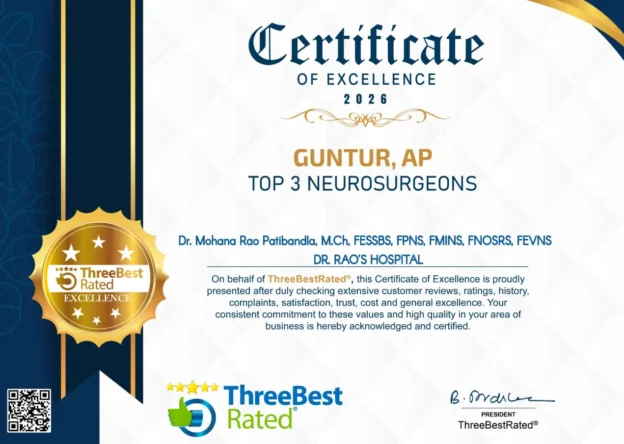
three best rated certificate webp

Dr. Mohana Rao Patibandla – No. 1 top neurosurgeon in Guntur – 5 years – ThreeBestRated

Dr. Mohana Rao Patibandla Ranked Among Top Neurosurgeons in Guntur for the Fifth Consecutive Year: A Benchmark in Excellence

In a remarkable achievement that reflects consistency, clinical excellence, and patient trust, Dr. Mohana Rao Patibandla has once again been ranked among the Top Neurosurgeons in Guntur by ThreeBestRated for the fifth consecutive year (2022–2026). This recognition is not just an award—it is a testament to sustained quality, innovation, and dedication in the highly demanding field of neurosurgery.

At a time when healthcare decisions are increasingly influenced by both clinical outcomes and patient experience, such consistent recognition underscores a rare combination: technical expertise, compassionate care, and institutional excellence.

National Law Review


What Makes This Recognition Significant?

The ThreeBestRated platform is known for its rigorous 50-point inspection process, which evaluates professionals based on:

  • Reputation and credibility
  • Patient satisfaction and feedback
  • Clinical performance and outcomes
  • Service consistency
  • Accessibility and trustworthiness

Unlike many awards that rely on nominations or paid listings, this ranking is independently verified, making it one of the most trusted recognitions for patients seeking reliable healthcare providers.

Being listed once is an achievement. Being listed five years in a row signals something much deeper—consistency at the highest level.


The Rise of Advanced Neurosurgical Care in Guntur

Traditionally, patients from cities like Guntur had to travel to metropolitan hubs such as Hyderabad, Chennai, or Delhi for advanced neurosurgical procedures. This not only increased financial burden but also delayed critical treatment.

However, the emergence of specialized centers like Dr. Rao’s Hospital has transformed the regional healthcare landscape.

Today, patients in Andhra Pradesh have access to:

  • Advanced brain tumor surgeries
  • Minimally invasive spine procedures
  • Comprehensive stroke care
  • Epilepsy surgery programs
  • Pediatric neurosurgery

This shift represents more than convenience—it signifies decentralization of high-quality healthcare, bringing world-class treatment closer to patients.


Clinical Excellence: The Foundation of Recognition

One of the key reasons behind this consistent ranking is the strong emphasis on clinical outcomes.

High Success Rates

Elective neurosurgical procedures at Dr. Rao’s Hospital have demonstrated favorable outcomes in 90–95% of cases, reflecting meticulous surgical planning and execution.

Minimally Invasive Spine Surgery (MISS)

Patients undergoing minimally invasive spine procedures often experience:

  • Reduced blood loss
  • Shorter hospital stays
  • Early mobilization (within 24–72 hours)
  • Faster return to normal activities

Stroke Management

Timely intervention in stroke cases has led to significant improvements in recovery, emphasizing the importance of rapid diagnosis and treatment.

These outcomes are not accidental—they are the result of evidence-based protocols, advanced technology, and surgical expertise.


Comprehensive Neurosurgical Services Under One Roof

A major strength of Dr. Rao’s Hospital is its ability to provide end-to-end neurological care.

1. Brain Tumor Surgery

Advanced techniques such as neuronavigation and microsurgery enable precise tumor removal while preserving critical brain functions.

2. Spine Surgery

From degenerative spine conditions to complex deformities, the hospital offers both traditional and minimally invasive solutions tailored to each patient.

3. Stroke Care

Emergency stroke management, including thrombolysis and neurointerventional procedures, plays a crucial role in saving lives and reducing disability.

4. Epilepsy Surgery

For patients with drug-resistant epilepsy, surgical intervention offers a chance at a seizure-free life.

5. Pediatric Neurosurgery

Specialized care for children with neurological conditions ensures age-appropriate treatment and better long-term outcomes.

This multidisciplinary approach ensures that patients receive holistic, coordinated care rather than fragmented treatment.


The Role of Global Training and Expertise

Another defining factor in this recognition is the extensive international training of Dr. Mohana Rao Patibandla.

His exposure to advanced neurosurgical techniques in the United States across multiple subspecialties—including:

  • Skull base surgery
  • Pediatric neurosurgery
  • Neuro-oncology
  • Endovascular procedures
  • Functional neurosurgery

—has enabled the adoption of cutting-edge practices in India.

This global perspective ensures that patients in Guntur benefit from the same standards of care available in leading international centers.


Patient-Centric Care: Beyond Surgery

While technical skill is critical, what truly distinguishes a great neurosurgeon is the ability to connect with patients and families.

At Dr. Rao’s Hospital, patient care extends beyond the operating room:

  • Clear communication about diagnosis and treatment options
  • Emotional support for patients and caregivers
  • Transparent decision-making
  • Post-operative rehabilitation and follow-up

This patient-first approach has contributed significantly to high satisfaction rates and positive feedback, which play a crucial role in independent rankings.


Technology and Innovation in Neurosurgery

Modern neurosurgery relies heavily on technology, and Dr. Rao’s Hospital has consistently invested in:

  • Neuronavigation systems
  • High-resolution imaging
  • Microsurgical instruments
  • Endoscopic techniques

These tools enhance precision, reduce complications, and improve outcomes.

Innovation is not just about adopting new technology—it is about integrating it effectively into patient care.


Reducing the Need for Medical Travel

One of the most impactful aspects of this achievement is its regional significance.

By offering advanced neurosurgical care locally, Dr. Rao’s Hospital has:

  • Reduced the need for patients to travel to metro cities
  • Lowered treatment costs
  • Enabled faster access to care
  • Improved overall patient convenience

This has positioned Guntur as an emerging hub for specialized neurological treatment.


The Importance of Consistency in Healthcare

Healthcare is not a field where occasional excellence is sufficient. Patients depend on consistent, reliable outcomes.

Being recognized for five consecutive years demonstrates:

  • Sustained quality standards
  • Continuous improvement
  • Long-term patient trust

Consistency is often more difficult than achieving one-time success, making this milestone particularly noteworthy.


Building Trust Through Transparency

In today’s digital era, patients are more informed than ever. They rely on:

  • Online reviews
  • Independent ratings
  • Verified outcomes

Platforms like ThreeBestRated play a crucial role in helping patients make informed decisions.

By consistently meeting high standards, Dr. Rao’s Hospital has built a reputation based on transparency and trust, rather than marketing alone.


The Future of Neurosurgery in Regional India

The success of institutions like Dr. Rao’s Hospital highlights a broader trend:

Decentralization of Specialized Care

Advanced medical services are no longer confined to metropolitan cities.

Increased Accessibility

Patients in smaller cities can now access world-class treatment without long-distance travel.

Growth of Medical Infrastructure

Investment in technology and expertise is transforming regional healthcare ecosystems.

This shift is likely to continue, benefiting millions of patients across India.


Lessons from This Achievement

The five-year consecutive ranking offers valuable insights for healthcare providers:

  1. Focus on Outcomes – Clinical results should always be the top priority
  2. Invest in Technology – Modern tools enhance precision and safety
  3. Prioritize Patient Experience – Compassionate care builds trust
  4. Maintain Consistency – Long-term excellence matters more than short-term success
  5. Adopt Global Standards – Continuous learning and training are essential

Conclusion

The recognition of Dr. Mohana Rao Patibandla as one of the top neurosurgeons in Guntur for five consecutive years is more than an individual achievement—it represents a milestone in regional healthcare excellence.

Supported by the advanced capabilities of Dr. Rao’s Hospital, this accomplishment reflects a commitment to:

  • Clinical precision
  • Patient-centered care
  • Technological innovation
  • Consistent quality

As healthcare continues to evolve, such examples set a benchmark for others to follow.

For patients and families, this recognition offers reassurance that world-class neurosurgical care is not just available—but thriving—in Guntur.

Contact:

Dr. Mohana Rao Patibandla, M. Ch (NIMS), FESBSS (KIMS), FAANS (USA), FMINS (OSU, USA), FEVNS (UVA, USA), FPNS (UCD, USA), FNOSRS (UVA, USA).

Dr. Rao’s Hospital / Patibandla Narayana Swamy Neurosciences LLP

12-19-67, Old Bank Road, Kothapet, Besides AK Khan Biryani point, Guntur, Andhra Pradesh, India 522001

Phone: +91 9010056444

Email: info@drraoshospitals.com;  Website: https://drraoshospitals.com

గుంటూరులో 5వ సంవత్సరం వరుసగా టాప్ న్యూరోసర్జన్‌గా గుర్తింపు: డా. మొహన రావు పాటిబండ్ల విజయగాథ

(Best Neurosurgeon in Guntur | Advanced Brain & Spine Care in Andhra Pradesh)

గుంటూరులో అత్యుత్తమ న్యూరోసర్జరీ సేవలను అందిస్తూ నిరంతరంగా విశ్వాసాన్ని గెలుచుకుంటున్న Dr. Mohana Rao Patibandla గారు మరోసారి గర్వకారణమైన గుర్తింపును సాధించారు. ప్రముఖ అంతర్జాతీయ ప్లాట్‌ఫామ్ ThreeBestRated ద్వారా 2022–2026 వరకు ఐదేళ్ల పాటు వరుసగా గుంటూరులో టాప్ న్యూరోసర్జన్‌గా ఎంపిక కావడం ఒక విశేష మైలురాయి.

ఈ గుర్తింపు కేవలం అవార్డు కాదు—ఇది నిరంతర నాణ్యత, క్లినికల్ ప్రతిభ, మరియు రోగుల నమ్మకానికి ప్రతిబింబం.


🧠 ఈ గుర్తింపు ఎందుకు ముఖ్యమైనది?

ThreeBestRated ప్లాట్‌ఫామ్ 50 పాయింట్ల కఠిన పరిశీలన విధానం ద్వారా వైద్యులను అంచనా వేస్తుంది:

  • రోగుల సంతృప్తి (Patient Satisfaction)
  • క్లినికల్ ఫలితాలు (Clinical Outcomes)
  • సేవల స్థిరత్వం (Consistency)
  • ప్రతిష్ట మరియు విశ్వసనీయత (Reputation & Trust)

👉 ఐదేళ్ల పాటు వరుసగా ఎంపిక కావడం అంటే ఇది ఒకసారి సాధించిన విజయం కాదు—నిరంతర మెరుగుదల మరియు స్థిరమైన నాణ్యతకు నిదర్శనం.


🏥 గుంటూరులో అత్యాధునిక న్యూరోసర్జరీ కేంద్రం

Dr. Rao’s Hospital గుంటూరులోనే అత్యాధునిక మెదడు, వెన్నెముక, మరియు నాడీ చికిత్సల కోసం ప్రత్యేకంగా నిర్మించబడిన సెంటర్.

🔗 Internal Links (SEO కోసం ముఖ్యమైనవి)

👉 ఈ ఇంటర్నల్ లింక్స్ SEO మరియు Google ranking కోసం చాలా ముఖ్యమైనవి.


🧬 క్లినికల్ ఫలితాలు (Clinical Excellence)

✅ అధిక విజయ శాతం

ఎలెక్టివ్ న్యూరోసర్జరీల్లో 90–95% వరకు సక్సెస్ రేటు.

✅ Minimally Invasive Spine Surgery (MISS)

  • 24–72 గంటల్లో నడవగలగడం
  • తక్కువ నొప్పి
  • తక్కువ ఆసుపత్రి రోజులు

✅ Stroke Management

త్వరిత చికిత్స ద్వారా:

  • మెరుగైన రికవరీ
  • వికలాంగత తగ్గింపు

👉 ఇది గుంటూరులోనే అత్యుత్తమ న్యూరోకేర్ అందుబాటులో ఉందని నిరూపిస్తుంది.


🧠 అందుబాటులో ఉన్న సేవలు

🧠 Brain Tumor Surgery

అత్యాధునిక neuronavigation తో కచ్చితమైన ట్యూమర్ తొలగింపు

🦴 Spine Surgery

Slip disc నుండి complex spine deformities వరకు చికిత్స

⚡ Epilepsy Surgery

మందులతో తగ్గని fits కి శస్త్రచికిత్స

🧒 Pediatric Neurosurgery

పిల్లల కోసం ప్రత్యేక న్యూరోసర్జరీ సేవలు

🚑 Stroke Treatment

ఎమర్జెన్సీ స్ట్రోక్ కేర్ మరియు intervention


🌍 అంతర్జాతీయ అనుభవం (Global Expertise)

డా. మొహన రావు పాటిబండ్ల గారు USAలో పలు ఫెలోషిప్‌లు పూర్తి చేశారు:

  • Skull Base Surgery
  • Pediatric Neurosurgery
  • Neuro-oncology
  • Endovascular Neurosurgery

👉 దీని వల్ల గుంటూరులోనే అంతర్జాతీయ స్థాయి చికిత్స అందుబాటులోకి వచ్చింది.


❤️ Patient-Centric Care (రోగి కేంద్రిత సేవలు)

  • స్పష్టమైన వైద్య వివరణలు
  • కుటుంబ సభ్యులకు మార్గదర్శకత్వం
  • ఆపరేషన్ తర్వాత పూర్తి ఫాలోఅప్
  • విశ్వాసం ఆధారిత సేవ

👉 ఇది ఎందుకు ఆయనను Best Neurosurgeon in Guntur గా గుర్తిస్తున్నారు అనేది స్పష్టంగా చూపిస్తుంది.


📊 SEO & AEO Optimized FAQs

❓ గుంటూరులో బెస్ట్ న్యూరోసర్జన్ ఎవరు?

👉 గుంటూరులో టాప్ న్యూరోసర్జన్‌గా 5 సంవత్సరాలుగా గుర్తింపు పొందిన డా. మొహన రావు పాటిబండ్ల గారు.

❓ గుంటూరులో బ్రెయిన్ ట్యూమర్ ఆపరేషన్ ఎక్కడ చేయించాలి?

👉 Dr. Rao’s Hospital లో advanced neuronavigation తో సురక్షితంగా చేస్తారు.

❓ Spine surgery తర్వాత ఎంత రోజుల్లో నడవగలం?

👉 Minimally invasive surgery ద్వారా 24–72 గంటల్లో నడవవచ్చు.

❓ Epilepsy surgery safeనా?

👉 సరైన కేసుల్లో చాలా సురక్షితంగా మరియు ప్రభావవంతంగా ఉంటుంది.


📈 గుంటూరులో మెడికల్ రివల్యూషన్

ఈ గుర్తింపు వల్ల:

  • మెట్రో నగరాలకు వెళ్లాల్సిన అవసరం తగ్గింది
  • ఖర్చులు తగ్గాయి
  • వేగంగా చికిత్స అందుతుంది

👉 గుంటూరు ఇప్పుడు Neurosurgery Hub in Andhra Pradesh గా మారుతోంది.


🏆 ఎందుకు ఇది ప్రత్యేకం?

✔️ 5 సంవత్సరాల నిరంతర గుర్తింపు
✔️ అధిక క్లినికల్ ఫలితాలు
✔️ అంతర్జాతీయ అనుభవం
✔️ అత్యాధునిక టెక్నాలజీ
✔️ రోగుల నమ్మకం


📢 ముగింపు (Conclusion)

Dr. Mohana Rao Patibandla గారు గుంటూరులో వరుసగా 5 సంవత్సరాలు టాప్ న్యూరోసర్జన్‌గా గుర్తింపు పొందడం అనేది వ్యక్తిగత విజయమే కాదు—ఇది ప్రాంతీయ వైద్య రంగంలో ఒక విప్లవాత్మక మార్పు.

Dr. Rao’s Hospital ద్వారా అందిస్తున్న సేవలు:

  • అత్యుత్తమ మెదడు శస్త్రచికిత్స
  • అత్యాధునిక వెన్నెముక చికిత్స
  • స్ట్రోక్ మరియు ఎపిలెప్సీ కేర్

👉 ఇప్పుడు ప్రపంచ స్థాయి న్యూరోకేర్ గుంటూరులోనే అందుబాటులో ఉంది.


📞 Contact & Appointment

📞 Phone: 090100 56444
📧 Email: info@drraoshospitals.com
🌐 Website: https://drraoshospitals.com

YouTube

Facebook

Instagram

Google Business Page

LinkedIn

X / Twitter

Dr. Mohana Rao Patibandla, Top Neurosurgeon in India 2024, featured on The Enterprise World magazine cover for leadership in minimally invasive neurosurgery at Dr. Rao’s Hospital, Guntur.

Emerging Innovations in Neurosurgery: From Endoscopic to AI


Emerging Innovations in Neurosurgery: From Endoscopic Brain Surgery to AI-Guided Spine Procedures

The field of neurosurgery is undergoing a transformative evolution, driven by cutting-edge technologies that redefine what’s possible in brain and spine care. From endoscopic brain surgery to AI-guided spine procedures, these innovations promise more precise, less invasive, and highly personalized treatments.

At Dr. Rao’s Hospital, one of India’s most advanced centers for neurosurgical excellence, innovation meets compassion. Led by Dr. Mohana Rao Patibandla — one of the best neurosurgeons in Guntur — the hospital integrates artificial intelligence, robotics, and endoscopic techniques to deliver the highest standards of care.


1. Endoscopic Brain Surgery: A New Window into the Brain

What is Endoscopic Brain Surgery? It’s a minimally invasive approach where neurosurgeons use a small camera (endoscope) and micro-instruments to access deep-seated areas of the brain through tiny openings or natural pathways like the nasal cavity. This allows precise tumor removal with minimal disruption to healthy tissues.

Benefits of Endoscopic Brain Surgery

  • Smaller incisions and reduced scarring
  • Less blood loss and faster recovery
  • Shorter hospital stay and reduced infection risk

At the Neurosurgery Department of Dr. Rao’s Hospital, advanced endoscopic procedures are performed routinely for brain tumors, colloid cysts, hydrocephalus, and skull base lesions. These surgeries combine technology with surgical mastery for optimal patient outcomes.

[Source: WHO – Surgical Safety and Innovation]


2. AI-Guided Spine Surgery: Where Precision Meets Technology

How does AI improve spine surgery? Artificial Intelligence assists spine surgeons by analyzing preoperative imaging, planning precise screw placements, and guiding robotic systems during the procedure. AI tools reduce human error and optimize patient-specific surgical plans.

At the Spine Surgery Unit at Dr. Rao’s Hospital, AI-integrated navigation and robotic assistance are redefining complex spinal deformity corrections and fusion surgeries. Patients benefit from enhanced safety, accuracy, and quicker recovery times.

[Source: NIH – Artificial Intelligence in Neurosurgery]


3. Intraoperative Neuromonitoring (IONM): Real-Time Safety

Intraoperative Neuromonitoring (IONM) has become essential in modern neurosurgery. It allows continuous monitoring of nerve function during surgery, helping prevent permanent neurological damage.

  • Protects critical brain and spinal pathways
  • Detects early warning signals during operations
  • Reduces postoperative complications

Dr. Mohana Rao presented his clinical experience on the efficacy of IONM in over 1000 neurosurgical cases, showcasing its vital role in improving safety across brain and spine surgeries.


4. Minimally Invasive Skull Base Surgery: Access Without Trauma

Traditionally, skull base surgery involved large openings and long recoveries. Today, with endoscopic transnasal approaches, neurosurgeons can reach complex regions through the nasal passage, minimizing trauma and preserving facial structures.

These approaches are particularly effective for:

  • Pituitary tumors
  • Craniopharyngiomas
  • Meningiomas
  • Chordomas

Dr. Rao’s Hospital is among the few centers in India where such minimally invasive skull base surgeries are routinely performed — including advanced procedures like endoscopic transnasal odontoidectomy.

[Source: PubMed – Endoscopic Skull Base Surgery]


5. Neuro-navigation and 3D Brain Mapping: The GPS of Neurosurgery

Neuro-navigation systems use real-time imaging to create 3D brain maps, allowing surgeons to precisely locate and remove tumors while avoiding vital brain areas. This technology acts as a “GPS for the brain,” improving both precision and safety.

Combined with intraoperative MRI and 3D mapping, these systems allow Dr. Rao’s Hospital’s Neurosurgery Department to offer unmatched accuracy in delicate brain tumor resections and epilepsy surgeries.


6. Robotics in Neurosurgery: Precision Beyond the Human Hand

Robotics has made its mark in neurosurgery by enhancing accuracy and stability during intricate procedures. With robotic assistance, neurosurgeons can perform deep-brain and spinal stabilization surgeries with sub-millimeter precision.

At Dr. Rao’s Hospital’s Neurology and Neurosurgery Units, robotic-assisted procedures are revolutionizing patient safety and postoperative outcomes through automation and artificial intelligence.


7. AI in Predictive and Personalized Neurosurgery

Artificial Intelligence is not limited to the operating room — it now extends to predictive modeling, outcome forecasting, and personalized rehabilitation. AI helps doctors estimate patient recovery times, surgical risks, and long-term mobility outcomes with remarkable accuracy.

[Source: Mayo Clinic – AI in Personalized Medicine]


8. The Future of Neurosurgical Care at Dr. Rao’s Hospital

The integration of AI, robotics, and endoscopy marks a new era in neurosurgery — one that prioritizes precision, speed, and safety. Patients at Dr. Rao’s Hospital benefit from:

  • Real-time intraoperative neuromonitoring
  • Minimally invasive surgical techniques
  • Shorter hospital stays and faster recovery
  • Multidisciplinary neurological care under one roof

To book an appointment or consultation, visit the Contact Page or call 📞 090100 56444.


Conclusion: Pioneering the Future of Neurosurgery in India

Neurosurgery is evolving from open procedures to precision-guided, minimally invasive solutions powered by AI and robotics. At the forefront of this revolution is Dr. Mohana Rao Patibandla, one of the best neurosurgeons in Guntur.

Under his leadership, Dr. Rao’s Hospital stands as a national hub for advanced neurosurgical innovation, offering safer and smarter treatments for complex brain and spine disorders.

If you’re searching for the best neurosurgeon in Guntur or expert care for complex neurological conditions, visit Dr. Rao’s Hospital. Contact us at 📞 090100 56444 or 📧 info@drraoshospitals.com.


What is endoscopic brain surgery?

Endoscopic brain surgery is a minimally invasive technique using a small camera and instruments through tiny openings to treat brain tumors, cysts, and hydrocephalus with less recovery time.

How does AI assist in spine surgery?

AI analyzes scans and guides surgical tools to enhance precision and safety during spinal procedures. It reduces errors and improves postoperative outcomes.

Why choose Dr. Rao’s Hospital for advanced neurosurgery?

At Dr. Rao’s Hospital, led by Dr. Mohana Rao Patibandla, one of the best neurosurgeons in Guntur, patients receive world-class minimally invasive, AI-assisted, and compassionate neurosurgical care.


Follow Dr. Rao’s Hospital