
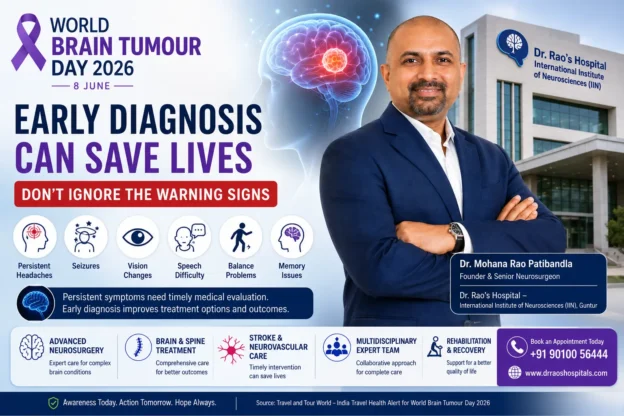
World Brain Tumour Day 2026: Early Diagnosis Can Save Lives
Every year, World Brain Tumour Day serves as a reminder that awareness, timely diagnosis, and access to expert medical care can make a significant difference in the lives of patients affected by brain tumours. In 2026, the message is particularly powerful: do not ignore persistent neurological symptoms, and do not delay seeking medical advice when warning signs appear.
A recent Travel and Tour World feature highlighted how World Brain Tumour Day 2026 has become an important public health awareness initiative in India. The article emphasized Dr. Mohana Rao Patibandla’s call for early diagnosis and urged patients, families, and travelers to take persistent neurological symptoms seriously rather than dismissing them as temporary health issues.
For many patients, symptoms such as headaches, dizziness, nausea, seizures, or vision changes are often attributed to stress, fatigue, travel, or lifestyle factors. However, persistent symptoms may sometimes indicate a more serious neurological condition requiring professional evaluation.
What Is World Brain Tumour Day?
World Brain Tumour Day is observed annually on June 8 to increase awareness about brain tumours, encourage early detection, support patients and caregivers, and promote access to quality neurological and neurosurgical care.
Brain tumours affect individuals of all ages, including children and adults. They can significantly impact neurological function, quality of life, and overall health. The goal of World Brain Tumour Day is to educate the public about symptoms, risk factors, diagnosis, treatment options, and the importance of seeking medical attention when symptoms persist.
The Travel and Tour World article emphasizes that awareness should not create fear. Instead, it should encourage individuals to recognize warning signs and seek timely medical evaluation. Early action often leads to better treatment planning and improved outcomes.
Understanding Brain Tumours
A brain tumour is an abnormal growth of cells within the brain or surrounding structures. Brain tumours may be benign (non-cancerous) or malignant (cancerous). Some originate in the brain itself, while others spread from cancers located elsewhere in the body.
The effects of a brain tumour depend on several factors:
- Tumour size
- Tumour location
- Rate of growth
- Tumour type
- Impact on surrounding brain structures
Because different regions of the brain control different functions, symptoms can vary significantly from one patient to another.
Why Early Diagnosis Matters
One of the most important messages associated with World Brain Tumour Day 2026 is the value of early diagnosis. According to the Travel and Tour World report, Dr. Mohana Rao Patibandla emphasized that persistent neurological symptoms should not be ignored and that timely medical evaluation can help patients access appropriate care sooner.
Early diagnosis does not guarantee a cure in every case. However, it can:
- Improve treatment planning
- Expand available treatment options
- Reduce delays in care
- Improve quality of life
- Support better decision-making for patients and families
- Facilitate timely referral to specialists
Many neurological conditions can mimic one another. Therefore, a proper diagnosis requires evaluation by qualified healthcare professionals using clinical examination and appropriate diagnostic tests.
Common Brain Tumour Symptoms
Brain tumour symptoms can vary depending on the tumour’s location and size. Some symptoms may develop gradually, while others appear suddenly.
Symptoms Patients Should Not Ignore
- Persistent headaches
- Seizures
- Vision problems
- Speech difficulties
- Balance problems
- Weakness in the arms or legs
- Numbness or tingling sensations
- Memory difficulties
- Personality or behavioral changes
- Persistent nausea or vomiting
- Excessive sleepiness
- Confusion or cognitive decline
The Travel and Tour World article specifically highlights recurring headaches, seizures, vision changes, speech difficulties, balance problems, weakness, memory issues, personality changes, and persistent nausea as warning signs that warrant medical attention.
Warning Signs That Require Immediate Medical Attention
Certain neurological symptoms require urgent medical evaluation because they may indicate serious neurological conditions.
Red Flag Symptoms
- A first-time seizure
- Sudden weakness on one side of the body
- Severe confusion
- Sudden vision loss
- Persistent vomiting with headache
- Sudden difficulty speaking
- Rapid changes in consciousness
According to the Travel and Tour World report, patients should not postpone medical evaluation simply because they are traveling, working, or managing other responsibilities. Timely assessment can be critical.
The Travel Health Perspective: Why Travelers Should Be Aware
One unique aspect of the World Brain Tumour Day 2026 discussion is its connection to travel health. The article points out that travelers frequently dismiss neurological symptoms as temporary discomfort associated with travel.
Examples include:
- Headaches attributed to travel stress
- Dizziness blamed on heat or fatigue
- Nausea mistaken for motion sickness
- Vision problems linked to lack of sleep
- Weakness assumed to be exhaustion
While these explanations may sometimes be correct, persistent or worsening symptoms should never be ignored. Travelers often delay care because they are away from home, uncertain about local healthcare facilities, or focused on completing their journey.
The article emphasizes that health awareness should travel with the patient. Recognizing warning signs early and seeking timely medical evaluation can help prevent dangerous delays.
Global Statistics on Brain Tumours
Brain tumours remain a significant global health concern. According to the World Health Organization and international cancer registries:
- Hundreds of thousands of new brain and central nervous system tumours are diagnosed globally each year.
- Brain tumours affect both children and adults.
- Early diagnosis improves access to treatment planning.
- Advanced imaging technologies have improved diagnostic accuracy.
- Multidisciplinary treatment approaches continue to improve patient outcomes.
Sources:
Expert Brain Tumour Care in Andhra Pradesh
Patients seeking specialized evaluation for brain tumours and other neurological conditions increasingly look for comprehensive neuroscience centers offering advanced diagnostic and treatment capabilities.
Learn more:
- Dr. Rao’s Hospital – International Institute of Neurosciences (IIN)
- Neurosurgery Department
- Neurology Services
- About Dr. Mohana Rao Patibandla
How Brain Tumours Are Diagnosed
Accurate diagnosis is the foundation of effective brain tumour treatment. While symptoms may raise suspicion, a definitive diagnosis requires a comprehensive neurological evaluation and advanced imaging studies.
The diagnostic process typically begins with a detailed medical history and neurological examination. Physicians assess symptoms, neurological function, cognitive abilities, vision, balance, coordination, muscle strength, and reflexes.
Common Diagnostic Tests for Brain Tumours
- Magnetic Resonance Imaging (MRI)
- Computed Tomography (CT Scan)
- Functional MRI (fMRI)
- MR Spectroscopy
- Positron Emission Tomography (PET)
- Neurological Examination
- Biopsy when required
Advanced imaging technologies allow physicians to evaluate tumour size, location, growth characteristics, and potential involvement of surrounding brain structures. Early diagnosis enables more effective treatment planning and helps patients understand available treatment options.
Treatment Options for Brain Tumours
Brain tumour treatment is highly individualized. The best treatment strategy depends on the tumour type, location, size, growth rate, patient’s age, neurological condition, and overall health status.
Modern treatment often involves a multidisciplinary team that may include neurosurgeons, neurologists, neuro-oncologists, radiation oncologists, neuroradiologists, rehabilitation specialists, and nursing professionals.
Surgical Treatment
Surgery remains one of the most important treatment options for many brain tumours. Advances in microsurgical techniques, neuronavigation systems, intraoperative imaging, and minimally invasive approaches have improved surgical precision and safety.
The goals of surgery may include:
- Removing the tumour completely when possible
- Reducing tumour size
- Relieving pressure within the skull
- Obtaining tissue for diagnosis
- Improving neurological function
Radiation Therapy
Radiation therapy uses carefully targeted radiation to destroy tumour cells while minimizing damage to surrounding healthy tissue. It may be used after surgery, as a primary treatment, or when surgery is not feasible.
Chemotherapy and Targeted Therapy
Certain brain tumours respond to chemotherapy or targeted medications. Treatment recommendations depend on tumour biology, molecular characteristics, and individual patient factors.
Advanced Treatment Technologies
- Microsurgical techniques
- Neuronavigation systems
- Endoscopic neurosurgery
- Intraoperative neuromonitoring
- Precision radiation therapy
- Molecular tumour profiling
- Advanced neuroimaging
The Importance of Rehabilitation and Long-Term Follow-Up
Treatment does not end after surgery or radiation therapy. Many patients benefit from rehabilitation programs designed to improve neurological function, mobility, speech, cognition, and quality of life.
Depending on individual needs, rehabilitation may include:
- Physical therapy
- Occupational therapy
- Speech and language therapy
- Cognitive rehabilitation
- Psychological support
- Nutritional counseling
Long-term follow-up is also important because some tumours require ongoing monitoring through periodic imaging and neurological evaluations.
Why Awareness Campaigns Like World Brain Tumour Day Matter
World Brain Tumour Day helps bridge the gap between medical knowledge and public awareness. Many patients delay seeking care because they are unaware of warning signs or assume symptoms are minor.
The Travel and Tour World feature highlights how educational initiatives can empower patients to recognize neurological symptoms early and seek timely evaluation. Public awareness campaigns also support caregivers, encourage research, and promote access to specialized care.
By improving awareness, healthcare organizations can help reduce delays in diagnosis and ensure more patients receive appropriate treatment when it is most effective.
Why Choose Dr. Rao’s Hospital for Brain Tumour Treatment?
Patients searching for brain tumour treatment in Guntur, the best neurologist in Guntur, or the best neurosurgeon in Guntur often seek comprehensive neuroscience centers capable of providing advanced diagnosis, treatment, and rehabilitation services.
Dr. Rao’s Hospital – International Institute of Neurosciences (IIN) provides specialized brain, spine, nerve, and neurovascular care supported by advanced technology and multidisciplinary expertise.
Useful Internal Links
- Dr. Rao’s Hospital Official Website
- Neurosurgery Department
- Neurology Services
- Spine Surgery Department
- Contact Dr. Rao’s Hospital
- About Dr. Mohana Rao Patibandla
Frequently Asked Questions (FAQ)
What are the early symptoms of a brain tumour?
Common symptoms include persistent headaches, seizures, vision changes, weakness, balance problems, memory difficulties, personality changes, and persistent nausea or vomiting.
Can headaches always indicate a brain tumour?
No. Most headaches are not caused by brain tumours. However, persistent or unusual headaches accompanied by neurological symptoms should be evaluated by a healthcare professional.
How is a brain tumour diagnosed?
Diagnosis typically involves neurological examination, MRI scans, CT scans, and sometimes biopsy procedures to determine tumour type and characteristics.
Can brain tumours be treated successfully?
Many brain tumours can be effectively managed using surgery, radiation therapy, chemotherapy, targeted therapy, or combinations of these approaches depending on the tumour type.
Why choose Dr. Rao’s Hospital for brain tumour treatment?
Dr. Rao’s Hospital – International Institute of Neurosciences (IIN) provides advanced neurosurgical care, modern technology, multidisciplinary expertise, and patient-centered treatment for complex neurological conditions.
Image SEO Recommendations
Conclusion
World Brain Tumour Day 2026 serves as an important reminder that awareness, education, and early diagnosis can significantly influence patient outcomes. While not every headache or neurological symptom indicates a brain tumour, persistent symptoms should never be ignored.
As highlighted in the Travel and Tour World report, recognizing warning signs early and seeking prompt medical evaluation can help patients access appropriate care when it matters most. Increased awareness empowers individuals, families, and communities to make informed healthcare decisions.
Advances in diagnostic imaging, neurosurgery, radiation therapy, and multidisciplinary care continue to improve outcomes for patients with brain tumours. Access to specialized neuroscience services closer to home further strengthens the ability of patients to receive timely treatment and long-term support.
Call to Action
If you or a loved one experiences persistent headaches, seizures, vision changes, weakness, balance problems, or other neurological symptoms, do not delay seeking professional medical advice.
If you are searching for the best neurologist in Guntur, the best neurosurgeon in Guntur, or expert brain tumour treatment in Guntur, visit
Dr. Rao’s Hospital – International Institute of Neurosciences (IIN).
Follow Dr. Rao’s Hospital
- Facebook: Facebook
- Instagram: Instagram
- YouTube: YouTube
- LinkedIn: LinkedIn
- X (Twitter): X
- Google Business: Google Business
- Google Maps: Google Maps
Keywords:
world brain tumour day 2026, brain tumour symptoms, brain tumour warning signs, brain tumour treatment in Guntur, best neurologist in Guntur, best neurosurgeon in Guntur, brain tumour diagnosis, brain surgery in Guntur, neurological symptoms, brain tumour awareness, Dr Mohana Rao Patibandla, advanced neurosurgery, neuroscience hospital Andhra Pradesh
