Tag Archives: trigeminal neuralgia treatment

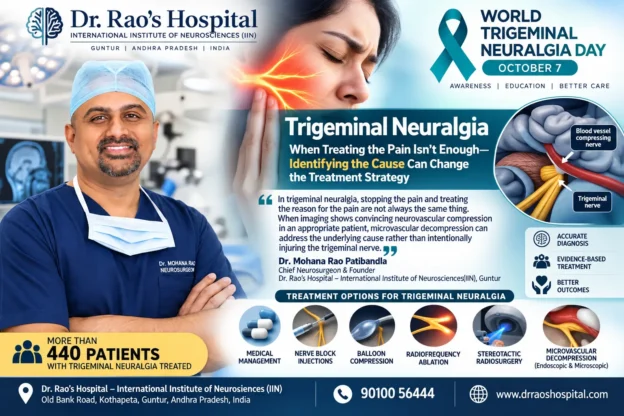
World Trigeminal Neuralgia Day infographic showing Dr. Mohana Rao Patibandla and treatment options for trigeminal neuralgia at Dr. Rao's Hospital in Guntur

Trigeminal Neuralgia: When Treating the Pain Isn’t Enough, Guntur Neurosurgeon Says

Trigeminal Neuralgia Treatment: Why Finding the Cause of Facial Pain Matters


Trigeminal neuralgia can cause sudden, severe facial pain that feels like an electric shock.
But for some patients, the most important question is not simply how to stop the pain—it is
whether an underlying cause can be identified and treated.


What Is Trigeminal Neuralgia?


Trigeminal neuralgia is a neurological condition characterized by recurrent attacks of
severe facial pain. Patients may describe the pain as electric shocks, stabbing sensations,
or lightning-like pain.


Everyday activities such as talking, chewing, brushing the teeth, touching the face, or even
exposure to a light breeze may trigger an attack.


Because the pain may occur around the jaw, cheek, or teeth, some patients initially consult
a dentist. When dental disease does not adequately explain the symptoms, a neurological
cause should be considered.


Trigeminal Neuralgia Does Not Have One Best Treatment for Everyone


One of the most important principles in treating trigeminal neuralgia is that the same
procedure is not necessarily appropriate for every patient.


Treatment should take into account the patient’s symptoms, neurological examination,
MRI findings, age, medical fitness, previous treatments, and willingness to accept the
risks associated with a particular procedure.


The goal is not simply to choose the procedure with the highest reported success rate.
The more useful question is:

Which treatment provides the best balance of durable pain control, preservation
of facial sensation, procedural risk, and the patient’s individual preferences?


Why MRI Matters in Trigeminal Neuralgia


Appropriate brain MRI is an important part of evaluating suspected trigeminal neuralgia.
Imaging can help exclude other causes and can provide information relevant to treatment
planning and surgical candidacy.


However, an MRI should not be interpreted in isolation. Simply seeing a blood vessel close
to the trigeminal nerve does not automatically establish that the vessel is responsible
for the patient’s pain.


The clinical symptoms and imaging findings need to tell a consistent story.


When a patient has clinical features consistent with classical trigeminal neuralgia and
MRI demonstrates a convincing neurovascular relationship, the treatment discussion may
change significantly.


What Is Neurovascular Compression?


In classical trigeminal neuralgia, a blood vessel may compress or contact the trigeminal
nerve and contribute to the characteristic attacks of facial pain.


When the clinical diagnosis and imaging support this mechanism, treatment may be directed
at the underlying neurovascular conflict rather than only interrupting pain transmission.


This distinction is particularly important when long-term pain control and preservation
of facial sensation are important goals.


What Is Microvascular Decompression (MVD)?


Microvascular decompression, commonly called MVD, is a surgical procedure designed to
address the underlying neurovascular conflict in appropriately selected patients.


Unlike procedures that intentionally injure or interrupt the trigeminal nerve to control
pain, MVD involves identifying the offending vascular structure and separating it from
the nerve, typically by placing protective material between them.


This makes MVD fundamentally different from procedures that intentionally interrupt
trigeminal nerve transmission.


The European Academy of Neurology guideline cited in the recent discussion recommends
microvascular decompression as first-line surgery for classical trigeminal neuralgia
when surgery is indicated.


Why MVD May Be Considered for Long-Term Pain Relief


The objective of treatment is not always simply immediate pain relief. For appropriately
selected patients, durable pain control while preserving facial sensation may be an
important consideration.


Comparative evidence cited in the EIN Presswire release reports higher short- and
long-term pain freedom with MVD compared with stereotactic radiosurgery in selected
patients, together with lower rates of facial numbness and dysesthesia, although MVD
carries greater postoperative procedural risk.


One prospective long-term comparison cited in the release reported pain-free rates
after MVD of 83% at five years compared with 47% after stereotactic radiosurgery,
with a longer median time to pain recurrence following MVD.


These findings do not mean that MVD is the right procedure for every patient. Instead,
they reinforce the importance of matching the treatment to the patient’s diagnosis,
anatomy, health, and treatment goals.


Is Microvascular Decompression Suitable for Everyone?


No. Not every person with trigeminal neuralgia is an appropriate candidate for MVD.


An older patient with significant medical comorbidities, a patient who does not want
intracranial surgery, or a patient without convincing neurovascular compression may be
better served by a less invasive treatment approach.


The decision should therefore be individualized rather than based solely on the name
of the procedure.


Other Treatment Options for Trigeminal Neuralgia


Depending on the patient’s diagnosis and individual circumstances, treatment options
may include:


  • Medical treatment for patients who achieve adequate pain control
  • Nerve-block and injection-based treatment in selected circumstances
  • Radiofrequency ablation through the foramen ovale
  • Balloon compression or rhizotomy
  • Stereotactic radiosurgery
  • Microvascular decompression
  • Endoscopic-assisted or endoscopic microvascular decompression in appropriately selected cases


The European Academy of Neurology guideline cited in the release recommends surgery when
pain is inadequately controlled with medication or medication is poorly tolerated, with
the choice of procedure guided by the type of trigeminal neuralgia and individual
circumstances.


More Than 440 Trigeminal Neuralgia Patients: Experience Across the Treatment Spectrum


Dr. Rao’s Hospital – International Institute of Neurosciences (IIN) reports treatment
experience involving more than 440 patients with trigeminal neuralgia.


The institutional procedural experience reported in the EIN Presswire release includes
approximately:


  • 213 microvascular decompression procedures
  • 114 endoscopic MVD procedures
  • 76 stereotactic radiosurgery procedures
  • 35 balloon compression/rhizotomy procedures
  • 120 radiofrequency ablation procedures


These figures represent institutional procedural experience rather than unique patient
counts. An individual patient may undergo more than one procedure during the course of
treatment.


This breadth of experience highlights an important principle: having multiple treatment
options is valuable only when those options are used selectively and appropriately.


When Recurrent Trigeminal Neuralgia Should Prompt Reassessment


Repeated procedures can provide meaningful pain relief and may remain appropriate for
patients who are not candidates for MVD or who prefer a less invasive approach.


However, when pain repeatedly returns, reassessment may be appropriate rather than
automatically repeating the same procedure.


Recurrent pain should prompt consideration of whether the diagnosis remains consistent
with classical trigeminal neuralgia, whether there is convincing neurovascular conflict,
what previous procedures have changed, and whether the treatment strategy should be
modified.


Five Questions to Ask Before Trigeminal Neuralgia Treatment


Patients considering a procedure for trigeminal neuralgia may benefit from discussing
the following questions with their treating specialist:

  1. Does my clinical picture fit classical trigeminal neuralgia?
  2. Does my MRI show convincing neurovascular compression of the trigeminal nerve?
  3. If MVD is being considered, what is my expected chance of durable pain relief and what are the operative risks?
  4. If a less invasive procedure is recommended, how quickly should I expect pain relief, how durable is it likely to be, and what is the risk of facial numbness?
  5. If the pain returns, what will the next treatment option be?


Trigeminal Neuralgia: Treat the Cause When the Cause Can Be Identified


Trigeminal neuralgia is often described simply as severe facial pain. For some patients,
however, there may be an identifiable anatomical problem behind that pain.


When the clinical diagnosis, imaging, and patient profile point toward convincing
neurovascular compression, it may be appropriate to discuss whether the underlying
cause can be treated rather than repeatedly treating only the symptom.


This does not mean that every patient with trigeminal neuralgia requires surgery.
Rather, when classical trigeminal neuralgia, convincing neurovascular compression,
and appropriate surgical candidacy come together, microvascular decompression may
deserve serious consideration because it can address the underlying neurovascular
conflict while aiming to preserve facial sensation.


Why Treatment Should Be Individualized


There is no universal “best procedure” for every patient with trigeminal neuralgia.
The most appropriate treatment depends on the mechanism of pain, MRI findings,
overall health, previous treatment, age, procedural risks, and patient preferences.


The goal should be a carefully considered treatment strategy that balances pain relief,
durability, preservation of sensation, procedural risk, and the patient’s individual
circumstances.


If facial pain continues despite treatment, a specialist reassessment can help determine
whether the diagnosis, imaging interpretation, or treatment strategy needs to be revisited.


Dr. Mohana Rao Patibandla – Neurosurgeon in Guntur


Dr. Mohana Rao Patibandla is the Founder and Chief Neurosurgeon of
Dr. Rao’s Hospital – International Institute of Neurosciences (IIN), Guntur, Andhra Pradesh.


His clinical practice includes minimally invasive neurosurgery, skull base surgery,
pediatric neurosurgery, cerebrovascular and endovascular neurosurgery, neuro-oncology,
and stereotactic radiosurgery.


Dr. Rao’s Hospital is a dedicated neurosciences centre providing neurosurgical and
neurological care with infrastructure that includes intraoperative neurophysiological
monitoring, neuronavigation, a hybrid operating theatre, and a biplane catheterisation
laboratory.


Trigeminal Neuralgia Treatment in Guntur

If you or a family member is experiencing recurrent electric-shock-like facial pain,
pain triggered by chewing or touching the face, or persistent facial pain despite
previous treatment, specialist neurological evaluation may help determine the underlying
cause and appropriate treatment options.

Dr. Rao’s Hospital – International Institute of Neurosciences (IIN)
Old Bank Road, Kothapeta, Guntur, Andhra Pradesh, India
Phone: +91 90100 56444
Email: info@drraoshospitals.com


Visit Dr. Rao’s Hospital

YouTube

Facebook  

Instagram 

Google GMB 

LinkedIn 

X / Twitter

Dr Mohana Rao Patibandla Wiki

Dr Mohana Rao Patibandla


Medical Disclaimer


This article is intended for general educational and informational purposes only.
It does not replace an individual medical consultation, diagnosis, or treatment plan.
Treatment decisions for trigeminal neuralgia should be made after appropriate clinical
evaluation, imaging review, and discussion of the potential benefits and risks with a
qualified neurosurgeon or neurologist.


Dr. Mohana Rao Patibandla presenting on Percutaneous Endoscopic Lumbar Discectomy (PELD) at NEUROENDOCON 2026 conference in Jaipur

Neuroendoscopy Revolution: Insights from NEUROENDOCON 2026

Neuroendoscopy Revolution: Insights from NEUROENDOCON 2026

The field of neurosurgery is undergoing a profound transformation—driven by precision, minimal invasiveness, and advanced technology. Neuroendoscopy is at the forefront of this revolution, redefining how complex brain and spine disorders are treated.
 

This shift was prominently showcased at NEUROENDOCON 2026, the 12th Annual Conference of the Neuroendoscopy Society of India held in Jaipur. The event brought together leading neurosurgeons, innovators, and researchers to discuss cutting-edge advancements in minimally invasive neurosurgery.

Among the distinguished faculty was Dr. Mohana Rao Patibandla, Founder of Dr. Rao’s Hospital, who shared key insights into modern neurosurgical techniques.

Learn more:
https://drraoshospitals.com


NEUROENDOCON 2026: A Platform for Innovation

The conference served as a hub for innovation, featuring:

  • Cadaveric hands-on workshops
  • Live surgical demonstrations
  • Case-based discussions
  • Expert panel sessions

The central theme was clear: Minimally invasive neurosurgery is the future.


The Rise of Neuroendoscopy

Traditional neurosurgery often involved large incisions and prolonged recovery. Neuroendoscopy has transformed this approach by offering:

  • Smaller incisions
  • Reduced tissue damage
  • Enhanced visualization
  • Faster recovery
  • Improved surgical precision

This aligns with modern neurosurgical philosophy—precision and individualized care.


Transforming Spine Surgery: PELD

One of the key highlights of Dr. Rao’s presentation was Percutaneous Endoscopic Lumbar Discectomy (PELD).

This minimally invasive spine surgery offers:

  • Tiny incision
  • Minimal muscle damage
  • Faster recovery
  • Early mobilization

Dr. Rao emphasized that patient selection and surgical planning are critical for success.


Trigeminal Neuralgia: Advanced Endoscopic Solutions

Trigeminal neuralgia, one of the most painful neurological conditions, can now be treated more effectively using endoscopic techniques.

Endoscopic-assisted microvascular decompression (MVD) allows:

  • Better visualization of nerve compression
  • Improved surgical precision
  • Reduced recurrence rates

Endoscopic Pituitary Surgery

Endoscopic transnasal surgery for pituitary tumors represents a major advancement in skull base surgery.

  • No external scars
  • Enhanced visualization
  • Shorter hospital stay
  • Better outcomes

Modern techniques include neuronavigation and high-definition imaging systems.


Technology Driving Neurosurgery

NEUROENDOCON 2026 highlighted the role of technology in neurosurgery:

  • Neuronavigation systems
  • Intraoperative imaging
  • High-definition endoscopy
  • Biplane cath labs

These innovations significantly improve surgical safety and outcomes.


Dr. Rao’s Hospital: A Center of Excellence

Dr. Rao’s Hospital in Guntur, Andhra Pradesh, is a leading center for:

  • Neurosurgery
  • Neurology
  • Spine surgery
  • Neuro-oncology
  • Endovascular procedures

The hospital is equipped with advanced infrastructure and follows globally accepted treatment protocols.

Visit:
https://drraoshospitals.com


The Future of Neurosurgery

The future is shifting toward:

  • Minimally invasive procedures
  • Personalized treatment
  • Function preservation
  • Technology-driven precision

Patients can expect faster recovery, less pain, and better outcomes.


Conclusion

NEUROENDOCON 2026 reinforced that neurosurgery is entering a new era—one defined by innovation, precision, and patient-centric care.

With experts like Dr. Mohana Rao Patibandla and institutions like Dr. Rao’s Hospital leading the way, patients now have access to world-class neurosurgical care in India.


Contact Dr. Rao’s Hospital

📞 Phone: +91 90100 56444
📧 Email: info@drraoshospitals.com
🌐 Website: https://drraoshospitals.com


Frequently Asked Questions (FAQs)

What is neuroendoscopy?

Neuroendoscopy is a minimally invasive surgical technique that uses a small camera (endoscope) to treat brain and spine conditions with high precision and minimal tissue damage.

What is PELD surgery?

Percutaneous Endoscopic Lumbar Discectomy (PELD) is a minimally invasive spine surgery used to treat slipped discs with faster recovery and less pain.

Is endoscopic brain surgery safe?

Yes, endoscopic brain surgery is considered safe when performed by experienced neurosurgeons, offering reduced complications and faster healing.

What conditions can be treated with neuroendoscopy?

Neuroendoscopy is used for conditions like pituitary tumors, hydrocephalus, trigeminal neuralgia, and spinal disc herniations.

Where can I get advanced neuroendoscopy treatment in India?

Dr. Rao’s Hospital in Guntur offers advanced neuroendoscopy and minimally invasive neurosurgery with state-of-the-art technology.

The best neurosurgery and spine surgery hospital in India

Best Neurological & Spine Care at Dr. Rao’s Hospital, India

Best Neurological & Spine Care at Dr. Rao’s Hospital, India


Neuro Hospital

When it comes to comprehensive neurological care, choosing the right neuro hospital is crucial. A dedicated neuro hospital specializes in diagnosing and treating conditions related to the brain, spine, and nervous system. These hospitals are equipped with state-of-the-art technology, skilled neurosurgeons, and specialized healthcare professionals to handle the complexities of neurological conditions. Dr. Rao’s Hospital in Guntur is a leading neuro hospital in India, providing world-class care with a patient-centric approach. According to The Times of India coverage.

Nerve Specialist Doctor Near Me

Finding a qualified nerve specialist doctor near you is essential for anyone experiencing nerve-related issues such as neuropathy, nerve compression, or other neurological disorders. A nerve specialist is trained to identify the root cause of nerve pain and offer effective treatment options, whether medication, physical therapy, or surgery. At Dr. Rao’s Hospital, patients can access some of the best nerve specialists dedicated to providing accurate diagnoses and tailored treatment plans.

Neuroscience Hospital

A neuroscience hospital is a specialized facility that diagnoses, treats, and researches neurological disorders. These hospitals bring together a multidisciplinary team of experts, including neurologists, neurosurgeons, neuroradiologists, and rehabilitation specialists. Dr. Rao’s Hospital in Guntur is one of India’s premier neuroscience hospitals, offering cutting-edge treatments for various neurological conditions, from epilepsy to brain tumors. The hospital’s commitment to excellence has made it a top choice for patients seeking the best neurological care.

Neuro Spine Center

The spine is a critical part of the nervous system, and issues related to the spine can lead to severe neurological complications. A neuro spine center specializes in the treatment of spinal disorders that affect the nervous system, such as herniated discs, spinal stenosis, and spinal cord injuries. Dr. Rao’s Hospital’s Neuro Spine Center is renowned for its advanced surgical techniques and minimally invasive procedures, ensuring the best possible outcomes for patients. In a recent India today article.

Top Neurologists in the US

The United States is home to some of the top neurologists in the world, known for their contributions to medical research and patient care. However, you don’t have to travel to the US to receive world-class neurological care. Dr. Rao’s Hospital in Guntur boasts a team of highly skilled neurologists who have trained and worked alongside the top neurologists in the US. These experts bring their global experience to India, offering the same level of care you’d expect from a leading US medical institution.

Best Spine Dr

Spine health is vital to overall well-being, and finding the best spine doctor is critical to effectively addressing spinal issues. The best spine doctors stay updated with the latest advancements in spinal surgery and have a proven track record of successful outcomes. Dr. Rao at Dr. Rao’s Hospital is considered one of the best spine doctors in India, specializing in complex spinal surgeries and minimally invasive techniques that minimize recovery time and maximize patient comfort. According to mid-day

Neurosurgery Procedures

Neurosurgery procedures are among the most complex and delicate surgeries performed in the medical field. These procedures require precision, expertise, and the latest technology to ensure the best outcomes. Dr. Rao’s Hospital offers a wide range of neurosurgery procedures, including brain tumor removal, spinal fusion, deep brain stimulation, and more. The hospital’s state-of-the-art operating rooms and experienced surgical team make it a leader in neurosurgical care.

Best Doctor for Trigeminal Neuralgia

Trigeminal neuralgia is a severe, chronic pain condition affecting the facial trigeminal nerve. It is often described as one of the most painful conditions a person can experience. Finding the best doctor for trigeminal neuralgia is crucial for effective management and relief. Dr. Rao at Dr. Rao’s Hospital is a leading expert in treating trigeminal neuralgia, offering surgical and non-surgical options tailored to each patient’s needs. His compassionate approach and extensive experience make him the top choice for patients suffering from this debilitating condition.

Brain & Spine Clinic

A specialized brain & spine clinic offers focused care for conditions affecting the brain and spine. These clinics are equipped with the latest diagnostic tools and treatment options, providing patients with comprehensive care in one location. Dr. Rao’s Hospital features a dedicated Brain & Spine Clinic, where patients receive personalized treatment plans that address their unique needs. The clinic’s multidisciplinary team works together to ensure the best possible outcomes, whether through surgery, rehabilitation, or ongoing medical management.

Best Neurological Hospital in India

India is home to some of the world’s best neurological hospitals, and Dr. Rao’s Hospital in Guntur is at the forefront. As the best neurological hospital in India, Dr. Rao’s Hospital offers a full spectrum of services, from advanced neurosurgery to cutting-edge neurological research. The hospital’s commitment to quality care, patient safety, and innovative treatments has earned it a reputation as a top destination for neurological patients from around the globe.

Affordable Medical Tourism at Dr. Rao’s Hospital

Medical tourism is an increasingly popular option for patients seeking high-quality medical care at affordable prices. India, specifically Dr. Rao’s Hospital, has become a leading destination for medical tourists, particularly those requiring neurosurgery and spinal care. Dr. Rao’s Hospital offers affordable medical tourism packages that include treatment, accommodation, and support services, ensuring a stress-free experience for international patients. The hospital’s team assists with everything from travel arrangements to post-operative care, making it a trusted choice for patients worldwide.


You can expect top-tier neurological and spine care from one of India’s most respected neurosurgeons at Dr. Rao’s Hospital in Guntur. Whether you need complex neurosurgery or seek a specialist for a specific neurological condition, Dr. Rao’s Hospital provides expert care focusing on patient satisfaction and positive outcomes. With a reputation for excellence and a commitment to affordability, Dr. Rao’s Hospital is the ideal choice for both local and international patients seeking the best in neurological and spinal care.

Dr. Rao’s Contact Information: