

Stereotactic Radiosurgery in Guntur: Precision Neurosurgery Without Traditional Surgery
The future of neurosurgery is increasingly defined by precision, safety, and minimally invasive treatment strategies. Among the most transformative innovations in modern neuroscience is Stereotactic Radiosurgery (SRS)—a technology that allows neurosurgeons to treat complex brain disorders without making a single incision.
This topic was recently highlighted by Dr. Mohana Rao Patibandla, Founder and Chief Neurosurgeon of Dr. Rao’s Hospital – International Institute of Neurosciences (IIN), Guntur, during his invited faculty lecture titled “Stereotactic Radiosurgery: What Every Beginner Should Know” at the 5th Annual Young Neurosurgeons Forum Conference (YNFCON 2026) held at The Westin Mumbai Powai Lake.
Addressing young neurosurgeons from across India, Dr. Patibandla shared practical insights into the principles, applications, patient selection, and future of stereotactic radiosurgery, drawing upon his experience of approximately 3,000 stereotactic radiosurgical procedures and extensive international fellowship training in neuro-oncology, skull base surgery, cerebrovascular neurosurgery, endovascular neurosurgery, and functional neurosurgery.
As one of the leading centers for advanced neurosciences care in India, Dr. Rao’s Hospital – International Institute of Neurosciences (IIN) continues to bring world-class neurosurgical innovations to patients across Andhra Pradesh, Telangana, India, and international destinations.
What Is Stereotactic Radiosurgery?
Despite its name, stereotactic radiosurgery is not surgery in the conventional sense.
There are:
- No scalp incisions
- No craniotomy
- No surgical scars
- No blood loss
- Minimal recovery time
Instead, SRS uses highly focused beams of radiation delivered with submillimeter precision to target abnormal tissue while minimizing radiation exposure to surrounding healthy brain structures.
According to the National Cancer Institute, stereotactic radiosurgery is an advanced form of radiation therapy used to treat tumors and abnormalities in the brain and nervous system.
The principle is simple:
Multiple low-dose radiation beams converge on a precisely identified target. While each beam individually causes minimal tissue exposure, the cumulative dose at the target is powerful enough to stop tumor growth, damage abnormal blood vessels, or interrupt pathological nerve activity.
This is why stereotactic radiosurgery is often described as:
“Surgery without a scalpel.”
Why Dr. Mohana Rao Patibandla Presented This Topic at YNFCON 2026
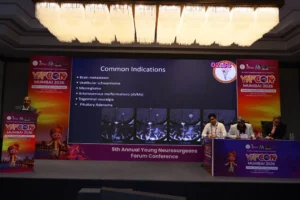
Dr. Mohana Rao Patibandla presents “Stereotactic Radiosurgery: What Every Beginner Should Know” during YNFCON 2026 in Mumbai, highlighting the major indications and applications of stereotactic radiosurgery in modern neurosurgical practice.
The Young Neurosurgeons Forum Conference (YNFCON) is one of India’s premier educational platforms for emerging neurosurgeons.
As neurosurgery evolves toward precision-based treatments, young specialists must understand not only traditional microsurgery but also:
- Radiosurgery
- Endovascular therapy
- Neuronavigation
- Neuroendoscopy
- Functional neurosurgery
- Image-guided interventions
During his lecture, Dr. Patibandla emphasized that future neurosurgeons must be capable of selecting the most appropriate treatment rather than simply performing surgery.
A patient with a deep-seated lesion may benefit more from radiosurgery than open surgery.
Similarly, a patient with trigeminal neuralgia may achieve excellent pain relief without requiring a major cranial procedure.
The central message of the lecture was clear:
Good neurosurgeons know how to operate. Great neurosurgeons know when not to operate.
Why Stereotactic Radiosurgery Has Revolutionized Neurosurgery
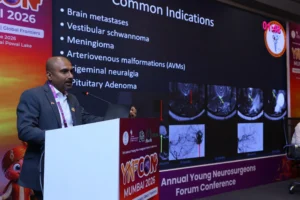
Dr. Mohana Rao Patibandla discussing brain metastases, AVMs, vestibular schwannomas, meningiomas, trigeminal neuralgia, and pituitary adenomas as key indications for stereotactic radiosurgery.
Over the past several decades, stereotactic radiosurgery has fundamentally changed the treatment of many neurological conditions.
Traditionally, lesions located deep within the brain often required major surgery associated with significant risks.
Today, carefully selected patients can receive treatment with:
- Minimal discomfort
- Outpatient or short-stay procedures
- Rapid return to normal activities
- Excellent long-term outcomes
This shift represents one of the most important advancements in modern minimally invasive neurosurgery.
At Dr. Rao’s Hospital, treatment recommendations are based on evidence, imaging findings, lesion characteristics, patient health status, and long-term outcomes rather than a one-size-fits-all approach.
Learn more about advanced neurosurgical services: https://drraoshospitals.com/neurosurgery/
Conditions Treated with Stereotactic Radiosurgery
1. Brain Metastases
Brain metastases represent one of the most common indications for stereotactic radiosurgery worldwide.
Cancer cells from:
- Lung cancer
- Breast cancer
- Kidney cancer
- Melanoma
- Gastrointestinal cancers
can spread to the brain.
Historically, whole-brain radiation therapy was often used.
Today, stereotactic radiosurgery allows physicians to precisely target metastatic lesions while preserving cognitive function and reducing unnecessary radiation exposure.
For many patients, this approach provides:
- Excellent local tumor control
- Improved quality of life
- Reduced neurocognitive side effects
2. Vestibular Schwannoma (Acoustic Neuroma)
Vestibular schwannomas are benign tumors arising from the vestibular nerve.
Symptoms may include:
- Hearing loss
- Tinnitus
- Dizziness
- Balance problems
- Facial numbness
Stereotactic radiosurgery is particularly valuable for:
- Small tumors
- Medium-sized tumors
- Elderly patients
- Patients unfit for surgery
- Residual tumors following microsurgery
Long-term tumor control rates exceed 90% in many published studies.
Learn more: https://drraoshospitals.com/skull-base-surgery/
3. Meningiomas
Meningiomas are among the most common primary brain tumors.
While many can be surgically removed, some tumors are located near critical structures such as:
- Optic nerves
- Cavernous sinus
- Brainstem
- Cranial nerves
For these patients, stereotactic radiosurgery offers an excellent treatment option.
It is commonly used for:
- Small meningiomas
- Recurrent tumors
- Residual disease after surgery
4. Arteriovenous Malformations (AVMs)
AVMs are abnormal connections between arteries and veins.
These lesions carry the risk of:
- Brain hemorrhage
- Seizures
- Neurological deficits
- Headaches
While microsurgery remains the gold standard for many AVMs, radiosurgery is highly effective for:
- Deep AVMs
- Eloquent brain AVMs
- Small to moderate-sized lesions
The radiation gradually causes obliteration of abnormal vessels over months to years.
Patients with vascular disorders may also benefit from: https://drraoshospitals.com/endovascular-neurosurgery/
5. Trigeminal Neuralgia
Often called the “suicide disease” because of its severe pain, trigeminal neuralgia causes sudden electric shock-like facial pain.
When medications fail, stereotactic radiosurgery can provide significant pain relief by targeting the trigeminal nerve root.
Advantages include:
- No incision
- Outpatient treatment
- Minimal recovery
- High patient satisfaction
6. Pituitary Adenomas
Pituitary tumors may require surgery, medication, radiosurgery, or a combination of treatments.
SRS is particularly useful for:
- Residual tumor
- Recurrent tumor
- Hormone-secreting adenomas
Learn more:
https://drraoshospitals.com/pituitary-tumor-surgery/
How Does Stereotactic Radiosurgery Work?

The answer lies in precision.
Multiple radiation beams converge on the target.
This combination of precision and safety makes stereotactic radiosurgery one of the most important advances in modern neuroscience.
One of the most common questions patients ask is:
The truth is that all three technologies are designed to achieve the same goal: delivering highly precise radiation to a target while minimizing exposure to surrounding healthy tissue.
Gamma Knife is considered one of the most established radiosurgery systems for intracranial lesions.
- Exceptional accuracy
- Extensive long-term clinical data
- Excellent outcomes for brain tumors and AVMs
- Proven effectiveness in trigeminal neuralgia
CyberKnife utilizes a robotic arm and advanced image-guidance systems.
- Frameless treatment
- Brain and spine applications
- Real-time tracking
- Flexible treatment delivery
Modern Linear Accelerator (LINAC) systems are widely used worldwide.
- Brain and body treatment capability
- Fractionated stereotactic radiotherapy
- Versatility
- Excellent precision
The key message is simple:
During his YNFCON 2026 lecture, Dr. Mohana Rao Patibandla emphasized that patient selection is the single most important determinant of radiosurgical success.
Is the lesion well-defined?
Is the lesion an appropriate size?
Are critical structures nearby?
Is radiosurgery the best option?
- Microsurgery
- Endovascular treatment
- Observation
- Combination therapy
Although stereotactic radiosurgery is considered very safe, no treatment is completely risk-free.
Radiation Edema
Radiation Necrosis
Cranial Nerve Dysfunction
Temporary Neurological Symptoms
Fortunately, modern treatment planning significantly reduces these risks.
Patients from Andhra Pradesh, Telangana, Odisha, Tamil Nadu, Karnataka, and international locations seek consultation at Dr. Rao’s Hospital because of its commitment to advanced neurosciences care.
International Fellowship Training
- Neuro-oncology
- Pediatric neurosurgery
- Skull base surgery
- Endovascular neurosurgery
- Functional neurosurgery
- Stereotactic radiosurgery
- Cerebrovascular surgery
Approximate experience includes:
Comprehensive Neurosciences Care
- Neurosurgery
- Neurology
- Neuro-oncology
- Endovascular therapy
- Neurocritical care
- Neurorehabilitation
Dr. Rao’s Hospital – International Institute of Neurosciences
Frequently Asked Questions About Stereotactic Radiosurgery
Stereotactic radiosurgery is a non-invasive treatment that uses highly focused radiation beams to treat tumors, vascular abnormalities, and neurological disorders.
No. There are no incisions or surgical cuts. The term “surgery” refers to the precision of the treatment.
Most procedures are completed within a few hours.
Many patients can return home the same day.
No. Most patients experience minimal discomfort.
It can control or eliminate many tumors depending on the diagnosis, size, and location.
Yes. Radiosurgery is a well-established treatment option for selected AVMs.
Yes. Stereotactic radiosurgery is an effective minimally invasive treatment option.
Most patients resume normal activities within one or two days.
Patients with well-defined lesions that can be safely targeted while preserving surrounding healthy tissue.
Dr. Mohana Rao Patibandla’s Message to Young Neurosurgeons
“The future of neurosurgery is not choosing between surgery and radiosurgery. It is understanding when each treatment provides the best outcome for the patient.”
- Microsurgery
- Radiosurgery
- Endovascular treatment
- Neuronavigation
- Minimally invasive techniques
The next decade will likely see significant advancements in:
According to the National Institute of Neurological Disorders and Stroke (NINDS), precision medicine will continue to transform the treatment of neurological disorders.
If you or a loved one has been diagnosed with:
a comprehensive evaluation can help determine whether stereotactic radiosurgery is the right treatment option.
 12-19-67, Old Bank Road, Kothapet, Guntur, Andhra Pradesh, India


Follow Dr. Mohana Rao Patibandla
X (Twitter):
https://x.com/MohanaRaoPatib
Instagram:
https://www.instagram.com/dr_mohana_rao/
Google Maps:
https://g.page/r/CSzUiYw6Fj7IEBE
Conclusion
Through his invited lecture at YNFCON 2026 Mumbai, Dr. Mohana Rao Patibandla highlighted the growing importance of stereotactic radiosurgery and the need for future neurosurgeons to understand its principles, indications, and applications.
External Links for the Blog
- National Cancer Institute (NCI) – Stereotactic Radiosurgery
- National Institute of Neurological Disorders and Stroke (NINDS)
- Congress of Neurological Surgeons (CNS)
- American Association of Neurological Surgeons (AANS)
- National Comprehensive Cancer Network (NCCN)
- International Stereotactic Radiosurgery Society (ISRS)
- World Federation of Neurosurgical Societies (WFNS)
- PubMed Medical Literature Database
Recommended Internal Links for Dr. Rao’s Hospital Website
- Dr. Rao’s Hospital – International Institute of Neurosciences
- Neurosurgery Services
- Brain Tumor Treatment
- Skull Base Surgery
- Endovascular Neurosurgery
- Pituitary Tumor Surgery
- Minimally Invasive Spine Surgery
- Neurology Services
Call to Action
If you or your loved one has been diagnosed with a brain tumor, meningioma, vestibular schwannoma, AVM, trigeminal neuralgia, pituitary adenoma, or metastatic brain disease, early expert evaluation can help determine whether stereotactic radiosurgery is the most appropriate treatment option.
Dr. Rao’s Hospital – International Institute of Neurosciences (IIN), Guntur, Andhra Pradesh
Follow Dr. Mohana Rao Patibandla
 LinkedIn:
Dr. Mohana Rao Patibandla LinkedIn
 Facebook:
Dr. Rao’s Hospital Facebook
 YouTube:
Dr. Mohana Rao Patibandla YouTube Channel