World Alzheimer’s Month 2026: Understanding Memory Disorders, Early Diagnosis, and the Importance of Brain Health
Dr. Mohana Rao Patibandla highlights why recognizing early signs of memory disorders and seeking timely neurological evaluation can improve quality of life for patients and families.
GUNTUR, Andhra Pradesh, India — September 2026 — As the world observes World Alzheimer’s Month throughout September, Dr. Mohana Rao Patibandla, Founder, Chairman, and Chief Neurosurgeon of Dr. Rao’s Hospital – International Institute of Neurosciences (IIN), Guntur, is encouraging individuals and families to recognize the early signs of memory disorders, understand the difference between normal aging and dementia, and seek timely neurological evaluation.
World Alzheimer’s Month is a global awareness campaign dedicated to improving understanding of Alzheimer’s disease and other forms of dementia, reducing stigma, and promoting early diagnosis and supportive care. Millions of families worldwide are affected by memory disorders, making awareness, education, and timely medical intervention increasingly important.
Why World Alzheimer’s Month Matters
Alzheimer’s disease is the most common cause of dementia, a condition that affects memory, thinking, behavior, and the ability to perform everyday activities. While aging is the strongest known risk factor, Alzheimer’s disease is not a normal part of aging.
According to global health estimates, the number of people living with dementia continues to rise as populations age, creating significant emotional, social, and healthcare challenges for families and communities.
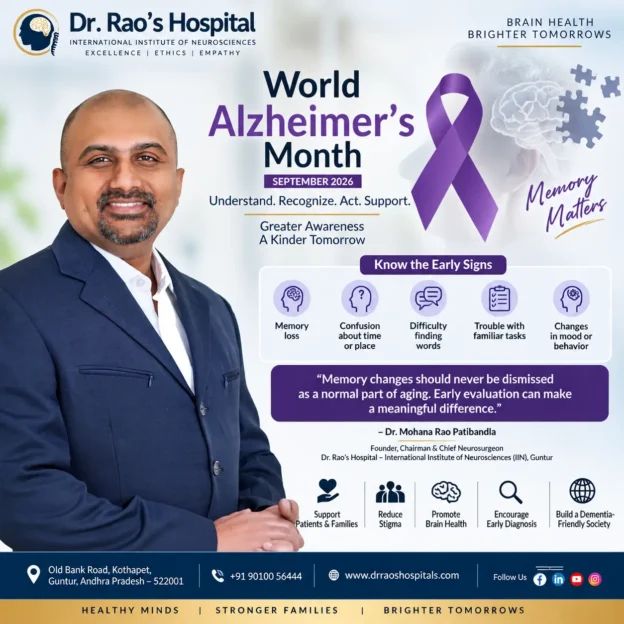
“Memory changes should never be dismissed simply as growing older,” said Dr. Mohana Rao Patibandla. “Persistent memory loss, difficulty performing familiar tasks, changes in judgment, or confusion about time and place deserve a neurological evaluation. Early diagnosis helps patients and families understand the condition, begin appropriate treatment, and plan supportive care.”
Understanding Alzheimer’s Disease and Memory Disorders
Memory disorders include a broad range of neurological conditions that affect cognitive function. While occasional forgetfulness may occur with healthy aging, progressive memory loss may indicate an underlying neurological disorder.
Alzheimer’s disease gradually damages brain cells involved in memory, learning, language, and reasoning. Over time, symptoms may become more noticeable and interfere with daily life.
Common symptoms include:
- Frequently forgetting recently learned information.
- Repeating questions or conversations.
- Difficulty finding words during conversations.
- Misplacing items and being unable to retrace steps.
- Confusion about dates, time, or familiar places.
- Changes in mood, personality, or behavior.
- Difficulty planning or solving routine problems.
Not every memory complaint is Alzheimer’s disease. Some conditions, including vitamin deficiencies, thyroid disorders, sleep disorders, depression, medication effects, and other neurological diseases, can also affect memory and may be treatable.
The Importance of Early Diagnosis
Early diagnosis is one of the most important messages of World Alzheimer’s Month.
A neurological assessment can help determine whether memory symptoms are related to Alzheimer’s disease, another type of dementia, or a potentially reversible condition.
Early evaluation may include:
- Detailed medical and neurological history.
- Cognitive and memory assessments.
- Physical and neurological examination.
- Brain imaging when clinically indicated.
- Laboratory investigations to identify reversible causes of memory impairment.
An accurate diagnosis allows patients and caregivers to understand available treatment options, lifestyle interventions, rehabilitation strategies, and long-term care planning.
Brain Health Across Every Stage of Life
Maintaining brain health is important not only in older adults but throughout adulthood. Research suggests that several lifestyle measures may support cognitive health and reduce the risk of cognitive decline.
Dr. Mohana Rao Patibandla recommends:
- Regular physical activity.
- Control of blood pressure, diabetes, and cholesterol.
- A balanced diet rich in fruits, vegetables, and healthy fats.
- Quality sleep and treatment of sleep disorders.
- Mental stimulation through reading, learning, and social engagement.
- Avoiding tobacco and excessive alcohol consumption.
- Regular health check-ups for vascular risk factors.
These measures support overall brain health and may help reduce the risk of stroke and vascular cognitive impairment in addition to promoting healthy aging.
Supporting Families Living with Dementia
Alzheimer’s disease affects not only patients but also families and caregivers. Caring for someone with dementia often requires emotional support, education, patience, and coordinated medical care.
Families are encouraged to seek medical guidance early, learn about disease progression, and create a safe and supportive environment that helps preserve independence for as long as possible.
“Compassionate care is just as important as clinical care,” added Dr. Mohana Rao Patibandla. “Supporting caregivers, educating families, and addressing behavioral and cognitive symptoms are essential parts of dementia care.”
When Should Someone See a Neurologist?
Individuals should consider neurological evaluation if memory changes:
- Persist for several months.
- Interfere with work or daily activities.
- Are noticed by family members or caregivers.
- Are accompanied by personality or behavioral changes.
- Occur alongside language, balance, or movement problems.
Timely evaluation helps identify the underlying cause and ensures appropriate management.
Raising Awareness During World Alzheimer’s Month
World Alzheimer’s Month serves as a reminder that awareness can lead to earlier recognition, better access to care, and reduced stigma surrounding dementia and memory disorders.
Healthcare professionals encourage communities to have open conversations about cognitive health and to seek professional medical advice whenever persistent memory concerns arise.
About Dr. Mohana Rao Patibandla
Dr. Mohana Rao Patibandla is the Founder, Chairman, and Chief Neurosurgeon of Dr. Rao’s Hospital – International Institute of Neurosciences (IIN), Guntur. Trained in India and the United States, he specializes in minimally invasive brain and spine surgery, cerebrovascular neurosurgery, skull base surgery, pediatric neurosurgery, functional neurosurgery, and advanced neurosciences care. He is actively involved in clinical practice, research, medical education, and public awareness initiatives focused on neurological disorders and brain health.
About Dr. Rao’s Hospital – International Institute of Neurosciences (IIN)
Dr. Rao’s Hospital – International Institute of Neurosciences (IIN) is a dedicated neurosciences hospital in Guntur, Andhra Pradesh, providing comprehensive care in neurology, neurosurgery, spine surgery, stroke care, neurocritical care, pediatric neurosciences, neuro-oncology, cerebrovascular disorders, minimally invasive brain surgery, and rehabilitation. The institute is committed to evidence-based, ethical, and patient-centered neurosciences care.
Media Contact
Dr. Rao’s Hospital – International Institute of Neurosciences (IIN)
12-19-67, Old Bank Road, Kothapet, Guntur, Andhra Pradesh – 522001, India
Phone: +91 90100 56444
Email: info@drraoshospitals.com
Website: www.drraoshospitals.com
Dr. Mohana Rao Patibandla, M. Ch (NIMS), FESBSS (KIMS), FAANS (USA), FMINS (OSU, USA), FEVNS (UVA, USA), FPNS (UCD, USA), FNOSRS (UVA, USA).
Dr. Rao’s Hospital / Patibandla Narayana Swamy Neurosciences LLP
12-19-67, Old Bank Road, Kothapet, Besides AK Khan Biryani point, Guntur, Andhra Pradesh, India 522001
Phone: +91 9010056444
Email: info@drraoshospitals.com; drpatibandla@gmail.com; Website: https://drraoshospitals.com
Advanced Neurosurgery in Guntur
Comprehensive Neurology Care in Guntur
Advanced Spine Surgery in Guntur
Minimally Invasive Brain and Spine Surgery
Pediatric Neurosurgery in Guntur
Advanced Epilepsy Surgery in Guntur
International Patients – Neurosurgery in India
Book an Appointment at Dr. Rao’s Hospital
Dr. Rao’s Hospital – International Institute of Neurosciences
Dr. Mohana Rao Patibandla – Best Neurosurgeon in Guntur
World-Class Neurosurgery at Dr. Rao’s Hospital
Advanced Neurosurgery and Spine Care at Dr. Rao’s Hospital
Minimally Invasive Brain Surgery
Brain Specialist in Andhra Pradesh
Neurosurgery Excellence at Dr. Rao’s Hospital
Advanced Spine Surgery at Dr. Rao’s Hospital
Comprehensive Spine Surgery Services
Minimally Invasive Neurosurgery
Keyhole Brain and Spine Surgery
Stroke and Cerebrovascular Treatment
Hybrid Cath Lab and Endovascular Neurosurgery
Brain Aneurysm and Cerebrovascular Care
Pediatric Neurosurgery in Guntur
Functional Neurosurgery in Andhra Pradesh
Deep Brain Stimulation and Functional Neurosurgery
Advanced Epilepsy Surgery in Guntur
Minimally Invasive Neuro-Oncology
Advanced Brain Tumor Treatment in Andhra Pradesh
Stealth 8 Neuronavigation System
Flat Panel Biplane Hybrid Cath Lab
Intraoperative Neuromonitoring (IONM)
Dr. Mohana Rao Patibandla – Biography
Dr. Mohana Rao Patibandla – Neurosurgeon in Guntur
Dr. Mohana Rao Patibandla’s Vision for Advanced Neurosurgery
- Why Dr. Rao’s Hospital Is Emerging as a Global Destination for Advanced Neurosurgery and Spine Care
- Minimally Invasive Brain Surgery: Revolutionizing Neurosurgery
- Advanced Spine Surgery and Spine Neuro Care
- Brain & Spine Center at Dr. Rao’s Hospital
- Neurosurgery Excellence at Dr. Rao’s Hospital
- Dr. Mohana Rao Patibandla – Professional Biography
World Federation of Neurosurgical Societies (WFNS)
American Association of Neurological Surgeons (AANS)
Congress of Neurological Surgeons (CNS)
National Institute on Aging – Alzheimer’s Disease
Alzheimer’s Disease International