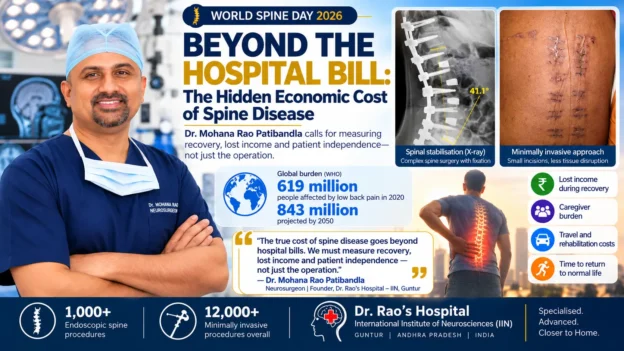
Beyond the Hospital Bill: The Hidden Economic Cost of Spine Disease
Following World Spine Day 2026, Dr. Mohana Rao Patibandla calls for a more patient-centred approach to spine care that considers recovery, lost income, caregiver burden and independence.
When patients think about the cost of spine surgery, they usually consider the hospital bill, surgical fees, implants, medicines and investigations. However, the financial impact of spinal disease can extend well beyond these immediate expenses.
Time away from work, travel for treatment, rehabilitation, assistance from family members and the time required to resume everyday activities can all contribute to the wider burden of spinal disease.
This World Spine Day, Dr. Mohana Rao Patibandla, founder and chief neurosurgeon at Dr. Rao’s Hospital – International Institute of Neurosciences (IIN), Guntur, Andhra Pradesh, highlights an important question: Should the value of spine surgery be measured only by the cost of the operation, or should we also consider the patient’s recovery and ability to return to everyday life?
Why the Economic Burden of Spine Disease Matters
Spinal disorders can affect mobility, employment, sleep, physical activity and quality of life. For some patients, persistent back pain makes it difficult to perform routine tasks. For others, a serious spinal condition may interrupt employment or require family members to provide ongoing assistance.
The World Health Organization estimates that low back pain affected approximately 619 million people worldwide in 2020. The number is projected to reach 843 million by 2050.
Low back pain is the leading cause of disability worldwide. Its consequences extend beyond physical discomfort to participation in work, family responsibilities and social life.
These figures underline why spinal health deserves attention not only as a medical issue but also as a public-health and economic concern.
Read the World Health Organization’s fact sheet on low back pain.
The Hidden Costs Patients and Families May Overlook
1. Lost income during recovery
For salaried employees, time away from work can affect earnings and professional responsibilities. For self-employed people, small-business owners and daily-wage workers, even a short interruption may create financial pressure.
The time needed to resume work varies according to the diagnosis, procedure, physical demands of the job, recovery and the individual’s overall health. Patients should discuss realistic return-to-work expectations with their treating team.
2. Caregiver burden
Family members often help patients with transport, household activities, appointments and daily care. This support is valuable, but it may require caregivers to take time away from employment or other responsibilities.
Considering the patient’s recovery also means recognising the practical demands placed on the family.
3. Travel and rehabilitation expenses
Patients travelling long distances for specialist treatment may incur transport, accommodation and food expenses. Depending on the condition and treatment plan, rehabilitation, follow-up visits and assistance at home may add to the total cost of care.
Access to appropriate specialist services closer to home may reduce some travel-related burdens, although the actual financial benefit depends on the patient’s circumstances.
4. Delayed return to normal activities
Recovery is not measured solely by the number of days spent in hospital. Mobility, independence, comfort, functional improvement and the ability to resume appropriate daily activities are also important considerations.
These outcomes differ between patients and procedures. They should be discussed realistically rather than promised as guaranteed benefits of a particular surgical technique.
How Minimally Invasive Spine Surgery Fits Into the Discussion
Minimally invasive spine surgery (MIS) uses specialised surgical approaches and instruments to access selected spinal conditions while limiting disruption to surrounding tissues.
Depending on the diagnosis and procedure, minimally invasive techniques may offer advantages such as reduced blood loss, smaller incisions and shorter hospital stays compared with certain conventional open procedures.
Endoscopic spine surgery is one form of minimally invasive treatment. It uses an endoscope and specialised instruments to visualise and treat selected spinal problems through a targeted surgical approach.
However, minimally invasive surgery is not appropriate for every spinal condition, and it is not automatically less expensive in every setting. Costs depend on the procedure, equipment, implants, hospitalisation, rehabilitation and other individual factors.
The right surgical approach must be determined by clinical assessment, imaging findings, spinal anatomy, the nature of the disease and the patient’s overall health.
Patients should ask their surgeon about the expected benefits, risks, alternatives, likely recovery requirements and total anticipated expenses before making a treatment decision.
What Does the Research Say About Cost and Recovery?
Published comparative research has reported potential advantages of minimally invasive techniques in selected lumbar fusion procedures, including lower blood loss and shorter hospital stays in some studies. Economic findings, however, vary across procedures, institutions and study designs.
International findings should not automatically be interpreted as guaranteed savings for patients in India. Local treatment costs, access to rehabilitation, employment patterns and individual recovery requirements can influence the overall economic impact.
For this reason, claims about cost savings should be based on appropriately designed economic evaluations rather than assumptions based on incision size or hospital stay alone.
A Better Way to Evaluate the Value of Spine Care
Dr. Mohana Rao Patibandla believes that a broader discussion of spine care should consider clinical outcomes alongside the wider burden of treatment and recovery.
“The true cost of spine disease goes beyond hospital bills. We must measure recovery, lost income and patient independence—not just the operation.”
A more comprehensive evaluation of spine care can consider several areas:
- Clinical outcomes: Functional improvement, complications, readmissions and other relevant measures of safety and effectiveness.
- Direct medical expenses: Hospitalisation, investigations, medicines, implants and surgical fees.
- Recovery-related expenses: Rehabilitation, transport, follow-up and assistance at home.
- Work and productivity: Time away from employment and the ability to resume appropriate activities.
- Patient independence: Mobility, daily functioning and the support required during recovery.
These measures can help patients understand the wider implications of treatment and provide a foundation for future research into the cost-effectiveness of different approaches to spine care.
Spine Care at Dr. Rao’s Hospital, Guntur
Dr. Rao’s Hospital – International Institute of Neurosciences (IIN), Guntur, provides specialised neurological, neurosurgical and spine services, including minimally invasive and endoscopic spine surgery for appropriately selected patients.
According to hospital records, Dr. Mohana Rao Patibandla’s clinical experience includes more than 1,000 endoscopic spine procedures and more than 12,000 minimally invasive procedures overall. These figures represent separate categories of clinical activity and should not be interpreted as comparative evidence of cost savings or clinical outcomes.
The hospital’s approach to spine care focuses on individual assessment, appropriate treatment selection and discussion of the expected benefits, risks and recovery requirements of available options.
Patients seeking evaluation for back pain, neck pain, disc disease, spinal stenosis or other spinal conditions should receive a diagnosis-based treatment plan. Many cases of back pain do not require surgery and may be managed with appropriate non-surgical care.

Intraoperative neurophysiological monitoring using the Medtronic NIM Eclipse system to display real-time neural response waveforms during surgery.

Medtronic StealthStation S8 neuronavigation system supporting image-guided planning and navigation in advanced brain and spine surgery.
When Should You Seek Medical Attention for Back Pain?
Persistent, recurrent or worsening back pain that interferes with normal activities deserves medical assessment. Symptoms such as progressive limb weakness, new bladder or bowel dysfunction, or numbness around the groin or saddle region require urgent medical evaluation.
Early assessment can help identify the cause of symptoms and determine whether non-surgical treatment, further investigations or specialist intervention is needed.
World Spine Day 2026: Looking Beyond the Operation
World Spine Day, observed on 16 October, provides an opportunity to raise awareness of spinal health, prevention, access to care and the impact of spinal disorders on everyday life.
The conversation should extend beyond surgical technology to include the patient’s experience before, during and after treatment.
Clinical effectiveness and safety remain essential, while affordability, recovery, independence and family burden also deserve attention.
The future of spine care should be measured not only by what happens in the operating room, but also by how comprehensively we understand the patient’s recovery and the wider burden of spinal disease.
Frequently Asked Questions
What is the economic burden of spine disease?
The economic burden includes direct medical expenses and other costs associated with illness, such as lost income, transport, rehabilitation, caregiver time and disruption to daily activities.
Does minimally invasive spine surgery always cost less?
No. Costs vary according to the procedure, equipment, implants, hospital, recovery needs and individual circumstances. Minimally invasive surgery may offer advantages in selected cases, but savings are not guaranteed.
What are the potential advantages of endoscopic spine surgery?
For appropriately selected conditions, endoscopic spine surgery may allow targeted treatment through a small access route with limited tissue disruption. Suitability and outcomes depend on the diagnosis, anatomy and surgeon’s assessment.
Does every patient with back pain need surgery?
No. Many patients can be managed with non-surgical treatment. Surgery is considered when the diagnosis, symptoms, clinical findings and response to other treatments support an operative approach.
How should patients compare spine surgery options?
Patients should discuss the expected clinical benefits, risks, alternatives, total anticipated expenses, recovery requirements and follow-up plan with their treating surgeon.
About Dr. Rao’s Hospital – International Institute of Neurosciences
Dr. Rao’s Hospital – International Institute of Neurosciences (IIN) is a specialised neurological, neurosurgical and spine-care institution located in Guntur, Andhra Pradesh, India. Founded by Dr. Mohana Rao Patibandla, the hospital provides specialised services across multiple areas of neurosciences.
Address: 12-19-67, Old Bank Road, Kothapet, Opposite Sravani Hospital, Guntur, Andhra Pradesh, India.
Phone: +91 90100 56444
Email: info@drraoshospitals.com
Website: https://drraoshospitals.com/
Editorial note: This article is intended for general educational purposes and does not replace individual medical advice. Treatment decisions should be made in consultation with a qualified healthcare professional.