MISSABCON 2026 | Neurosurgical Research
Endo-TLIF vs MIS-TLIF: What a 110-Patient Study Presented at MISSABCON 2026 Found
A comparative study presented by Dr. Rao examines two minimally invasive
approaches to lumbar fusion, looking at blood loss, hospital stay,
operative time, pain, disability, fusion and complications.
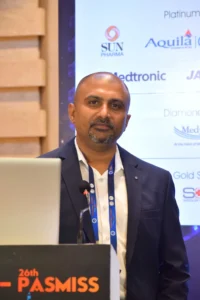
Dr. Rao presents his comparative research on Endo-TLIF versus MIS-TLIF at MISSABCON 2026, examining outcomes of minimally invasive lumbar fusion in patients with single-level lumbar degenerative disease.
during a scientific session at MISSABCON 2026.
A Simple Question Behind a Complex Spine Surgery Study
Minimally invasive spine surgery has changed considerably over the last
several years. Surgeons today have multiple ways of reaching and treating
spinal problems while attempting to reduce unnecessary disruption of
surrounding tissues.
But having more than one minimally invasive technique creates an important
clinical question:
If two techniques can achieve the same basic surgical goal,
how do they differ in recovery, surgical demands and outcomes?
A comparative study presented by Dr. Mohana Rao Patibandla (Dr. Rao)
at MISSABCON 2026 examined this question by comparing
endoscopic transforaminal lumbar interbody fusion (Endo-TLIF)
with minimally invasive transforaminal lumbar interbody fusion (MIS-TLIF).
The study focused on patients with single-level lumbar degenerative disease
and compared perioperative, clinical and radiological outcomes.
Research Presented at MISSABCON 2026
The research was presented at MISSABCON 2026 in Chennai, a major scientific meeting focused on minimally invasive spine surgery.
MISSABCON 2026 was held in conjunction with the Pacific and Asian Society of Minimally Invasive Spine Surgery (PASMISS) and the Chennai Ortho Spine Society’s COSSCON meeting.
The official conference programme included free-paper sessions, international scientific sessions, innovation-focused sessions and educational programmes covering contemporary minimally invasive spine surgery.
How Was the Study Designed?
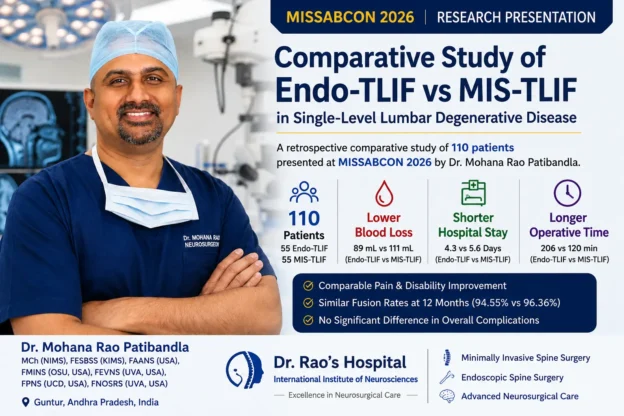
This was a retrospective comparative study involving 110 patients with single-level lumbar degenerative disease.
- Total patients: 110
- Endo-TLIF group: 55 patients
- MIS-TLIF group: 55 patients
- Study period: January 2022 to December 2024
- Outcomes assessed: perioperative, clinical and radiological outcomes
The study therefore does not simply compare the appearance of two surgical
techniques. It examines several practical measures that matter during and
after lumbar fusion surgery.
What Is Endo-TLIF?
Endo-TLIF refers to endoscopic transforaminal lumbar interbody fusion. It uses an endoscopic working corridor to access the affected spinal level and perform decompression and fusion in appropriately selected patients.
Endoscopic techniques have become an important part of the evolution of minimally invasive spine surgery because they can provide visual access through relatively small working corridors.
However, minimally invasive does not automatically mean appropriate for every patient. The choice of approach depends on the diagnosis, anatomy, spinal stability, imaging findings and the surgeon’s assessment.
Learn more about minimally invasive spine surgery at Dr. Rao’s Hospital
.
What Is MIS-TLIF?
MIS-TLIF stands for minimally invasive transforaminal lumbar interbody fusion. It is an established minimally invasive approach to lumbar fusion that uses specialised access techniques to reduce disruption of surrounding tissues compared with conventional open surgery.
Both Endo-TLIF and MIS-TLIF aim to achieve the fundamental objectives of appropriate decompression, interbody fusion and spinal stabilisation.
The research question is therefore not simply which procedure is “better,” but how the two approaches compare across different clinical and perioperative measures.
What Did the 110-Patient Study Find?
The study identified several statistically significant differences between the two groups.
1. Blood Loss
Mean blood loss was approximately:
- Endo-TLIF: 89.22 mL
- MIS-TLIF: 110.85 mL
The difference was statistically significant.
2. Hospital Stay
Mean hospitalisation was reported as:
- Endo-TLIF: 4.27 days
- MIS-TLIF: 5.57 days
The Endo-TLIF group had the shorter reported hospital stay.
3. Operative Time
The advantage was not present across every measure.
Mean operative time was:
- Endo-TLIF: 205.64 minutes
- MIS-TLIF: 120.36 minutes
Endo-TLIF therefore required substantially longer operative time in
this study.
4. X-Ray Exposure
X-ray exposure was also higher in the Endo-TLIF group:
- Endo-TLIF: 41.32 exposures
- MIS-TLIF: 27.45 exposures
This is an important finding because it demonstrates that a technique
may have advantages in one area while creating additional technical
demands in another.
Endo-TLIF vs MIS-TLIF: Key Perioperative Findings
| Measure | Endo-TLIF | MIS-TLIF | Study Finding |
|---|---|---|---|
| Blood loss | 89.22 mL | 110.85 mL | Lower with Endo-TLIF |
| Hospital stay | 4.27 days | 5.57 days | Shorter with Endo-TLIF |
| Operative time | 205.64 min | 120.36 min | Longer with Endo-TLIF |
| X-ray exposure | 41.32 times | 27.45 times | Higher with Endo-TLIF |
What Happened to Pain and Function?
Both groups showed significant improvement in clinical measures following surgery.
The study assessed pain using the Visual Analogue Scale (VAS) and disability using the
Oswestry Disability Index (ODI).
Both Endo-TLIF and MIS-TLIF groups demonstrated reductions in VAS and ODI
scores at postoperative assessments compared with preoperative values.
The study found a lower back-pain VAS score in the Endo-TLIF group at postoperative day three. At later follow-up assessments, the reported differences were not statistically significant.
The broader finding is therefore important: both approaches produced meaningful clinical improvement.
What About Muscle Injury?
The study also examined creatine kinase (CK), a laboratory marker that can reflect muscle injury.
At postoperative day one, CK levels were lower in the Endo-TLIF group. The reported values were approximately 264.74 compared with 365.88.
By postoperative day five, the difference was no longer statistically significant.
This finding forms part of the study’s assessment of the early tissue response to the two surgical approaches.
Did Both Techniques Achieve Similar Fusion?
Fusion is one of the most important outcomes when evaluating lumbar interbody fusion surgery.
At 12 months, the reported fusion rates were:
- Endo-TLIF: 94.55%
- MIS-TLIF: 96.36%
The difference was not statistically significant.
The study also reported no significant differences between the groups in measured lumbar lordosis, segmental lordosis or disc height at the evaluated follow-up points.
What About Complications?
The study reported no statistically significant difference in overall
complications between the two groups.
| Outcome | Endo-TLIF | MIS-TLIF |
|---|---|---|
| Nerve damage | 3.64% | 1.82% |
| CSF leak | 1.82% | 1.82% |
| Total complications | 9.09% | 5.45% |
The reported difference in total complications was not statistically significant.
These figures should be interpreted in the context of the study design, patient population and follow-up rather than used to predict an individual patient’s risk.
Why These Findings Matter
The most interesting aspect of the research is that it does not present Endo-TLIF as universally superior to MIS-TLIF.
Instead, the findings show a series of advantages and trade-offs. Endo-TLIF was associated with lower blood loss and shorter hospitalisation, while MIS-TLIF had shorter operative time and lower reported X-ray exposure.
At the same time, clinical and radiological outcomes were broadly comparable between the two groups.
That is an important message for modern spine surgery: minimally invasive surgery is not one single technique.
Different approaches can have different strengths, limitations and technical requirements.
What Does This Mean for Patients?
A patient reading a study like this may reasonably ask: “Which procedure should I have?”
The study does not provide a universal answer.
The appropriate surgical approach depends on the individual’s diagnosis, spinal anatomy, level of disease, symptoms, imaging findings, stability, previous treatment and overall health.
A technique that is appropriate for one patient may not be appropriate for another.
This is why consultation and individualised assessment remain important before deciding on lumbar fusion surgery.
Why Comparative Research Is Important in Spine Surgery
New surgical technologies are introduced regularly. Endoscopy, navigation, advanced imaging and other technologies are expanding the options available to spine surgeons.
But innovation should not be measured simply by how new a technique is. It should be evaluated through evidence.
Comparative research helps surgeons ask practical questions:
- Does the approach reduce blood loss?
- Does it shorten hospitalisation?
- Does it improve early recovery?
- Does it require longer operative time?
- Does it increase imaging or X-ray exposure?
- Does it achieve comparable fusion?
- Are complications different?
- Which patients are most likely to benefit?
These questions are ultimately more important than simply calling one technique “advanced.”
Dr. Rao’s Perspective
“Innovation in spine surgery should be guided by evidence. The important
question is not which technique is newer, but which approach is
appropriate for each patient.”
— Dr. Rao
For Dr. Rao, presenting clinical research at a scientific meeting is part
of a broader approach to research-led surgical practice: identify a clinical
question, evaluate the available evidence, share findings with peers and
continue refining treatment strategies.
From Clinical Experience to Scientific Discussion
Dr. Mohana Rao Patibandla is Founder and Chief Neurosurgeon of Dr. Rao’s Hospital – International Institute of Neurosciences in Guntur, Andhra Pradesh.
His academic and clinical interests include minimally invasive brain and
spine surgery, endoscopic surgery, skull-base surgery, cerebrovascular and
endovascular neurosurgery, neuro-oncology, pediatric neurosurgery,
stereotactic radiosurgery and intraoperative neurophysiological monitoring.
His professional profile and conference presentation materials document
advanced fellowship training in minimally invasive neurosurgery,
endoscopic skull-base surgery, endovascular neurosurgery, neuro-oncology
and radiosurgery, among other subspecialties.
Read more about Dr. Mohana Rao Patibandla’s training and neurosurgical practice
.
MISSABCON 2026 Research Presentation
Dr. Rao presents his comparative research on Endo-TLIF versus MIS-TLIF at MISSABCON 2026, examining outcomes of minimally invasive lumbar fusion in patients with single-level lumbar degenerative disease.
during a scientific session at MISSABCON 2026.
Study at a Glance
Endo TLIF vs MIS TLIF infographic
presented at MISSABCON 2026.
Key Takeaways
- The study included 110 patients with single-level
lumbar degenerative disease. - There were 55 patients in each group.
- Endo-TLIF was associated with lower reported blood loss.
- Endo-TLIF was associated with a shorter reported hospital stay.
- Endo-TLIF required longer operative time in the study.
- Endo-TLIF involved greater reported X-ray exposure.
- Both groups showed significant improvement in pain and disability
measures. - Fusion rates at 12 months were comparable.
- No statistically significant difference in overall complications
was reported. - The findings support individualised selection of minimally invasive
techniques rather than assuming one approach is universally superior.
An Important Scientific Perspective
This study was retrospective and focused on patients with single-level
lumbar degenerative disease. Its findings should therefore be interpreted
within that clinical context.
A conference presentation is also not the same as a prospective randomised
clinical trial or a peer-reviewed journal publication.
Further research can help determine how these findings apply across
different patient populations and surgical indications.
The value of the research lies in contributing comparative clinical data
to the continuing discussion about minimally invasive spine surgery.
Learn More
Related Neurosurgical Research and Information
Considering Minimally Invasive Spine Surgery?
If you have been diagnosed with lumbar degenerative disease, disc
problems, spinal instability or another condition requiring possible
fusion surgery, the first step is a detailed clinical and imaging
assessment.
The choice between Endo-TLIF, MIS-TLIF and other treatment options
should be based on your individual anatomy, diagnosis, symptoms,
imaging findings and overall health.
Book a Consultation with Dr. Rao
Dr. Rao’s Hospital – International Institute of Neurosciences
Guntur, Andhra Pradesh, India
Phone: +91 90100 56444
Email: info@drraoshospitals.com