On World Alzheimer’s Day, Neurosurgeon Says India’s Real Alzheimer’s Gap Isn’t Access to New Drugs — It’s Access to Diagnosis
As at-home, subcutaneous formulations of anti-amyloid Alzheimer’s therapies advance in the U.S., Indian specialists say the more urgent problem for most of the country’s 8.8 million dementia patients is that they are never formally diagnosed at all.
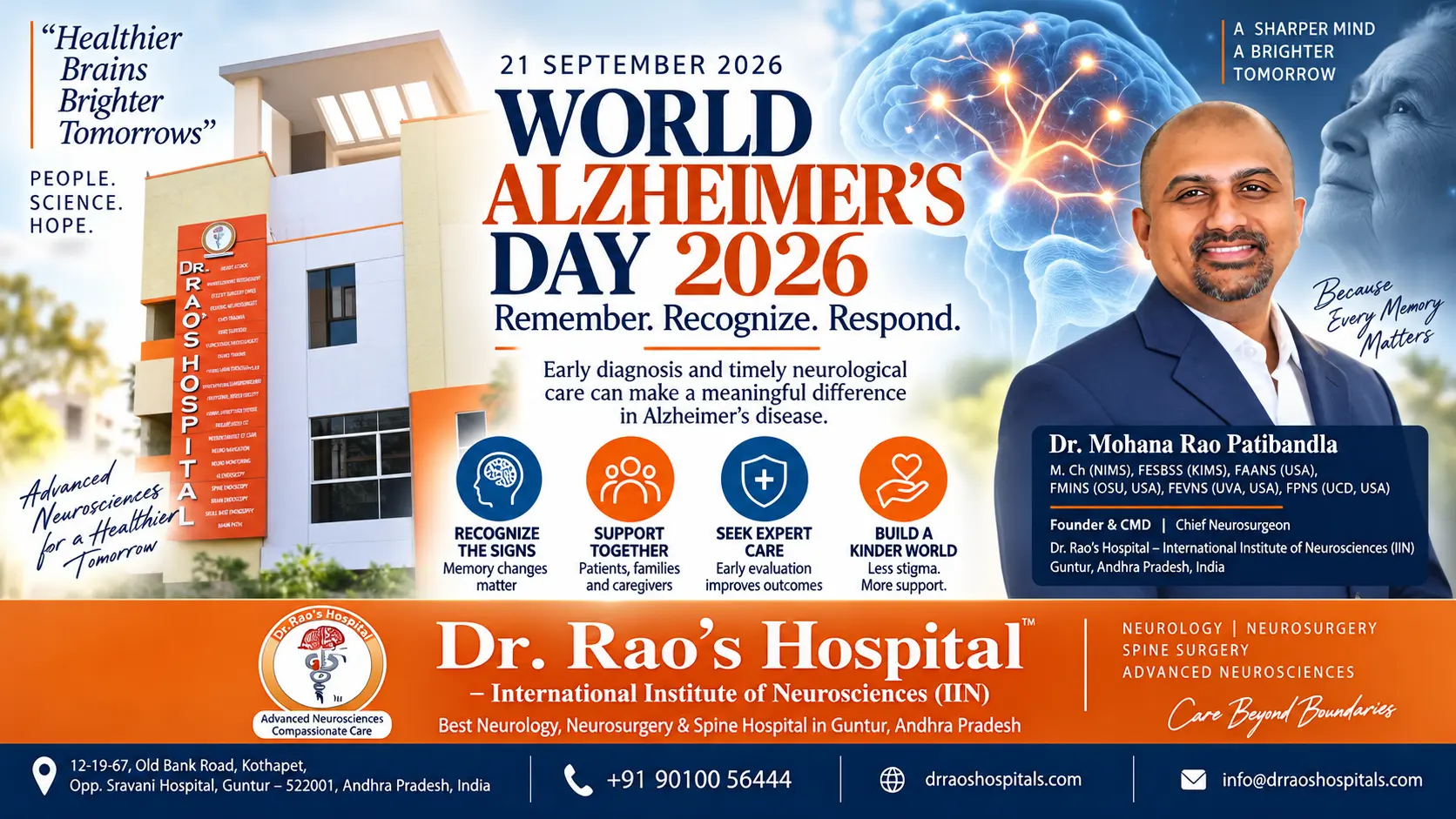
GUNTUR, ANDHRA PRADESH, INDIA, September 21, 2026 /EINPresswire.com/ — Marking World Alzheimer’s Day, neurosurgeons in India are drawing attention to a growing disconnect: as Alzheimer’s treatment technology in the United States moves toward more convenient, at-home delivery — including a subcutaneous autoinjector formulation of the anti-amyloid drug lecanemab (marketed as Leqembi), approved by the U.S. FDA in 2025, with a once-weekly starting-dose option now under review — the vast majority of Indians living with dementia never receive a formal diagnosis in the first place.
An estimated 8.8 million Indians aged 60 and above are currently living with dementia, according to nationwide estimates published in Alzheimer’s & Dementia, with Alzheimer’s disease accounting for roughly 70 to 75 percent of these cases. That number is projected to rise sharply as India’s population of adults over 60 — currently around 138 million — is expected to nearly reach 194 million within the next five years.
According to Dr. Mohana Rao Patibandla, a neuro-oncology and skull base neurosurgeon and Founder & Director of Dr. Rao’s Hospital – International Institute of Neurosciences (IIN) in Guntur, the newer generation of anti-amyloid drugs represents genuine scientific progress — but one that will have limited real-world impact in India without a parallel push on early recognition.
“Anti-amyloid therapies like lecanemab work by targeting the disease in its earliest stages, before significant cognitive decline has occurred — that’s precisely where their benefit is greatest,” Dr. Rao said. “But in India, memory loss in an older adult is still very often dismissed by families as a normal part of ageing rather than investigated as a medical condition. By the time a family brings a patient in for evaluation, the disease has frequently progressed well past the stage where early-intervention therapies would have made the most difference.”
Dr. Rao noted that this pattern is compounded by geography. “A therapy delivered through a simple weekly injection is a meaningful convenience improvement for patients in cities with access to a memory clinic or neurologist,” he said. “But for a large share of India’s ageing population living outside major cities, the more basic barrier isn’t the format of the treatment — it’s whether a diagnostic pathway exists to identify the condition at all.”
Globally, dementia affects more than 55 million people, according to World Health Organization estimates, a figure expected to nearly double by 2050 amid population ageing, with low- and middle-income countries — including India — projected to bear an increasingly large share of that burden.
Dr. Rao pointed to early warning signs that families and primary care physicians should treat as prompts for evaluation rather than as normal ageing: difficulty recalling recent conversations or events, repeated questions within a short span of time, disorientation in familiar surroundings, and noticeable changes in judgment or personality. “None of these require a specialist to notice first,” he said. “They usually show up at home, long before anyone thinks to bring them to a doctor. Closing that gap in recognition, not just improving the drugs themselves, is what will actually change outcomes for the majority of Indian families dealing with this disease.”
IIN’s neuroscience program includes cognitive and neurological evaluation as part of its broader practice, alongside the institute’s core focus areas in cerebrovascular, skull base, pediatric, and oncologic neurosurgery.
About Dr. Mohana Rao Patibandla
Dr. Mohana Rao Patibandla is a minimally invasive neurosurgeon, pediatric neurosurgeon, cerebrovascular endovascular neurosurgeon, skull base neurosurgeon, neuro-oncologist, and stereotactic radiosurgeon. He completed his M.Ch in Neurosurgery at the Nizam’s Institute of Medical Sciences (NIMS), Hyderabad, followed by subspecialty fellowships at the University of Colorado Denver (pediatric neurosurgery), Ohio State University (endoscopic skull base surgery), and the University of Virginia Medical Center (surgical neuro-oncology, Gamma Knife, and endovascular neurosurgery). He has authored 66 publications indexed on Google Scholar and was recognized with the AANS/CNS Section on Tumors BrainLab Community Neurosurgery Award for outstanding brain tumor research in 2018. In 2026, his team received the Best Free Paper Award and a Gold Medal at MISSABCON-PASMISS, the Pacific Asia Society of Minimally Invasive Spine Surgery’s international congress in Chennai, for work on minimally invasive and endoscopic approaches to complex craniovertebral junction disorders.
About Dr. Rao’s Hospital – International Institute of Neurosciences (IIN)
Dr. Rao’s Hospital – International Institute of Neurosciences (IIN), based in Guntur, Andhra Pradesh, is a dedicated neuroscience center offering minimally invasive skull base surgery, endovascular surgery, stereotactic radiosurgery, neuro-oncology, and pediatric neurosurgery. The institute is equipped with intraoperative neurophysiological monitoring (IONM), functional brain mapping, neuronavigation, a biplane catheterisation laboratory, a hybrid operation theatre, and intraoperative CT imaging. IIN draws patients from across India and internationally and has been recognized by Forbes India.
Media Contact:
Dr. Rao’s Hospital – International Institute of Neurosciences (IIN)
Old Bank Street, besides AK Biryani Point, Kothapeta, Guntur, Andhra Pradesh, India
enquiries: 9010056444
Email: info@drraoshospitals.com; drpatibandla@gmail.com;
Website: http://call to 9010056444https://drraoshospitals.com
Advanced Neurosurgery in Guntur
Comprehensive Neurology Care in Guntur
Advanced Spine Surgery in Guntur
Minimally Invasive Brain and Spine Surgery
Pediatric Neurosurgery in Guntur
Advanced Epilepsy Surgery in Guntur
International Patients – Neurosurgery in India
Book an Appointment at Dr. Rao’s Hospital
Dr. Rao’s Hospital – International Institute of Neurosciences
Dr. Mohana Rao Patibandla – Best Neurosurgeon in Guntur
World-Class Neurosurgery at Dr. Rao’s Hospital
Advanced Neurosurgery and Spine Care at Dr. Rao’s Hospital
BRAIN SURGERY LINKS
Minimally Invasive Brain Surgery
Brain Specialist in Andhra Pradesh
Neurosurgery Excellence at Dr. Rao’s Hospital
Spine Surgery Internal Links
Advanced Spine Surgery at Dr. Rao’s Hospital
Comprehensive Spine Surgery Services
Minimally Invasive Neurosurgery
Keyhole Brain and Spine Surgery
Stroke & Endovascular Internal Links
Stroke and Cerebrovascular Treatment
Hybrid Cath Lab and Endovascular Neurosurgery
Brain Aneurysm and Cerebrovascular Care
Functional Neurosurgery Internal Links
Functional Neurosurgery in Andhra Pradesh
Deep Brain Stimulation and Functional Neurosurgery
Neuro-Oncology Internal Links
Minimally Invasive Neuro-Oncology
Advanced Brain Tumor Treatment in Andhra Pradesh
Hospital Technology Internal Links
Stealth 8 Neuronavigation System
Flat Panel Biplane Hybrid Cath Lab
Intraoperative Neuromonitoring (IONM)
Dr. Mohana Rao Patibandla Links
Dr. Mohana Rao Patibandla – Biography
Dr. Mohana Rao Patibandla – Neurosurgeon in Guntur
Dr. Mohana Rao Patibandla’s Vision for Advanced Neurosurgery
Related Blog Links
- Why Dr. Rao’s Hospital Is Emerging as a Global Destination for Advanced Neurosurgery and Spine Care
- Minimally Invasive Brain Surgery: Revolutionizing Neurosurgery
- Advanced Spine Surgery and Spine Neuro Care
- Brain & Spine Center at Dr. Rao’s Hospital
- Neurosurgery Excellence at Dr. Rao’s Hospital
- Dr. Mohana Rao Patibandla – Professional Biography
EXTRA SOURCES
World Federation of Neurosurgical Societies (WFNS)
American Association of Neurological Surgeons (AANS)
Congress of Neurological Surgeons (CNS)