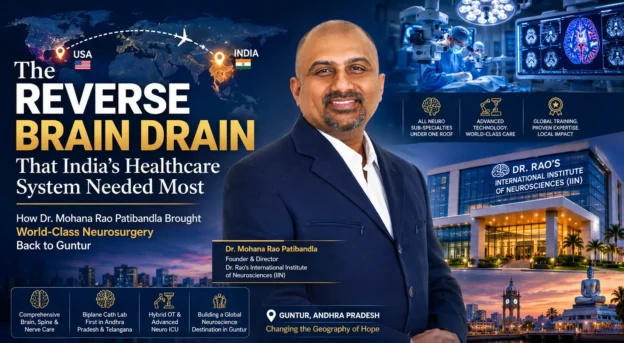
The Reverse Brain Drain That India’s Healthcare System Needed Most
What happens when one of the world’s most credentialed neurosurgeons walks away from a lucrative US career and plants a ₹100-crore super-specialty hospital in Guntur, Andhra Pradesh? Quietly, irreversibly — the geography of hope shifts.
Except, it turns out, sometimes it does.
Sometimes the brain comes back — carrying everything it absorbed abroad — and instead of landing in a Juhu clinic or a South Delhi hospital, it lands in Guntur. That is not a typo. Guntur: a mid-sized city in coastal Andhra Pradesh, roughly equidistant between Vijayawada and Ongole, better known historically for its cotton trade and chilli markets than for its neurosurgical ecosystem. And yet, in the middle of this city, a ₹100-crore institution called Dr. Rao’s International Institute of Neurosciences (IIN) now stands — fully equipped to perform procedures that most metro hospitals would refer to overseas.
This is the story of that institution. More precisely, it is the story of what happens when one extraordinary individual decides that the conventional direction of medical ambition is morally insufficient — and reverses it.
Facility investment
International publications
Academic citations
The man who could have stayed in America
To understand why Dr. Rao’s IIN is genuinely remarkable — and not merely well-marketed — you have to begin with the credentials of its founder, Dr. Mohana Rao Patibandla. Because the building, however impressive, is secondary. The singular fact is the person.
Dr. Patibandla completed not one, not two, but multiple advanced sub-specialty fellowships across elite American institutions. In Ohio, he trained in minimally invasive skull base surgery — a discipline so technically demanding that only a handful of surgeons worldwide attempt it. In Colorado, he completed a fellowship in pediatric neurosurgery, a field that requires its practitioners to recalibrate every instinct they have developed in adult operative work, because the margins are different, the anatomy is different, and the stakes of error in a developing nervous system are categorically different. In Virginia, he added three more disciplines simultaneously: neuro-oncology, stereotactic radiosurgery, and endovascular surgery — the latter involving navigation of catheters through the body’s vascular tree to treat aneurysms and arteriovenous malformations without ever opening the skull.
“Neurosurgery is not just precision — it’s access. This recognition reinforces our goal to deliver advanced care where patients need it most.”
— Dr. Mohana Rao Patibandla, Founder & Director, Dr. Rao’s Hospital, upon Forbes India feature
What makes this curriculum extraordinary is not the individual fellowships — several excellent Indian surgeons have done one or two of these. What is genuinely rare, recognised internationally, is that Dr. Patibandla completed all of them. He is, by documented clinical record, one of the very few neurosurgeons in the world to have formally trained across every single sub-specialty of neurosciences. This is not a marketing claim; it is a structural fact about how neurosurgery education works. The disciplines deliberately silo because mastering any one of them takes years. Mastering all of them in a sequence requires extraordinary focus — and an unusual life plan.
His academic output reflects this range. With over 70 international publications and more than 1,200 academic citations, Dr. Patibandla is not a peripheral figure in global neurosurgery literature. He is a cited contributor to it. He has delivered invited faculty lectures at MISSABCON, NESICON, SkullBaseCon, SNVICON, and AP MISSAB — the conferences where the field’s direction is actually debated and refined, not merely reported.
He could have settled anywhere in the world. He chose Guntur. Source: INDIA.COM
Infrastructure parity with the world’s best
The phrase “regional hospital” carries implicit baggage. It suggests emergency stabilisation, basic diagnostics, timely referrals to somewhere else. When healthcare advocates call a facility a “regional lifeline,” they usually mean it handles what it can and sends the complicated cases to the metros. That model, however compassionate, does not describe what Dr. Rao’s IIN has built.
The institute — the first fully independent, state-of-the-art standalone neuroscience facility in Andhra Pradesh — was constructed as a dedicated brain, spine, and nerve centre from the ground up. This distinction matters enormously. Most Indian hospitals, even excellent ones, embed neurosurgery within a multi-specialty campus where neurosurgical patients compete for ICU beds, operation theatre time, and specialist attention with cardiac, orthopaedic, and general surgery cases. Dr. Rao’s IIN allocates its entire infrastructure — all twenty of its neuro ICU beds equipped with US FDA-approved equipment, its dedicated interventional neuroradiology suite, its hybrid operation theatre — to one purpose: neurological care.
- Biplane catheterisation laboratory (first in Andhra Pradesh and Telangana) — enabling real-time dual-plane imaging for neurovascular procedures
- Intraoperative CT scan for live surgical guidance during complex skull base and spine operations
- Neuronavigation system — GPS-grade 3D mapping of the brain during surgery
- Functional brain mapping — preserving language, motor and cognitive function during tumour resections
- Intraoperative Neurophysiological Monitoring (IONM) — real-time neural integrity assessment during spinal and brain surgery
- Hybrid operation theatre — combining surgical and interventional capabilities in a single, sterile space
- 20-bed Neuro ICU with US FDA-approved monitoring equipment exclusively
- 24-hour emergency neurosurgical response
Each item on that list deserves a sentence. The biplane cath lab — a dual-arm X-ray system that allows surgeons to visualise blood vessels in two planes simultaneously — is the tool that makes endovascular treatment of brain aneurysms and strokes possible with precision. It is not found in most Indian hospitals outside a small cohort of elite metropolitan centres. Dr. Rao’s IIN has one, and it was the first in both Andhra Pradesh and Telangana.
The intraoperative CT allows the surgical team to scan the patient’s brain while the patient is still on the operating table, mid-procedure, verifying accuracy in real time rather than discovering an error after the fact. This capability exists in fewer than a dozen Indian hospitals, most of them in Delhi, Mumbai, or Bengaluru. The hybrid operation theatre collapses what would otherwise require two separate facilities — a conventional operating room and an interventional radiology suite — into a single space, enabling complex combined procedures on the most challenging vascular cases.
None of this infrastructure exists by accident. It reflects a deliberate philosophy: that Guntur’s patients deserve the same technological standard as patients in Tokyo or Houston, not a scaled-back version of it calibrated to what a regional city is assumed to need.
What “democratised global-tier” actually means in practice
The most honest way to assess a hospital’s true tier is to examine what cases it handles — not what it claims it can handle. The meaningful question is: what are the most complex cases referred out? At Dr. Rao’s IIN, the answer is revealing, because the referral pattern runs in an unexpected direction.
Patients come to Guntur. They come from Hyderabad. They come from neighbouring states — Odisha, Tamil Nadu, Karnataka — travelling specifically to access Dr. Patibandla’s precision keyhole and minimally invasive spine techniques. These techniques matter because they translate directly into clinical outcomes the patient experiences: a spine surgery that took a three-centimetre incision instead of a thirty-centimetre one means the patient is walking with reduced pain in days, not months. For working-class families whose livelihoods depend on physical capacity, this difference is not aesthetic — it is economic survival.
International patients arrive too. The value proposition for medical tourism is undeniable: procedures performed at IIN’s technical standard, with Dr. Patibandla’s credentials, cost a fraction of what the same operations would cost in a Western private hospital. Not a slight fraction. An order-of-magnitude fraction. A brain tumour resection performed with neuronavigation and intraoperative mapping in London or New York might cost tens of thousands of pounds or dollars. The identical procedure in Guntur, performed with equivalent technology and superior surgeon specialisation depth, costs a sum that is accessible to the South Asian diaspora and to patients across the developing world who cannot afford Western-priced care but will not accept lower technical standards.
“By transforming Guntur into a global hub for advanced neurosurgery, he has not just changed outcomes — he has changed the geography of hope.”
— Dr Rao’s Hospitals Editorial Analysis, 2026
This is what “democratised global-tier” means in concrete terms. The technology is equivalent. The surgeon’s subspecialty depth exceeds what most international centres offer. The cost is accessible. The location — rather than requiring patients to travel to infrastructure — brings the infrastructure to the patient’s region. It is an inversion of the conventional model, and it works.
The full clinical spectrum: why it matters that nothing gets referred away
A useful measure of a neuroscience centre’s completeness is whether it can handle every category of neurological condition from presentation through surgery through rehabilitation — or whether it handles the easy cases and refers the difficult ones elsewhere. Dr. Rao’s IIN handles the full spectrum, and this completeness is clinically significant.
Paediatric neurosurgery
Children with neurological disorders — congenital malformations, tumours, hydrocephalus, craniosynostosis — require surgeons who have trained specifically in the paediatric neurosurgical context. The structures are smaller. The physiological responses to anaesthesia and fluid management differ. The long-term developmental implications of every surgical decision extend across decades. Dr. Patibandla’s Colorado fellowship specifically addressed this sub-specialty. At IIN, children with complex neurological conditions do not need to be transported to Apollo in Chennai or NIMHANS in Bengaluru — they can be treated in Guntur, closer to their families, with equivalent expertise.
Functional neurosurgery
Epilepsy surgery and procedures for movement disorders such as Parkinson’s disease represent some of the most technically and ethically complex work in all of medicine. Functional neurosurgery requires not just a skilled surgeon but a full multidisciplinary team — neurologist, neuropsychologist, neuroradiologist, and electrophysiologist — working in concert. IIN maintains this team architecture. Patients with drug-resistant epilepsy who previously faced a choice between continuing seizures and expensive travel to a handful of metros now have a genuine alternative.
Neuro-oncology
Brain tumour surgery combines the technical demands of micro-neurosurgery with the strategic complexity of oncological management. The goal is maximum safe resection — removing as much tumour as possible while preserving the surrounding functional brain tissue. Achieving this requires functional brain mapping to identify and protect eloquent areas of speech, motor function, and cognition during tumour removal. IIN’s capability for awake craniotomy and functional mapping, supported by its intraoperative monitoring systems, places it in the same technical category as dedicated cancer neurosurgery centres in metropolitan India.
Cerebrovascular and endovascular care
Strokes and brain aneurysms are emergencies in the truest sense — outcomes deteriorate with every hour of delay. The endovascular approach, which treats these conditions through catheter navigation rather than open surgery, requires both the biplane cath lab hardware and a surgeon fellowship-trained in interventional neuroradiology. Dr. Patibandla’s Virginia training encompassed precisely this. When a patient in Guntur or a surrounding district presents with a ruptured aneurysm, IIN can respond with the full range of contemporary interventional options — immediately, without the transfer to a metro that previously meant hours of delay and deterioration.
The recognition architecture: not local acclaim, global validation
Institutions can claim excellence without external verification. Dr. Rao’s IIN and its founder have accumulated a body of recognition that cross-validates the clinical claims from multiple independent sources.
In April 2026, Dr. Patibandla was featured in Forbes India’s “Game-Changing Leaders You Should Know About” series — a recognition specifically citing his work in advancing neurosurgical care and establishing a specialised neuroscience centre outside metropolitan cities. The Times ICONs of Healthcare 2026 awards recognised IIN’s commitment to world-class outcomes. Dr. Patibandla received the Dr. A.P.J. Abdul Kalam Inspiration Award 2025 for Best Minimally Invasive Neurosurgeon in New Delhi. He was featured in EN TIMES as one of the Most Influential Healthcare Leaders 2026. He appeared on the cover of Time Iconic Magazine as one of the Top 10 Inspiring Neurosurgeons in Healthcare Leaders 2025.
India Today Health’s Eminent Doctors listing — which spans leading clinicians from Andhra Pradesh, Telangana, Tamil Nadu, Kerala, and Karnataka — included Dr. Patibandla, providing one of the most credible regional recognitions in Indian healthcare journalism.
These are not patient testimonials. They are not hospital-generated rankings. They are independent editorial and industry assessments from sources that have no stake in Guntur’s healthcare ecosystem and every reason to feature established metros instead. Their convergence on Dr. Rao’s IIN tells a story that self-promotion cannot manufacture.
Dr. Rao’s IIN offers world-class neurosurgical consultations in Guntur, with multi-city outreach clinics across Andhra Pradesh.
Why the TEDx talk matters beyond inspiration
In his TEDx talk — titled “My Journey to Bring Healing Home: A Neurosurgeon’s Quest in Guntur” — Dr. Patibandla articulated something that is easy to sentimentalise and harder to actually execute: the idea that excellence and accessibility are not opposing values, that a surgeon need not choose between doing world-class work and doing it where it is most needed.
The talk matters not as inspiration — though it is that — but as a statement of institutional philosophy. The infrastructure decisions at IIN, the deliberate investment in every sub-specialty rather than a profitable subset, the decision to remain in Guntur rather than open a chain across metro cities, all of these trace back to a coherent philosophy articulated in that talk. A hospital built on an articulated vision tends to remain coherent as it grows. A hospital built primarily on revenue optimisation tends to drift toward whatever services the market rewards most richly. The difference matters for patients in the long run.
The reverse brain drain that Dr. Patibandla embodies is not a single event. It is a structural argument: that the talent India sends abroad to acquire global expertise can return carrying that expertise as a public good, distributed not just to those who can afford metro private hospital prices but to anyone in a region who needs it. That argument is most convincing not when it is made in a talk, but when it is demonstrated in a building — a building where a farmer from Prakasam district and an NRI patient from New Jersey can access the same technology, performed by the same surgeon, at radically different price points.
The model that Indian healthcare policy should study
India’s healthcare planning discourse often frames the urban-rural healthcare divide as a problem of insufficient resources — not enough specialists, not enough equipment, not enough investment in smaller cities. That framing is not wrong, but it is incomplete. Dr. Rao’s IIN demonstrates that the divide is also a problem of incentive architecture: the system rewards specialists for concentrating in metros, so they concentrate in metros, so patients in smaller cities must travel to metros, which reinforces the perception that smaller cities cannot support high-quality care, which further discourages specialist investment there.
Breaking this cycle requires someone willing to absorb the perceived risk of locating world-class infrastructure in an unproven market. Dr. Patibandla absorbed that risk. The result — a hospital drawing patients not just from Guntur district but from across Andhra Pradesh, from neighbouring states, and from the global diaspora — proves that the demand was always there. The supply simply hadn’t arrived.
This is the model worth studying: not charity medicine, not scaled-back care, not the assumption that patients in smaller cities will accept second-tier treatment. World-class infrastructure, placed deliberately in a regional hub, becomes its own argument for the viability of regional excellence. Once the argument is made in bricks, technology, and patient outcomes, the conversation about whether tier-2 cities can sustain advanced medical infrastructure shifts from theoretical to settled.
Guntur is that settled argument. Dr. Mohana Rao Patibandla is what it looks like when a brain comes home.
In summary: what this institution actually is
It is not a regional hospital that handles what it can and refers the rest. It is not a satellite of a metropolitan parent with borrowed credibility. It is a purpose-built, fully independent, globally standard neuroscience centre that happens to be located outside the metros — by choice, by philosophy, and by moral deliberate intention. Its founder is one of the world’s most comprehensively sub-specialty-trained neurosurgeons, whose academic output continues to influence the global field. Its infrastructure matches or exceeds that of elite institutions in Indian metropolitan cities and is equipped to perform procedures offered at only a handful of centres nationally.
If there is a single sentence that captures what Dr. Rao’s IIN represents, it is this: a global-tier super-specialty hospital that brought the world to Guntur, so that Guntur would never again have to send its patients to the world.
That is the reverse brain drain. That is the revolution. And it is happening in Andhra Pradesh, one precisely navigated surgery at a time.